
一座从 1870 年开始的园子
波恩上卡塞尔的莱茵河谷坡地上,有一座只有近五公顷的小园子。园子的起点在 1870 年:当时莱茵铁路公司的负责人弗朗茨·卡尔·伦嫩在这块约七公顷的地皮上盖起一座英式木架大宅,并开始造园。今天园里还留着当年的几株老树,两株雪松、一棵银杏、一棵巨杉和一棵北美香柏,树龄都超过一百五十年。
1921 年,律师卡尔·哈勒从鲁尔河畔的穆尔海姆买下这处产业。他收藏的一批中世纪雕塑如今存放在科隆的一座艺术博物馆里;他和家人把这里养成了一处私人的树木收藏。两个女儿玛丽亚和蕾吉娜接手继续经营,把园子的格局和植物一一打理下去。
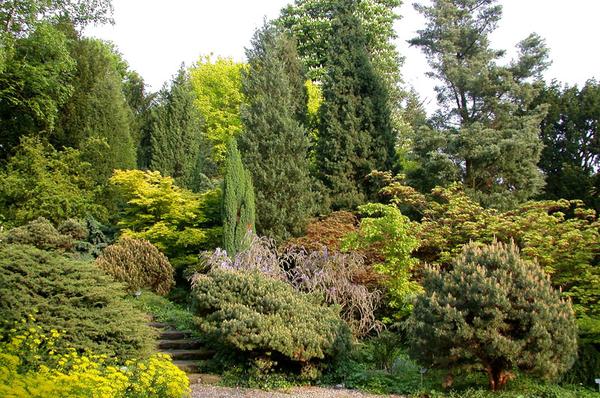
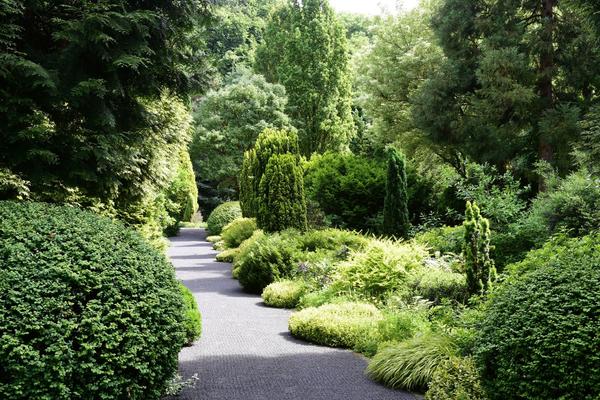
1975 年,山坡上修了一条公路,园子被切掉一大块,只剩今天这 4.9 公顷;原来种观赏植物的苗圃也随之撤掉,园地改成了树木园。从那以后,各种少见的针叶树成了背景,前面配上开花的宿根植物和月季,还有挑出来的阔叶乔灌木。如今园里有一千四百多种不同的乔木和灌木,数量相近的还有其它植物。
一座基金会和它的树木档案
1997 年,蕾吉娜·哈勒按两位姐姐的遗嘱,把这片园子连同收藏一起立成了一所公益基金会。基金会由一家专门代管基金会的机构负责,树木方面的日常养护和技术则由德国树木学会承担。基金会的任务是保住这片园地、把它养护好并继续开发,同时开放给科研使用,也开放给普通公众。
基金会的章程写得很具体。园子里的每株木本植物都要登记,记下估计的栽植年份,再配一段简略的状态说明,包括长势和冬季受害情况,这些资料录进数据库并放到网上;还要绘制比例准确的平面图,编写养护与发展规划并定期修订,通常十年一轮,另做年度的养护和投资预算;补种时优先挑那些在野外受威胁、或者苗圃里难得一见的树种;对公众限时开放,举办科学讲座之类的活动,并配一份带位置草图的图册。
2013 年,园子的发展思路整理成一份园子愿景,发表在德国树木学会当年的木本植物学文集里。理事会有八名成员,主席代表基金会,副主席代表哈勒家族,其中几位来自树木学会;这份名单截至 2025 年 1 月 1 日。
四块地被和这里的天气
园子分成四块:老园带着几栋房子,新园占着当年苗圃的地,再往外是成片的林子,林子中间有一处水面,最上面还有一块果树草地。老园 1.11 公顷,新园 0.86 公顷,林子与果树草地合计 2.94 公顷,总面积 4.91 公顷。地势从老园的海拔 56 米升到林地的 91 米,高差约 35 米。
位置是这座园子最大的运气。波恩上卡塞尔属于德国最暖的几个地区之一,波恩的气候温和而带海洋性,湾流和靠海的位置都有影响,园子又正好在科隆湾的南端。狭窄的莱茵河谷三面环山,风小、湿度大。园子朝西南的坡上,夏季日照更强、温度更高,坡地又不会积水,冬天冷空气顺着坡往下走。园里的墙、碎石地和几株大乔木挡住了风,等于又造了一层小气候,不少娇气树种和宿根植物因此能在这里活下来。
土壤是强砂质壤土,酸碱度在 6.3 到 7.0 之间。这些年的气候也写在数据里:1961 到 1990 年的平均气温是 10.8 摄氏度,1996 到 2006 年是 11.2 度,2024 年到了 13.1 度;2024 年最高 37.7 度,最低零下 4.6 度。降水方面,多年平均是 712 毫米,2024 年下了 934 毫米;最干的一年是 1921 年,396 毫米,最湿的是 1984 年,919 毫米。站方也提到,近几年干旱的夏天已经让最早的几棵树枯死,园里的植物配置正在跟着变。
园里种着什么
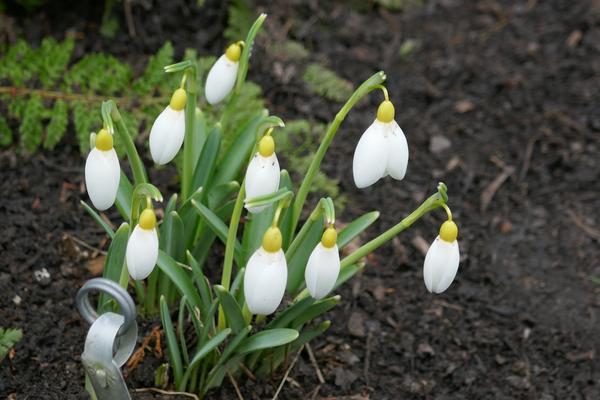
收藏按大类分:乔木、蕨类与禾草、灌木、宿根植物、月季,还有雪滴花。雪滴花这一类收得最齐,将近四百个种和品种,老园那片雪滴花草地和新园里分格种着的都算在内。德国《世界报》报道过,这批收藏是德国对外开放的一处雪滴花收藏里最大的。月季既有老品种也有新育的,邱园的英国月季就在名单上。
树木那边,最老的是 1870 年栽下的那几株,往后各年代的树陆续添进来。园方按属种和品种整理了清单:鸡爪槭的三个品种、连香树、中国杉、劳森扁柏、黎巴嫩雪松、喜马拉雅雪松都在其中;灌木里能看到贴梗海棠、常绿铁线莲、臭牡丹、流苏树和白叶小檗;宿根植物里有岩白菜、淫羊藿、刺芹和紫堇;蕨类则是铁线蕨、蹄盖蕨、桫椤这一路。
园子不只种植物。站方把这里也当成一片留给野生动物的栖息地,鸟类、两栖动物、爬行类和大量昆虫都能观察到。这片园子的树木档案有 150 多年的跨度,一株树的栽植年份、状态变化和它周围的植株都记在同一套资料里,这对研究本地和外来树种都是少见的样本。
怎么去、什么时候能进
园子不常年开放,只在站上公布的日期,或者有预约的团体来时才开放。进门免费,站上欢迎捐款。导览一次一个半到两小时,不用提前报名,站上请访客自愿捐一点维护费;天气照常也要走,遇到官方发布的灾害性天气预警才会取消。
无障碍方面,新园的主入口和主要园路没有台阶,路面是碎石;老园在坡上,只能走台阶上去。狗不许进园,导盲犬和持证的服务犬除外。园里没有垃圾桶,垃圾请自己带走;新园木架屋旁边有厕所和无障碍厕位。停车只能停在运动场那边的停车场,园内不许开车进去,自行车可以停在正门对面。坐公交 62 路和 66 路到上卡塞尔中站,往上坡走五分钟;坐火车从科隆或科布伦茨来,到波恩上卡塞尔站,走十二分钟。
想出一份力,办法有几种。可以认养一棵植物:一年期,从 250 欧元起,价格按植物的稀有程度、大小和价值定;园里会立一块牌子写上认养人的名字,每年还请认养人参加一场专门的聚会。也可以来做实习生:园里提供翻新过的木架屋里的免费住宿,有家具、淋浴和独立厨房,房间是无烟的;实习从四周到三个月,住得惯可以再商量延长。志愿者常年缺人,技术负责人迈克尔·德赖斯沃格特带着一支队伍。
这里的开放日跟着植物的物候走:雪滴花季有专门的开放日,玫瑰花期会另开一日,还有面向年轻人的园艺奖学金项目,2026 年当地报纸和园艺杂志都报道过这座园子,英国园艺家蒙蒂·唐的莱茵兰花园节目也来拍过。
A Garden That Began in 1870
On a slope above the Rhine in Bonn-Oberkassel there is a small garden of just under five hectares. It started in 1870, when Franz Carl Rennen, then head of the Rhine railway company, put up a large country house in English half-timbered style on a plot of roughly seven hectares and began laying out a park. A few of the trees he planted are still there: two cedars, a ginkgo, a giant sequoia and an incense cedar, all more than a hundred and fifty years old.
In 1921 the lawyer Carl Härle bought the property from Mülheim an der Ruhr. He collected medieval sculpture that now sits in one of Cologne’s art museums, and together with his family he turned the place into a private collection of woody plants. His two daughters, Maria and Regina Härle, took it over and went on shaping the layout and the planting.
In 1975 a road was built across the slope and a large slice of the garden was cut away, leaving the 4.9 hectares of today. The ornamental plant nursery that had occupied the site was wound up and the ground was turned into an arboretum. Since then rare conifers have formed the backdrop for flowering perennials and roses, with selected deciduous trees and shrubs in front. The park now holds more than 1,400 different trees and shrubs, plus a similar number of other plants.
A Foundation and Its Tree Records
In 1997 Regina Härle turned the garden and its collections into a charitable foundation, following the testamentary wishes of both sisters. A specialist body administers the foundation, while the German Arboretum Society looks after the trees and the technical side of the work. The foundation’s task is to preserve the site, keep it in good order and develop it further, and to open it to research and to the general public alike.
The statutes are specific about how that is done. Every woody plant is recorded with its estimated planting year and a short description of its condition, covering growth and winter damage, and the records go into a database that is available online. The foundation maintains a scaled site plan, and a care and development plan that is revised periodically, in practice about every ten years, alongside annual maintenance and investment budgets. New planting favours woody species that are threatened in the wild or hard to come by on the horticultural market. Public access is time-limited, scientific seminars and similar events are held, and the foundation produces an illustrated guide with site sketches.
In 2013 the thinking behind preserving and developing the garden was set down in a guiding vision, published that year in the arboretum society’s volume on woody plants. The board has eight members: the chair represents the foundation, the deputy represents the Härle family, and several come from the arboretum society. That list is dated 1 January 2025.
Four Parts and the Local Weather
The garden falls into four clear parts: the old park with its buildings, the new garden on the ground of the former nursery, an extensive wooded park with a stretch of open water in it, and an orchard meadow at the top. The old park covers 1.11 hectares, the new garden 0.86 hectares, the wood and orchard meadow 2.94 hectares, for a total of 4.91 hectares. The ground rises from about 56 metres above sea level in the old park to 91 metres in the wood, a difference of roughly 35 metres.
Its position is the garden’s great advantage. Bonn-Oberkassel belongs to the warmest parts of Germany; Bonn’s climate is mild and oceanic, shaped by the Gulf Stream and by its closeness to the sea, and the garden sits at the southern end of the Cologne Bay. The narrow Rhine valley is enclosed by low mountains on three sides, which brings little wind and high humidity. The slope faces southwest, so summer sun is stronger and temperatures higher, the slope never waterlogs, and cold air drains downhill in winter. Walls, gravel surfaces and the shelter of larger woody plants break the wind again and create a microclimate of their own, which is what allows a good many tender trees and perennials to thrive here.
The soil is strongly sandy loam with a pH between 6.3 and 7.0. The climate of recent years shows up in the figures: the average temperature was 10.8 °C for 1961 to 1990 and 11.2 °C for 1996 to 2006, and reached 13.1 °C in 2024, a year whose high was 37.7 °C and whose low was minus 4.6 °C. On rainfall, the long-term average is 712 millimetres and 2024 brought 934 millimetres; the driest year was 1921 with 396 millimetres and the wettest 1984 with 919 millimetres. The site also notes that the dry summers of recent years have already killed some of the oldest trees, and the planting is changing with them.
What Grows Here
The collections are organised by group: trees, ferns and grasses, shrubs, perennials, roses and snowdrops. The snowdrops are the most thoroughly gathered, with close to four hundred species and varieties between the snowdrop meadow in the old park and the beds in the new garden. The German newspaper Welt has reported that this is the largest publicly accessible snowdrop collection in the country. The roses include both old varieties and recent introductions, among them the English rose from Kew Gardens.
Among the trees, the oldest are those planted in 1870, and trees from later decades were added as the garden grew. The site keeps its list arranged by genus and variety: three forms of Japanese maple, Katsura tree, Chinese fir, Lawson cypress, Lebanon cedar and Himalayan cedar are all listed. The shrubs include flowering quince, evergreen clematis, glory tree, fringe tree and pale barberry, and the perennials include bergenia, barrenwort, sea holly and Corydalis; the ferns are of the maidenhair, lady fern and tree fern line.
The garden is not only about plants. The site treats it as a habitat for wildlife, and birds, amphibians, reptiles and a great many insects can be observed here. Its tree records span more than a hundred and fifty years, with the planting year, condition and surrounding planting of individual trees held in one set of records, which makes for an unusual sample when studying native and non-native woody species.
Getting There and When It Opens
The park is not open every day: it opens on the dates the site publishes, or for groups that have booked in. Entry is free and donations are welcome. Guided tours last an hour and a half to two hours, need no booking, and the site asks visitors to make a donation towards upkeep; they go ahead whatever the weather, and are only called off when the weather service issues a severe weather warning.
On access: the main entrance to the new garden and the main paths are level and gravelled, while the old park lies on the slope and can only be reached by steps. Dogs are not allowed, apart from guide and registered assistance dogs. There are no bins in the garden, so please take your rubbish away; toilets, including an accessible one, are next to the half-timbered house in the new garden. Parking is only possible at the sports ground, cars cannot enter the garden, and bicycles can be left at the racks opposite the main entrance. By tram, lines 62 and 66 serve Oberkassel-Mitte, five minutes uphill on foot; by train, Bonn-Oberkassel station is twelve minutes away for services from Cologne or Koblenz.
There are several ways to help. You can sponsor a plant for a year from 250 euros, the price depending on how rare, large or valuable the plant is; a sign in the park carries the sponsor’s name, and sponsors are invited to one exclusive gathering each year. There are also internships: a furnished room in the renovated half-timbered house, with shower and its own kitchen, is provided free, the house is non-smoking, and placements run from four weeks to three months, longer by arrangement. Volunteers are always wanted, and a technical manager leads the team.
Open days follow the plants: there is a dedicated snowdrop day, a separate opening during the rose season, and a young gardener scholarship programme. The garden was covered by the local newspaper and a gardening magazine in 2026, and the British gardener Monty Don has filmed it for his Rhineland gardens series.
相关文章:
 美国 华盛顿公园树木园 Washington Park Arboretum – 以自然式园林空间为主的城市植物园
 芬兰 Mustila树木园 – 芬兰历史最久面积最大的引种树木园
 瑞士 塞勒格沼泽公园 Park Seleger Moor – 瑞士最大杜鹃花与落叶杜鹃园
 英国 巴茨福德树木园 Batsford Arboretum – 英国非营利樱花国家收藏园
 荷兰 Trompenburg 公园与树木园 – 荷兰植物收藏 NPC的组成部分
 德国 Park der Gärten – 德国规模最大的主题花园园区之一杜鹃特色收藏
 德国 哈兹国家公园 Harz National Park – 德国最大的森林国家公园之一
 美国 湖泊荒原树木园 Lake Wilderness Arboretum – 世界上最大西部杜鹃花专类园之一
发表回复