

从一间郁金香苗圃起家
Florex 的起点在上世纪二十年代。Gerrit Jan Klumpenhouwer 拿出全部积蓄办起自己的球茎苗圃,紧接着就赶上经济危机和二战。他最小的儿子 Joop Klumpenhouwer 在这段日子里长大,十八岁开始做球茎买卖,先是骑着自行车在附近收,后来开车跑遍全国,再后来欧洲和世界各地都成了他的地盘。1953 年起 Joop 一直在球茎这行,攒够经验和力气之后创办了自己的公司 Florex。
1988 年以后,Joop 的女儿 Josien 和两个儿子 Gertjan、Wim 陆续进厂。柏林墙倒塌之前,Florex 就在波兰设了子公司,出口由此扩到几乎所有欧洲国家。1999 年,两个儿子从父亲手里接过公司,Wim 管销售和市场,Gertjan 任总经理,Josien 负责开发包装概念。Joop 已经退休,但几乎天天还到厂里转转。
2009 年并入安代克的种子公司
2009 年,Florex 接手了安代克做种子产品的 J. Sluys & Zn.。两家公司合到一起之后,Florex 成了这个行当里少有的球茎和种子一起做的企业,货盘里也添了更多种子货和高价位产品。公司自己的说法是,在零售概念和产品创新这两件事上,它现在是球茎行业里数得着的一家。
另一条线是自家动手种。种子组合装、洋葱苗、草莓苗和种薯这些都属于可食用花园的货,不是观赏用的花球,最近这些年公司在这一块做得挺顺。
现在做的活是给零售商备货
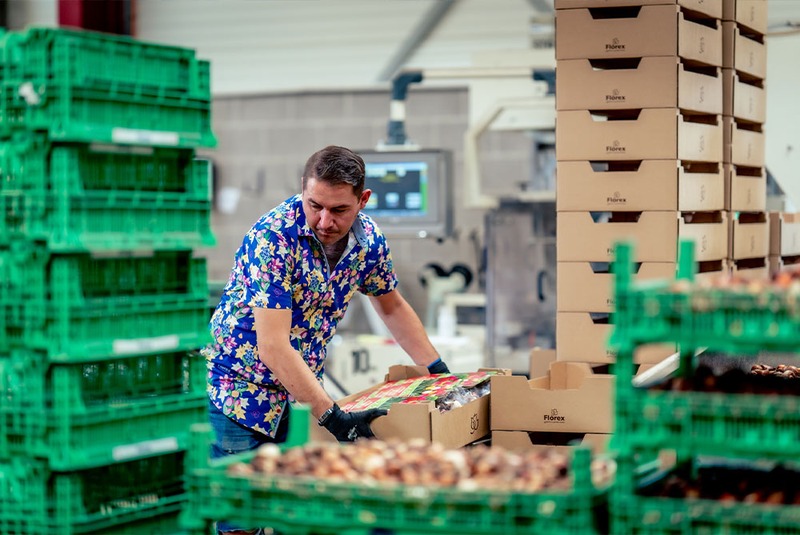
Florex 自己已经不种球了,那块地方成了包装和发货的场地:球茎、种子、洋葱苗和栽培概念,打好包发给欧洲各地的大型零售商。留住的是挑货的眼光——公司一年到头跑种植户、看展示花园,也去库肯霍夫花园找新品种、验质量,然后把最好的种植户出的货买进来。
一年下来工序是排好的。春季开花的一批(郁金香、水仙、风信子、番红花、雪滴花、观赏葱)从四月走到秋天:花谢之后剪花头,六七月球茎最大的时候起收,七八月收到剥好皮的货,检验分级后按每个品种各自合适的温度存进控温库,九月上零售商的货架,接着接补货单。大丽花是另一路:七月一直开到霜降,深秋块根最大时起收,晾干分级后存进 6 到 10 度的控温库,冬末才包装。
质量标志和环保那几件事
质量这一头挂着三块牌子:球茎可持续供应商质量标志、MPS 良好贸易规范,还有 SKAL 有机认证。SKAL 那张要求按有机农业标准种球茎,不用化肥,也不用化学植保农药;MPS 管的是追溯和可持续种植,另外还看企业有没有尽到社会责任。质量标志那家负责监督质量标准、球径规格和品种纯正性,每一包货都由它担保。
环保上的账也算得清楚:屋顶光伏板已经解决 75% 的用电,目标是全部自给、做到气候中和。新楼按很严的可持续标准建,外墙 500 平方米绿植,屋顶全白,室内控温省下不少电,一年下来少排的二氧化碳相当于 50 辆乘用车。包装全部改成 100% 纸,连订书钉都省了;纸、木头、金属、绿废和塑料分开放,塑料要一点点减掉。
供货条件和社会上的事
Florex 的官方交货付款条件写得很清楚:订单 30 个欧洲托盘起,仓库交货,价格用欧元,账期 30 天。运往欧盟以外还要植物检疫和出口文件费,每票 180 欧元,整车超过 30 个托盘只收一半;Galanthus、Cyclamen 和 Sternbergia 这几类要 CITES 证书,每个品种每个规格 95 欧元,还得留出至少两周。发货节奏按季节分开,秋季这批 6 月 1 日前下单第 33、34 周发,7 月 1 日前的第 35 周,再往后从第 36 周起;春季这批 11 月 1 日前下单第 3、4 周发,12 月 1 日前的第 5 周,再晚从第 6 周起。补货单从 9 月中旬和 2 月中旬开始接。
运输上公司建议全程温控货车,免得冻伤、闷热或者受潮。货到之后 8 天内可以提数量和质量异议,报价 1 个月有效。家族企业在社会责任上也有固定动作:给本地养老院和医院的职工家属捐球茎和种子,让职业学校的学生和有智力障碍的人来实习做工,还通过 Oxfam Novib 的小额信贷帮别人创业。
A nursery that grew into a trading house
Florex starts in the 1920s, when Gerrit Jan Klumpenhouwer put all his savings into a bulb nursery of his own. The economic crisis and the Second World War came straight after. His youngest son Joop Klumpenhouwer grew up through those years and began trading flower bulbs at eighteen, first by bicycle in the region, later by car across the Netherlands, and soon Europe and then the rest of the world became his territory. From 1953 he was in the bulb trade for good, and with that experience and energy he started his own company, Florex.
From 1988 the children joined: daughter Josien and two sons, Gertjan and Wim. Before the Berlin Wall came down, Florex set up a subsidiary in Poland, and exports expanded from there to virtually every country in Europe. In 1999 the two sons took over from their father. Wim handles sales and marketing, Gertjan is the managing director, and Josien still works on packaging concepts. Joop is retired but drops by almost every day.
The 2009 takeover of a seed company
In 2009 Florex took over J. Sluys & Zn., a seed business in Andijk. The two companies together made Florex one of the few players handling bulbs and seeds under one roof, and the range grew to include more seed lines and premium items. The company’s own line is that, when it comes to successful retail concepts and product innovation, it now counts among the names in the bulb trade.
A second line is grow your own. Growing sets with seeds, onion sets, strawberry plants and seed potatoes all belong to the edible garden range rather than the ornamental bulbs, and that is where the company has pushed hardest in recent years.
What the company does now
Florex no longer grows bulbs itself. The site is now for packing and distribution: flower bulbs, seeds, onion sets and growing concepts, packed and shipped to large retailers across Europe. What the company kept is the eye for picking. Growers are visited all year, show gardens are inspected, and Keukenhof is where new varieties are found and quality checked before the best growers’ product is bought in.
The year’s sequence is planned. Spring flowering bulbs, tulips, narcissi, crocuses, hyacinths, snowdrops and alliums, run from April into autumn: deadheading after flowering, lifting in June and July when the bulbs are at their largest, peeled bulbs received in July and August, then inspection, grading and storage at a temperature set for each species, and on the shelves from September with follow-up orders after that. Dahlias take a different route: they flower from July until the first frost, tubers are lifted in late autumn at their largest, dried and graded, kept in climate rooms at six to ten degrees, and packed at the end of winter.
Quality marks and the environmental work
Three marks sit behind the product: the quality mark for sustainable suppliers of horticultural quality products, MPS Good Trade Practice, and SKAL organic certification. SKAL requires bulbs to be grown to organic farming standards, without artificial fertilisers or chemical plant protection products. MPS covers traceability and sustainable growing, and also looks at whether a company takes its social responsibility seriously. The quality mark foundation supervises quality standards, bulb sizes and varietal authenticity, and stands behind every pack.
The environmental figures are worked out too. Solar panels on the roof now cover 75 percent of the electricity use, with the aim of supplying everything themselves and becoming climate neutral. The new building meets strict sustainability requirements: a green outer wall of 500 square metres and a completely white roof cut the energy needed for indoor climate control, and the annual reduction in carbon dioxide equals the emissions of 50 passenger cars. Packaging is now 100 percent paper, without even staples, and paper, wood, metal, green waste and plastic are separated, with plastic to be phased out.
The terms of supply and the work outside the company
Florex publishes its delivery and payment conditions in full. Orders start at 30 europallets, delivery is ex warehouse, prices are in euros and payment falls due in 30 days. Shipments outside the European Union carry a phytosanitary and export document fee of 180 euros, charged at half that for full loads of more than 30 pallets. Galanthus, Cyclamen and Sternbergia need a CITES certificate at 95 euros per article and size, and at least two weeks should be allowed. Deliveries are set out by season: autumn bulbs ordered before 1 June ship in weeks 33 and 34, before 1 July in week 35 and from week 36 afterwards; the spring range of dahlias, gladioli, begonias, onion sets and perennials ordered before 1 November ships in weeks 3 and 4, before 1 December in week 5 and from week 6 after that. Reorders are taken from mid September and from mid February.
Temperature controlled trucks are advised for transport, to rule out frost, heat and damp. Quality and quantity claims have to come in within 8 days of arrival, and an offer is valid for a month. As a family business the company also keeps up a set of commitments outside the business: bulbs and seeds are donated to the families of staff in local care homes and hospitals, students from vocational schools and people with a cognitive impairment can come and work there, and entrepreneurship is supported through Oxfam Novib microfinance.
相关文章:
 荷兰 普林斯球茎 Prins Bulbs – 面向英国零售的家族出口商
 荷兰 霍普曼 P. Hopman – 荷兰百年球茎出口商
 荷兰 Stuifbergen花卉球茎出口公司 – 专业园艺服务机构
 荷兰Van den Bos花卉球茎公司 – 对于专业的花卉种植者和进口商业来说,”荷兰Van den Bos花卉球茎公司”是从事百合、小苍兰及马
 荷兰 惠伯特有机球茎花卉苗圃 – SKAL 认证球茎批发零售苗圃
 美国 McClure & Zimmerman 球根花卉网 – 长期提供春季与秋季种植的球茎类花卉
 荷兰 图伦花卉球茎公司 M. Thoolen Flowerbulbs – 荷兰百年球茎出口商
 荷兰 博特球茎花卉公司 Bot Flowerbulbs – 北荷兰球茎预处理全球出口商
发表回复