

1811 年写进规划的一座园子
格拉茨这座植物园的起点要往回推两百年。1811 年,大公约翰发起组建约阿内姆博物馆(Joanneum)时,植物园就是规划里固定的一部分,用途写得明明白白:为教学,为「植物栽培之术」,也为「有益植物的传播」。当年留下的设计图出自 Trattinick、Host 和 von Portenschlag 三个人之手。园子最初落在博物馆院里,1843 年在那里教植物学和动物学的 Franz Xaver Unger 清点过一次,栽培的种数约 8000 种。
市区发展起来以后原址放不下了。1874 年,园子在别处买下一块地,按当时格拉茨的植物学教授 H. Leitgeb 的设计重新布置。此后多年想扩面积都没成功,能扩的地块先后被卖掉盖了别墅,园子就此固定在今天这块核心地上。1887 年才批下一个克制的方案,1888 和 1889 两年建起来、种下去。州政府把老园子里的全部植物无偿拨给了新园,直到今天,入口大厅上层那几株棕榈和树木园里的老树还是那一批。原来的约阿内姆园子则什么都没留下,如今只剩约阿内姆街区里那座约阿内姆世界博物馆,还隐约让人想起它。
今天的规模与温室
网站首页把这几行数字放在最上面,算得上这个园子对外的自我介绍:占地约 2.8 公顷,温室面积 1500 平方米,园里养着约 7500 个植物种。园子在格拉茨城内,海拔 365 米。
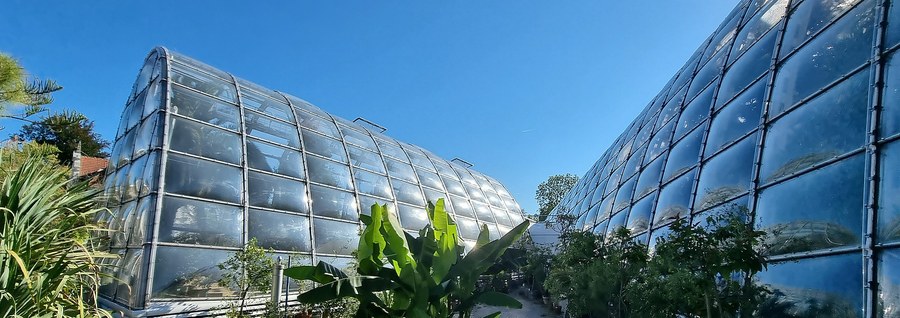
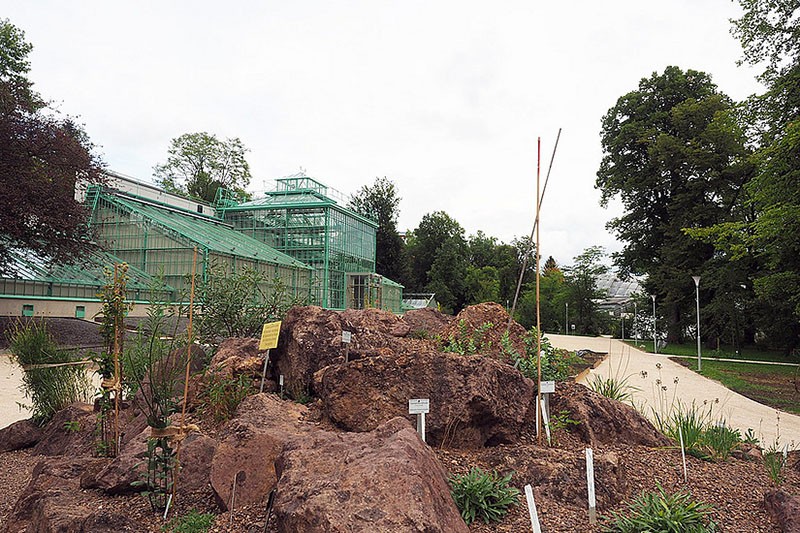
面积是一点点长出来的。1985 年买下植物学研究所西南方向 1349 平方米的地,现在那里是水池、蕨类山丘和蔷薇园;几年后通过换地又并入原邮政别墅的一部分土地,约 0.45 公顷,2006 年在那里开辟了 Bauergarten。温室是另一段历史:新温室来自 1982 年的一场比赛,建筑师 Volker Giencke 拿下了方案,1989 年动工,用铝制抛物线拱架和拱形亚克力板做外壳,中间停了一年多,1995 年 6 月 25 日才开门。如今在用的四座是 Tropenhaus、Kalthaus、Temperierthaus 和 Sukkulentenhaus,按四个气候带分区布置,每间走一遍就是从热带走到高山。园里还有一座历史温室 Historisches Glashaus,1889 年就建起来了,2008 年起受文物保护,闲置多年后经过整修,2021 年 9 月重新开放;Freiland Labor 的工作坊就设在这座玻璃房里,下雨天照样能办。
历任园长
第一任园长是系统植物学教授 Gottlieb Haberlandt。1910 年他把这个位置交给 Karl Fritsch,后者一直做到 1934 年。后面接的是 Felix J. Widder(1934—1964)、Friedrich Ehrendorfer(1965—1970)、Wilhelm Rössler(1970—1972)、Josef Poelt(1972—1991)、Herwig Teppner(1991—1993)、Paul Blanz(1993—1995)、Teppner 再度接手(1995—1999),以及直到 2002 年的 Helmut Mayrhofer。
2002 年起,园子由科学园长和技术园长两把钥匙一起管,当前的科学园长是 Dr.phil.nat. BSc MSc Sarah Bürli。园史在入口区用一段山毛榉的横切面做了展示,按一棵树活过的年头把园子的来历排了一遍;更完整的经过写在 2011 年 Grazer Universitätsverlag Leykam 出版的《Garten des Wissens – 200 Jahre Botanischer Garten Graz》里,作者是 Thomas Ster、Kurt Zernig、Ursula Brosch 和 Christian Berg。
研究方向
网站把研究这一块写得最实:植物园是植物生态学、自然保护、气候变化和生物多样性研究的中心,定位是科学、教育和自然保护之间的接口。研究集中在生态与演化过程上,想弄清楚环境变化怎么影响稀有植物的分布与状态;也研究高山植物的适应、雌雄异株这一性状本身的演化,以及全球变化对植物群落和生态系统的影响。
另一条线是昆虫和植物的关系,特别是植物体内那些可能让昆虫用来自我用药的物质。园子还参与食用菌栽培研究,松露就在其中。方法上是野外工作加温室和实验室试验,再配上统计建模。种子这一头每年出 Samenkatalog,另有一份种子索引 Index Seminum Graz。
开放时间与公众参与
对普通访客来说门槛不高:全年每天开放,周末和节日也开,进园免费。露地和温室的开放时间分两段,9 月 16 日到次年 5 月 14 日是 8:00 到 14:30,5 月 15 日到 9 月 15 日延长到 16:30;12 月 24 日到 1 月 6 日闭园。园内有规定:花坛和草坪不能踩,除导盲犬外动物不得入内。
导览要预约。一小时的温室导览把四个气候带走一遍,成人 6 欧、优惠 4 欧,八人以下的小团按 40 欧包干,需提前三周报名;连露地和历史温室一起看的 1.5 小时花园导览是 9 欧。给孩子的 Freiland Lab 里有寻宝一类的活动,主题围绕植物的用途展开,冬天项目会少一些。
还有两个长期办着的项目。一个是植物认养,项目名叫「Lass Wissen wachsen」,认养一株植物,可以在它旁边挂上写有自己名字的牌子,证书会寄到家。另一个是友谊会 Gesellschaft der Freund:innen,义务办讲座、办展览,每年组织一次 Gartenreise 去看别处的园子;会费花在信息材料、展览布置、免费导览的人力、印册子、年度旅行补贴和茶点开支上。
A garden first planned in 1811
The story of this botanical garden runs back two hundred years. In 1811, when Archduke Johann set about founding the Joanneum museum, a botanical garden was a fixed part of the plan, and its purpose was spelled out: for teaching, for the art of plant cultivation, and for the spread of useful plants. The drawings that survive come from Trattinick, Host and von Portenschlag. The garden first sat inside the museum grounds, and in 1843 Franz Xaver Unger, who taught botany and zoology there, counted the species under cultivation at roughly 8000.
As the city grew, the site no longer worked. In 1874 a plot was bought elsewhere and laid out to the designs of H. Leitgeb, then professor of botany in Graz. Years of trying to enlarge the garden came to nothing: every plot that might have allowed an extension was sold and built over with villas, and the garden was fixed at the size it has today. A restrained scheme was only approved in 1887, and the site was built and planted in 1888 and 1889. The state handed the entire plant collection of the old garden over to the new one free of charge, and the palm trees in the upper stock of the entrance hall and the old trees of the arboretum are still that same stock. Nothing of the original Joanneum garden survived; all that remains of it is a vague trace in the Joanneum quarter, where the Universal Museum Joanneum stands.
Size and greenhouses today
The site puts a few numbers at the top of its home page, which amounts to the garden introducing itself: about 2.8 hectares, 1500 square metres of greenhouse, and some 7500 plant species to find. The garden sits in the city of Graz at 365 metres above sea level.
The area grew a piece at a time. In 1985 the garden bought 1349 square metres to the southwest of the Botanical Institute, now the pond, the fern hill and the rosaceous planting; some years later a land swap brought in part of the former Postvilla grounds, about 0.45 hectares, where the Bauergarten was laid out in 2006. The greenhouses are a separate chapter: the new ones came out of a competition held in 1982, which the architect Volker Giencke won, construction began in 1989 using aluminium parabolic arches and curved acrylic panels, work stopped for a little over a year, and the doors opened on 25 June 1995. The four in use now are the Tropenhaus, the Kalthaus, the Temperierthaus and the Sukkulentenhaus, organised into four climate zones, so walking through them means walking from the tropics to the alpine zone. The garden also has a historical glasshouse, the Historisches Glashaus, built in 1889 and under heritage protection since 2008, unused for years and reopened in September 2021 after a full restoration; the Freiland Labor workshops are held in that glass building, so they can go ahead in the rain.
The directors
The first director was Gottlieb Haberlandt, professor of systematic botany. In 1910 he handed the position to Karl Fritsch, who held it until 1934. After him came Felix J. Widder (1934 to 1964), Friedrich Ehrendorfer (1965 to 1970), Wilhelm Rössler (1970 to 1972), Josef Poelt (1972 to 1991), Herwig Teppner (1991 to 1993), Paul Blanz (1993 to 1995), Teppner again (1995 to 1999) and Helmut Mayrhofer, who stayed until 2002.
From 2002 the garden has been run with two keys, a scientific director and a technical one, and the current scientific director is Dr.phil.nat. BSc MSc Sarah Bürli. The history of the garden is shown in the entrance area on a cross-section of a beech trunk, laid out against the lifespan of a single tree; the fuller account is in Garten des Wissens – 200 Jahre Botanischer Garten Graz, published in 2011 by Grazer Universitätsverlag Leykam, written by Thomas Ster, Kurt Zernig, Ursula Brosch and Christian Berg.
Research
The site is plainest about the research side: the botanical garden is a centre for plant ecology, nature conservation, climate change and biodiversity research, positioned as the point where science, education and conservation meet. The work concentrates on ecological and evolutionary processes, working out how environmental change affects the distribution and status of rare plants. It also studies plant adaptation to high altitudes, the evolution of dioecy, and the effects of global change on plant communities and ecosystems.
A second line looks at insect-plant interactions, particularly the plant substances that insects might use to medicate themselves. The garden also takes part in research on cultivating fungi, truffles included. The methods combine fieldwork with greenhouse and laboratory experiments and advanced statistical modelling. On the seed side there is an annual Samenkatalog and an index of seed, the Index Seminum Graz.
Opening hours and taking part
For an ordinary visitor the threshold is low: open every day of the year, weekends and public holidays included, and entry is free. The open-air and greenhouse sections keep two different timetables, from 16 September to 14 May running 8.00 to 14.30, and from 15 May to 15 September extending to 16.30; the garden closes between 24 December and 6 January. There are rules inside: the beds and lawns may not be walked on, and animals are not admitted, apart from assistance dogs.
Guided tours have to be booked. The one-hour greenhouse tour works through the four climate zones and costs 6 euros, 4 euros reduced; groups of fewer than eight pay 40 euros for the whole party, and booking is needed three weeks ahead. The 1.5-hour garden tour, which also takes in the open-air areas and the historical glasshouses, is 9 euros. The Freiland Lab runs sessions for children and nature enthusiasts, including a treasure hunt and a series on what plants are used for, with fewer offerings in the winter months.
Two longer-running projects are worth mentioning. One is plant adoption, called Lass Wissen wachsen: adopt a plant, have a name plate put beside it in the garden, and a certificate sent to your home. The other is the Gesellschaft der Freund:innen, which runs lectures and exhibitions on a voluntary basis and organises one Gartenreise a year to visit gardens elsewhere; the dues go on information material, exhibition fittings, the staff who lead free tours, printing, a subsidy for the annual trip and the cost of refreshments.
相关文章:
 奥地利 维也纳大学植物园 Botanischer Garten der Universität Wien – 12000余种植物收藏和研究
 奥地利 Graz大学植物园 – 植物迁地保护与科普基地
 瑞士 圣加仑植物园 Der Botanische Garten St.Gallen – 瑞士植物多样性展示的代表性机构之一
 德国 Garten Schlüter 苗圃 – 北德百年家族花园植物邮购商
 欧洲花园 Garten Europa – 园艺展示与体验空间
 德国 Park der Gärten – 德国规模最大的主题花园园区之一杜鹃特色收藏
 德国 Mein schöner Garten 订阅商店 – 德国十余种园艺刊物订阅服务
 德国 耶拿植物园Botanischer Garten Jena – 是决定性的(有用和药用植物)
发表回复