

1880 年,从希勒霍姆的一块地开始
P. Nelis & zoon’s 是荷兰的球茎种植与贸易企业,正式名称是 P. Nelis en zoon’s Bloembollenkwekerij en Handel B.V.,公司自称有 140 多年经验,在希勒霍姆和斯哈格布鲁克两处有场地。
起点很具体。1880 年,Piet Nelis 在希勒霍姆买了几块地,办起自己的球茎生意——最初只是一家种植场。是儿子 Kees 给这个家添上了贸易这一块,出口就是从那时开始的。大约 1910 年,父子在希勒霍姆另觅了场地,经过几十年的翻建,那仍是今天公司的主楼所在地。
1940 年,儿子 Piet 接过舵把,公司的重心随之转向贸易。瑞典、芬兰、奥地利和德国成了重要的出口目的地,后来东欧、挪威、日本和墨西哥也进入了名单。老 Piet 一直到 1990 年都与公司紧密相连。
直到今天,这家公司仍然保持家族企业的样子:管理层级短,员工与公司之间有很强的黏性。还有一件公司自己愿意拿出来讲的事——名字里的那个拼写错误已经成了历史的一部分。荷兰语里「zoon」是「儿子」,正确写法应该是「zoons」,但站上一路写下来的就是 P.Nelis&zoon’s,这个少一个 s 的写法就这么留了下来。
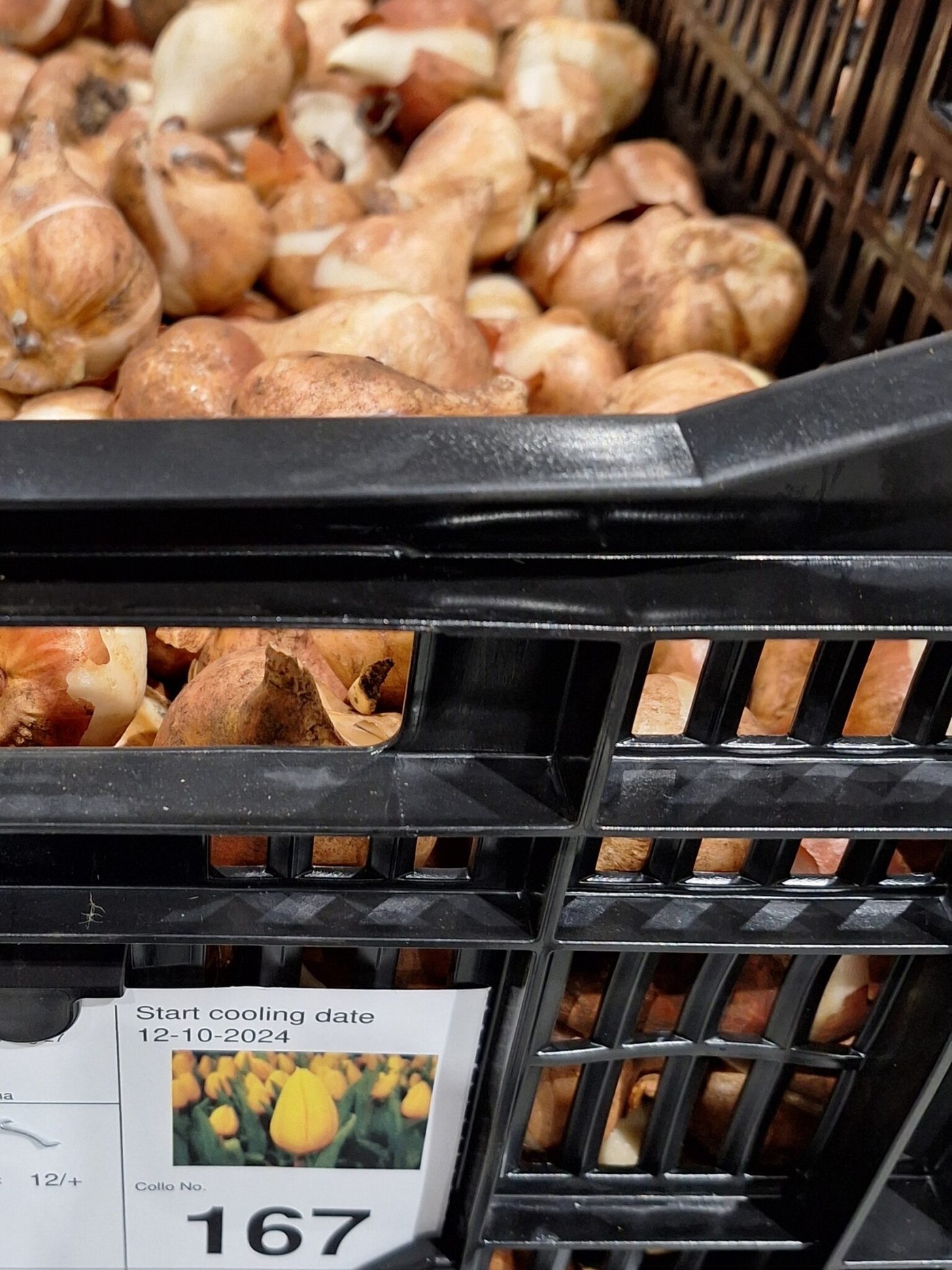
他们的根基是储存和预处理,不是种植
这家公司做球茎生意,但它的基础不是自己下地种球,而是把球茎收进来、储存好、处理到客户要的状态。站上的原话是:花的质量主要取决于储存和预处理的方式,所以每个环节都不留任何侥幸——最先进的冷藏与加热库房是一回事,手艺本身并不比它次要。
球从哪里来?答案跟着季节走,这是这家公司的看家本事。
第一批球来自法国波尔多周边。随着种植季推进,产地慢慢但确实地在荷兰境内移动:从泽兰省,到弗莱霍林德与东北圩田,再到北部沙地区和西弗里西亚。正因为产区这样一路铺开,他们才能做到从年初到年末都有货——不论是水培催花、盆栽土还是露地栽培。
供货方是长期固定下来的种植户,标准跟自己一样严。公司自己总结为:几乎所有合作都是与球茎种植户之间的长期关系,而把这种合作关系经营好,本身就包含了分享知识——关于有希望的新品种、球茎品质,以及别的对种植方要紧的细节。
分工也很明确:郁金香、风信子和水仙的预处理由公司自己做,muscari 和番红花也一并自己做;其他品类则与专业供应商紧密合作。他们主要做的是早期球——就是给早催花用的那批。
六道关口:从收货检验一直到装船
站上把整个流程拆成六步,每一步都有具体做法。
第一步是销售与栽培指导。客户会问:靠什么品种在市场里做出区分?哪些品种适合我的种法和当地气候?眼下什么颜色在消费者那边走得动?公司的代表是客户的固定对接人,一年上门好几次,交换种植结果、市场情况和新的催花排期——这样客户也能一直知道自己在市场上有没有位置,以及栽培技术上的变化对她有没有增益。
第二步是收货与检验。从不同产区收来的球,在进入第一次储存之前,每一批都要过一遍细致检查,看有没有最小的瑕疵:这批有没有病害?皮相怎么样?适合早花还是适合晚一点?每一批都要取样,样品的监测结果给出这批货准不准的把握。这样客户拿到的种植信息永远来自第一手,开花期也尽可能整齐,风险降到最低。
第三步是花芽分级,这是整条链上最要紧的一道关。预处理之后,最关键的是判断花芽分化到了哪个阶段。每一批都要取几颗球放到解剖显微镜下看——把球切开是专家的手艺,要很深的经验才能把一颗球从外到内核一层层拆开。做几次检查,批次处在哪个阶段就清楚了。只有当样品完全达到郁金香和风信香的 G 阶段或 A2 阶段,才开始做温度处理;中间温度按品种不同可以从一周到六周不等,之后才进入冷藏期。这道检查给客户的保证是:你的球会在你预期的时候开花。
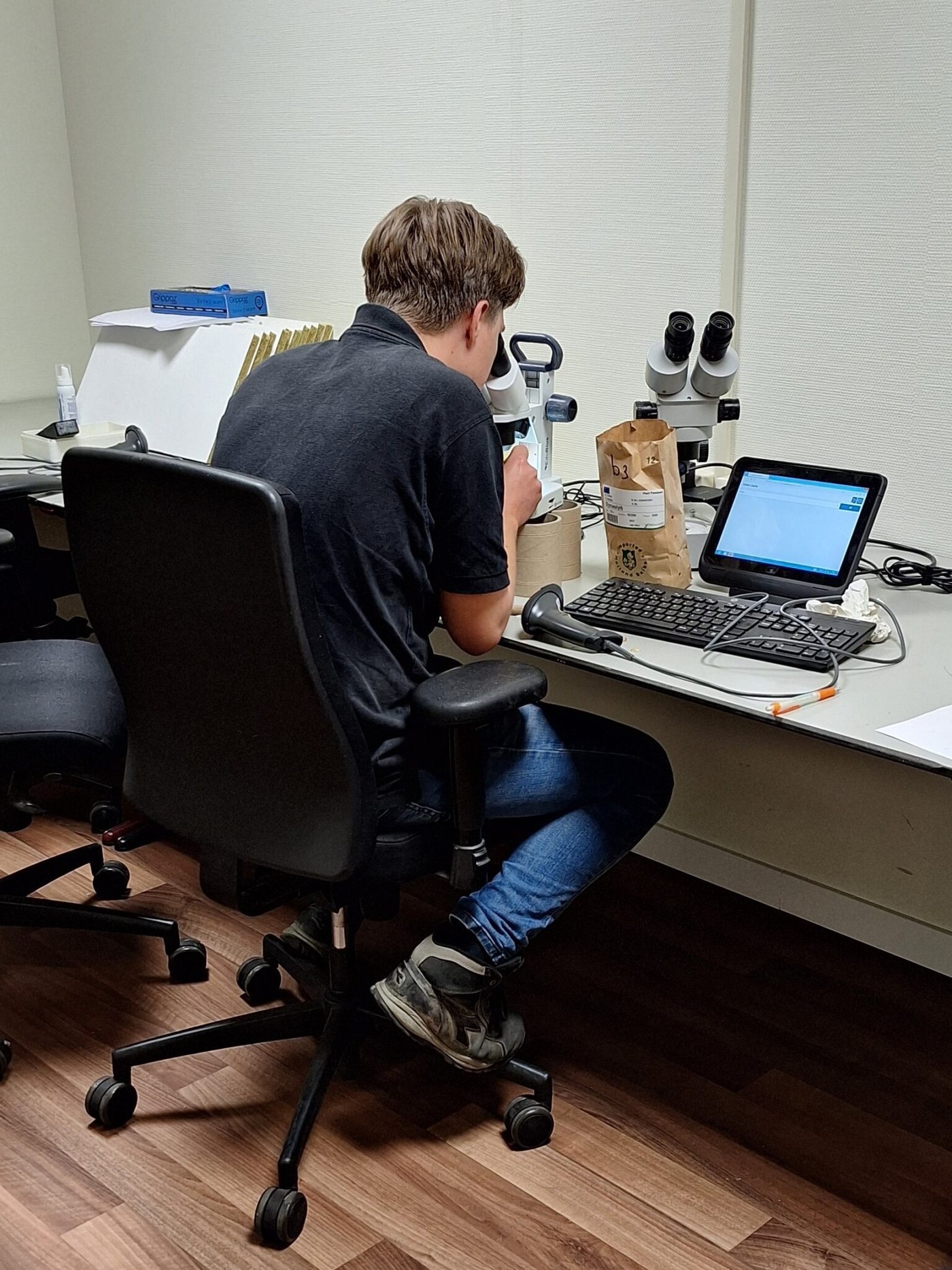
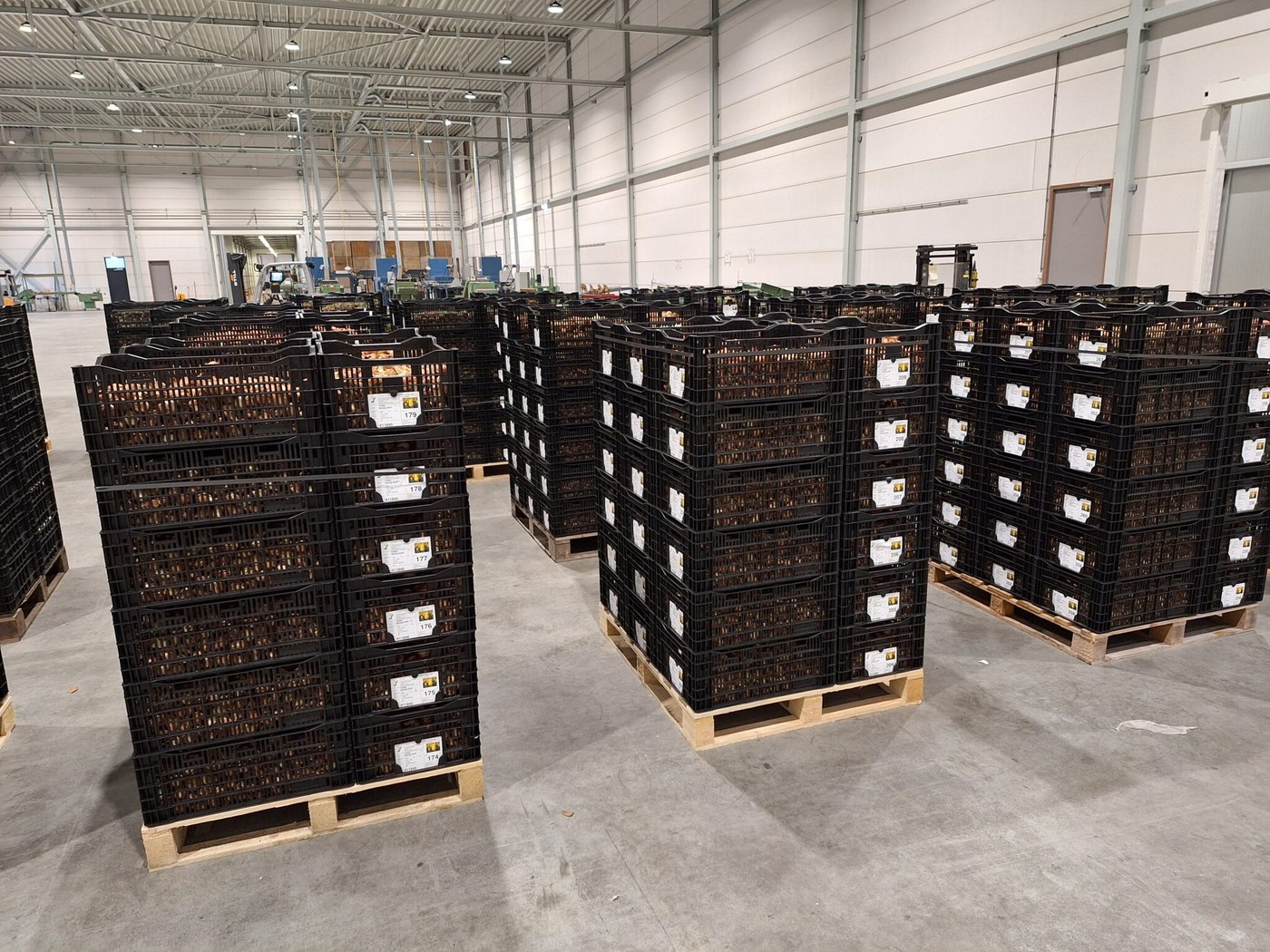
第四步是储存。要在自家预处理的这批球,在 P. Nelis 的库房里等待。希勒霍姆主楼有 44 个先进的温控库房,温度区间从零下 2 度到正 40 度,既能冷藏也能加热;斯哈格布鲁克另有 10 个库房,其中 6 个加热、4 个冷藏。靠这套设施,他们能在郁金香、风信子和水仙各自不同的储存期之间快速切换。
效率上的做法是:叉车上装了批次自动扫描装置,库位的分配因此可以高度自动化,装载率达到最优。追踪与追溯让每一批的来源和状态在数据库里一目了然,任何时候都能查到这批货此刻该在什么温度。从温度到相对湿度,温控始终维持在要求的水平上。
第五步是备货与发运。欧洲范围内用带调温条件的货车,球到客户手上时状态始终是好的。目的地更远,就走船——一程海运可能要走六周,专用集装箱里能控制全程温度,最后一段预处理甚至可以在船上完成,球到达世界任何一个目的地时都处在正确的阶段。公司对海运时间的经验很足,能把预处理精确对准每一程运输的时长。越来越多球正走向日本和南美这样的目的地——这些地方看重荷兰球的质量。
第六步回到销售端:年年都做,只是不换顺序——先谈买什么、怎么种、什么时候卖,再谈价格。
2022 年 9 月那场火,和一周之内恢复运转
2022 年 9 月 12 日,这家公司遇到了一次真正的意外。
那天员工发现打包车间里有烟。作为预防措施,冷库和机器被关掉,消防部门被叫来。消防队很快到达并立即查找源头,但有烟的地方就有火,很快处理区的一部分就烧了起来。
接下来的事要记下来。消防队打通了一条隔离带——火势蔓延到处理区时,这条通道把办公楼和大部分储藏库房隔了出来,连同里面那批数量可观的球茎存货一起保住了。各方随后一起动手抢救残局。
结果是:9 月 17 日那个星期六,公司已经恢复运转,订好的球开始发货。公司自己的形容是,那一周像灾难片里的一周——但一周之后,交易照常。
一百天之后,也就是 2022 年 12 月 23 日,公司发了一条后续说明。那年九月和十月本来是郁金香球茎出口商最紧张的两个月,但对 P. Nelis 来说,这场火反而让交付多了一份刺激:他们顶着别处火灾造成的市场短缺照样采购,照样加工、照样预处理、照样出口。一百天之后,所有作业和发运都已恢复成平常年份的样子。
当然还有难处,但难处在硬件上:仓库的翻修要排期,机器要重新采购和安装。公司说,这些不影响他们继续用同样的可靠品质、用心和效率去加工和处理球茎。
六百个名字,三十五个国家
公司的在线目录是一个能直接数的 WooCommerce 商店:共 599 个商品,589 个不重复的品种名,分在 21 个品类下。
郁金香是绝对的大头,378 个;水仙 80 个,风信子 44 个;另有 23 个商品被放在「不属于任何品类」的分类里。再往下是朱顶红 14 个、葡萄风信子 12 个、鸢尾 9 个、番红花 7 个、葱属 6 个、贝母 6 个、绵枣儿 5 个。剩下的雪滴花、雪 Narcissus 属的一些小众种、蜘蛛兰、番红花属的小种,加起来各一两个。
出口的方向,公司的负责人在 2020 年接受行业媒体采访时说过一句很具体的话:「我们主要出口郁金香,也出口风信子和水仙,卖到 35 个国家,其中很大一部分在欧洲以外。」同一段话里还有一条做法要记下来:凡是自己经手的品种,公司都会自己取样试种,检验这批球催花出来到底是什么品质。
行业活动上他们也很显眼。在郁金香交易展(Tulip Trade Event)上,公司展示了大约 250 个郁金香品种;这个展会是荷兰球茎业一年一度的开放日,参展名单里常年有 P. Nelis & zoon’s 这一家,2024 年 3 月的第六届、2026 年 3 月的第七届都在参展之列。仓库墙上挂着 MPS 认证的标识,站上的招聘栏里也一直挂着一个岗位——全职综合仓库作业员(每周 38 小时)。
Started in 1880 on a plot in Heemstede
P. Nelis & zoon’s is a Dutch flower bulb growing and trading business, formally P. Nelis en zoon’s Bloembollenkwekerij en Handel B.V., which describes itself as having over 140 years of experience and operates from two sites, in Heemstede and Schagerbrug.
The starting point is specific. In 1880 Piet Nelis bought a few plots in Heemstede and set up his own bulb business — at first purely a nursery. It was his son Kees who added trading to the package, and that is where the export began. Around 1910 the two of them moved to new premises in Heemstede, which, after many rebuilds, is still the company’s main site today.
In 1940 the next Piet took the helm, and the emphasis of the company shifted towards trading. Sweden, Finland, Austria and Germany became important export destinations, and later Eastern Europe, Norway, Japan and Mexico came into view. The older Piet stayed closely involved with the company until 1990.
To this day it still has the character of a family business, with short lines and staff with a strong attachment to the place. There is also one thing the company is happy to tell about itself: the misspelling in the name has become part of the history. The Dutch word for son is “zoon”, so it should be written “zoons” — but the name has been carried along as P.Nelis&zoon’s ever since, and the missing s stayed.
The base of the business is storage and preparation, not growing
This company trades flower bulbs, but its foundation is not growing them itself — it is taking them in, storing them, and preparing them into the condition the customer needs. The company’s own words put it this way: the quality of the flower is largely determined by the way of storing and preparing, so nothing is left to chance at any stage — and craft counts no less than the most advanced cooling and heating cells.
Where do the bulbs come from? The answer travels with the season, and this is where the company is good at its job.
The first bulbs come from the area around Bordeaux in France. As the growing season moves on, the origin shifts slowly but surely across the Netherlands: from Zeeland, to the Flevoland and Noordoost polder, on to the northern sandy areas and West-Friesland. It is precisely that spread of regions that lets them offer production from early to late in the year — whether for water forcing, pot soil or open-field cultivation.
The suppliers are growers they have held on to for years, held to standards as strict as their own. The company puts it as: in almost all cases these are long-term relationships with bulb growers, and working that relationship well is itself about sharing knowledge — on promising new varieties, on bulb quality, and on whatever else matters to the grower.
The division of labour is clear too: the preparation of tulips, hyacinths and narcissus is done in their own hands, as is muscari and crocus; for other products there is close cooperation with specialist suppliers. What they chiefly handle is early bulbs — the ones destined for early forcing.
Six checkpoints, from intake inspection to loading the ship
The company breaks the whole process into six steps, and each one has a specific method behind it.
The first step is sales and cultivation guidance. Customers keep asking: which varieties let you stand out in the market? Which suit the way you grow and your climate? What colours are working with consumers right now? The company’s representative is the fixed point of contact, and visits your business several times a year to exchange growing results, market conditions and new forcing schedules — so that the customer stays informed about her own position in the market, and about changes in growing technique that add value for her.
The second step is receipt and inspection. Bulbs arriving from the different growing areas get a thorough quality inspection at P. Nelis & zoon’s. Before the first storage, every batch is checked down to the smallest irregularity: is the batch free of disease? How is the skin quality? Is an incoming batch suited to early flowering or to a later stage? A sample is therefore taken from every batch, and the samples give a reliable picture of the condition of that batch. Monitoring the samples well means you can say with maximum certainty which batches are the early ones and which the late ones — so the growing information always reaches the customer first-hand, the flowering period is as uniform as possible, and the risk is minimal. It is the stage where craftsmanship, the master’s eye, goes hand in hand with modern technique such as inspection under a microscope.
The third step is stage inspection, the most important control in the whole chain. Once preparation is under way, what matters is checking the stage of flower initiation. From every batch several bulbs go under the inspection microscope — cutting a bulb is specialist work, and it takes a great deal of experience to dissect one, literally and figuratively, right down to the core. Several tests make clear what stage a batch is in. Only once the sample has fully reached stage G or A2, for tulip and hyacinth, does the temperature treatment begin; the intermediate temperature can vary from one to six weeks depending on the cultivar. The cooling period follows. That intensive stage control is the guarantee that your bulbs flower when you expect them to.
The fourth step is storage. The bulbs to be prepared in house wait at P. Nelis & zoon’s under ideal storage conditions. The main site in Heemstede has no fewer than 44 advanced cells for temperatures between -2 and +40 °C, so both cooling and heating are possible; a further ten cells are available in Schagerbrug, of which six are heating and four are cooling cells. That makes it possible to switch quickly between the different storage periods for tulips, hyacinths and narcissus.
Efficiency is handled with the same seriousness. Advanced tracking and tracing facilities make the origin and status of every batch transparent in the database, and the forklifts carry an automatic batch-scanning installation, so the allocation of cells can be automated to a high degree, with optimal occupancy as the result. Every batch can always be traced, giving a minute-by-minute view of the correct storage temperature, and reliable cooling and heating plant leave no doubt that climate control — from temperature to relative humidity — stays continuously at the required level.
The fifth step is making ready and transport. Even at the stage of preparing for despatch and shipping, you can count on a high standard of service from P. Nelis & zoon’s. For destinations within Europe the company uses trucks that make conditioned transport possible, so bulbs always arrive with you in the best condition. Further afield, the ship is an efficient alternative. For overseas destinations the temperature can be controlled in special containers over the six weeks a voyage may take, so that the last phase of preparation can be carried out on board and the bulbs arrive at the right stage at every destination in the world. P. Nelis & zoon’s has built up a great deal of experience in bulb exports, so the preparation can be tuned precisely to each transit time. More and more bulbs are finding their way to destinations such as Japan and South America, countries that know the value of Dutch bulbs.
The sixth step returns to the sales end — the same every year, only the order of the conversation changes: first what to buy, how to grow it and when to sell, then price.
The fire of September 2022, and getting back to work within a week
On 12 September 2022 the company met a real accident.
That day employees noticed smoke in the packing halls. As a precaution the cells and machines were switched off and the emergency services were called. The fire brigade arrived promptly and immediately began looking for the source, but where there was smoke there was also fire, and very quickly part of the processing area was burning.
What happened next is worth setting down. The fire brigade cut a corridor — as the fire reached the processing area, that passage isolated and saved the office and most of the storage cells with their large stock of bulbs. All the parties involved then rolled up their sleeves to salvage what remained.
The result: on Saturday 17 September the company was up and running again, and orders were being sent out for delivery. The company’s own description of that week is that it resembled a week from a disaster scenario — but a week later, trading went on as usual.
One hundred days later, on 23 December 2022, the company published a follow-up. September and October are normally the most intense months for tulip bulb exporters, but for P. Nelis & zoon’s the fire added an extra exciting element to the delivery of tulip bulbs to cut flower growers: they managed to purchase in what was largely a shortage of tulip bulbs caused by the fire elsewhere, and to process, prepare and export them as usual. One hundred days on, all operations and shipments were being performed as in any other year.
There were still challenges ahead, but those lay in the physical warehouse: renovations had to be scheduled and machines had to be bought and installed again. The company says none of that changes its determination to continue processing and preparing the bulbs with the same reliable quality, care and efficiency.
Six hundred names, thirty-five countries
The online catalogue is a WooCommerce store that can simply be counted: 599 products in total, 589 distinct variety names, across 21 categories.
Tulips dominate by a wide margin with 378; then 80 narcissus and 44 hyacinth; and a further 23 products sit in a category labelled “not part of any category”. Below that come amaryllis with 14, muscari with 12, iris with 9, crocus with 7, allium and fritillaria with 6 each, and scilla with 5. The rest — snowdrops, a few small galanthus and leucojum types, chionodoxa, anemone, camassia, ornithogalum, erythronia, hyacinthoides, puschkinia — are one or two apiece.
On where the exports go, the company’s director said something specific when the trade press interviewed him in 2020: “We export mainly tulips, but also hyacinths and narcissus, to 35 countries, a large share of them outside Europe.” The same passage contains another practice worth recording: of every variety they trade, the company takes its own samples to test the quality for forcing.
They are also visible at industry events. At the Tulip Trade Event the company showed around 250 tulip varieties; the event is the Dutch bulb industry’s annual open day, and P. Nelis & zoon’s is a regular name on the participant list — the sixth edition in March 2024 and the seventh in March 2026 both included them. An MPS certification mark hangs on the warehouse wall, and the company’s vacancies page has carried a role for some time: a full-time all-round warehouse worker, 38 hours a week.
相关文章:
 荷兰 霍普曼 P. Hopman – 荷兰百年球茎出口商
 荷兰Van Haaster – Nevada花卉球茎公司
 荷兰 诺德隆默斯 Nord Lommerse – 球茎处理与全球供应商
 荷兰Van den Bos花卉球茎公司 – 对于专业的花卉种植者和进口商业来说,”荷兰Van den Bos花卉球茎公司”是从事百合、小苍兰及马
 荷兰 普林斯球茎 Prins Bulbs – 面向英国零售的家族出口商
 荷兰 弗里林克父子出口公司 A. Frijlink & Zonen Export B.V. – 荷兰球茎出口遍及全球
 荷兰 斯滕沃登球茎 C. Steenvoorden – 荷兰覆盖五十余国的球茎出口商
 荷兰 Unex Inc. – 荷兰花卉种球与多年生植物出口领域的领先企业
发表回复