

从选帝侯的菜园到达勒姆
柏林植物园和植物博物馆同属柏林自由大学的中央机构,往前追溯,它的起点是 1679 年的一个菜园。当时勃兰登堡选帝侯弗里德里希·威廉把舍讷贝格自家厨房菜园扩成一座示范园,好让宫廷随时取用新鲜蔬果。这座园子后来和普鲁士科学院有过一段缘分,1718 年,科学院因为开销太大,把它划到了自己名下。
19 世纪初,植物学家威尔登诺积下的标本工作变成了皇家腊叶标本馆,1879 年又扩为皇家植物博物馆。舍讷贝格那点地方越来越挤,1888 年柏林决定搬家,新址选在达勒姆王家庄园的一片旧土豆地里,1910 年由恩格勒主持完成。
此后机构又换过两次归属,1946 年归到柏林市政府,1995 年转到柏林自由大学。从 1679 年算起,这座机构到今天已有三百多年的历史。
四十三公顷里的近两万种植物
今天的柏林植物园占 43 公顷,园内和温室里养着近两万种植物,在世界上规模最大、物种最丰富的植物园里排得上号。每年约有五十万人次来参观。
露天展区超过 30 公顷,按植物的亲缘关系和原产地分区:系统区集中展示同一科属的植物,植物地理区按世界各地的植被类型铺开,药用植物区、树木园和经济作物区各占一角。园方还按时令推荐四条路线,春天看番红花和银莲花,夏天看灌木和草本,秋天看变色的树叶和蘑菇,冬天看耐寒的仙人掌和常绿灌木。
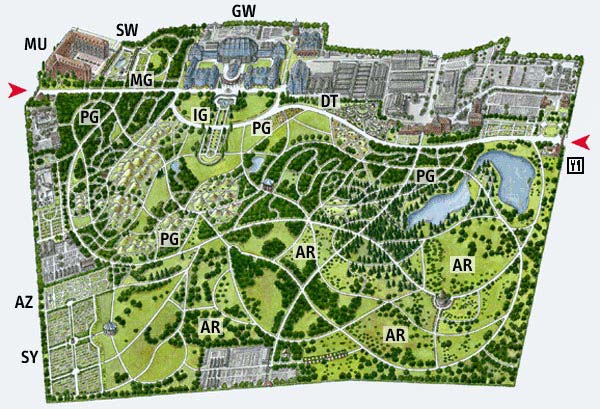
园区平面图标出了各区的位置:MU 是博物馆,GW 是温室群,PG 是植物地理区,SY 是系统区,AZ 是药用植物区,AR 是树木园,H 是主入口。温室群和博物馆挨着排在园区的一头,中间是草坪和树木区,园子另一侧有一大片水面,园路从主入口一直铺到远处的林子。
十五座编号温室
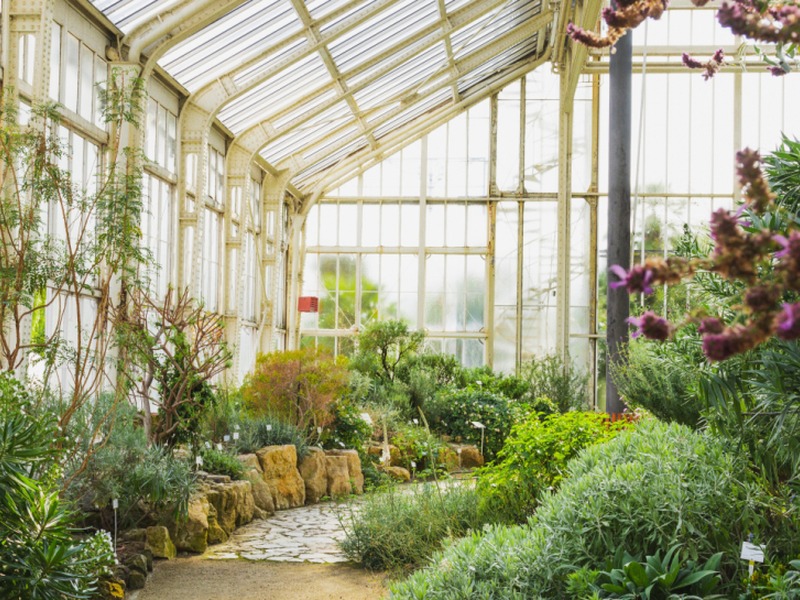
温室是植物园最出名的部分。主热带温室 A 座长 60 米、高 23 米,是全世界最大的几座之一,也是新艺术风格建筑里的名作,修复时按原样保留了当年的样子。
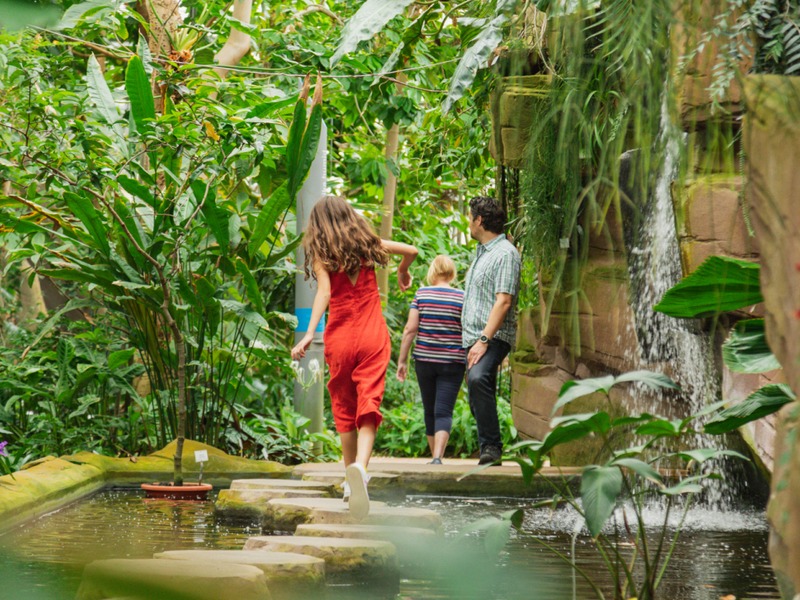
走进 A 座像是进了雨林:高大的树上挂着附生植物,藤本从头顶垂下来,侧厅专门展示南部非洲的沙漠植物,奇特子和生石花是其中最有名的两种。O 座维多利亚温室主打湿热,池子里的巨型王莲在夏天长势最盛。
其余温室各管一摊:B 座是天南星科,C 座是热带作物,D 座是兰花,E 座是雨林植物,F 座是蕨类,G 座是凤梨,H 座是非洲多肉,I 座是仙人掌,K 座是南非植物,L 座是食虫植物,M 座是澳大利亚和新西兰植物,N 座是山茶,P 座是地中海风格。另外还有一座新温室专门办展览活动。
博物馆与活体收藏
植物博物馆自 1880 年起就和植物园在同一片地方办公,是西欧唯一一座专门讲植物界及其文化史与自然史的博物馆。常设展正在改造,官方说法是到 2027 年前后才重新开放,这期间旧常设展仍然开放,可以先看化石植物复原出的成片景观、埃及墓葬里发现的花环,还有按真人尺寸做的菌类模型。
同一栋楼里还放着几样容易被忽略的东西:腊叶标本馆收藏着压制好的植物标本,达勒姆种子库存着野生和栽培种子,DNA 库保存植物遗传材料,图书馆专收植物学文献,蘑菇咨询处每周两次免费开放。
这些活体收藏、标本和种子每年要送出三万多份植物材料,供研究和教学使用。
研究方向与日常开放
植物园同时是研究机构,重点放在菊目、石竹目和硅藻三类群,地理上关注欧洲与地中海一带(含高加索),以及古巴和加勒比地区。2021 年 8 月,这里成立了国际植物学知识中心,作为全球生物多样性研究的一个节点。
开放时间分两段:4 月 1 日到 9 月 30 日,售票处和温室 10:00 到 19:00,园区出口延到 20:00;10 月 1 日到次年 3 月 31 日则是 9:00 到 18:00,园区 19:00 关闭。门票成人 10 欧元,优惠票 5 欧元,年票 30 欧元,学校团体每位学生 1 欧元,17 点后入园免费。
面向市民的免费咨询也在做:植物咨询站对所有柏林居民开放,蘑菇咨询每周两次免费开放。冬天还有圣诞花园灯光艺术展,2026 年 11 月 18 日到 2027 年 1 月 10 日。地中海温室 P 座的翻修 2025 年初一度停工,柏林参议院后来决定用联邦投资专项的钱把工程继续做下去。
From a Kitchen Garden to Dahlem
The Berlin Botanical Garden and its museum are central institutions of Freie Universität Berlin, and their origins go back to a kitchen garden in 1679. Elector Friedrich Wilhelm of Brandenburg had the kitchen garden at his Schöneberg residence expanded into a model garden, so that the court could always draw on fresh vegetables and herbs. The Prussian Academy of Sciences took the garden over in 1718, mainly because it had become too expensive to keep.
Around 1819 the botanical work of Carl Ludwig Willdenow grew into a royal herbarium, which became the Royal Botanical Museum in 1879. The Schöneberg site was by then too cramped: in 1888 Berlin decided to move, choosing former potato fields on the Dahlem crown estate, and the relocation was completed in 1910 under Adolf Engler.
The institution changed hands twice more, going to the Berlin city council in 1946 and to Freie Universität Berlin in 1995. Counting from 1679, it now has a history of more than three hundred years.
Nearly Twenty Thousand Species on 43 Hectares
The garden covers 43 hectares and holds nearly 20,000 plant species in the open air and under glass, which places it among the largest and most species-rich botanical gardens in the world. Around half a million people visit each year.
The outdoor collections spread over more than 30 hectares and are arranged by method and by origin: the systematic beds group plants by family, the plant geography beds follow the vegetation types of the world’s regions, and separate areas hold medicinal plants, the arboretum and economic plants. The garden also recommends four routes that change with the season – crocuses and hellebores in spring, shrubs and herbaceous perennials in summer, autumn colour and mushroom picking in autumn, and hardy cacti and evergreen shrubs in winter.
A site plan marks out the sections: MU for the museum, GW for the greenhouses, PG for the plant geography beds, SY for the systematic beds, AZ for the medicinal plants, AR for the arboretum and H for the main entrance. The greenhouses and the museum sit together at one end of the site, lawns and tree plantings fill the middle, a large stretch of water lies on the other side, and paths run from the main entrance into the woodland.
Fifteen Lettered Greenhouses
The greenhouses are the best-known part of the garden. House A, the main tropical house, is 60 metres long and 23 metres high, one of the largest in the world and a masterpiece of Art Nouveau architecture, restored faithfully to its original state.
Inside house A it feels like a rainforest: epiphytes hang from tall trees, lianas trail from the canopy, and an annex shows desert plants from southern Africa, including the odd-looking Welwitschia and the living stones. House O, the Victoria House, is built for tropical heat and humidity, and its giant water lily is at its best in the summer months.
The other houses each have their own subject: house B for aroids, C for tropical crops, D for orchids, E for rainforest plants, F for ferns, G for bromeliads, H for African succulents, I for cacti, K for South African plants, L for carnivorous plants, M for Australian and New Zealand plants, N for camellias and P for the Mediterranean house. A separate new glasshouse is used for special events.
The Museum and the Living Collections
The botanical museum has shared its site with the garden since 1880, and it is the only museum in Western Europe devoted to the plant world and its cultural and natural history. Its permanent exhibition is being rebuilt and is expected to reopen around 2027; the old permanent exhibition stays open in the meantime, with fossil plant formations reconstructed as miniature landscapes, flower garlands from Egyptian tombs and fungi modelled at full size.
The same building also holds the herbarium of pressed specimens, the Dahlem seed bank with seeds of wild and garden origin, the DNA bank with plant genetic material, the botanical library and the mushroom advice service, which opens twice a week.
Together these living collections, specimens and seeds supply more than thirty thousand plant parts a year for research and teaching.
Research Directions and Opening Hours
The garden is a research institution as well, working on three model groups: the orders Asterales and Caryophyllales, and the diatoms. Geographically the focus lies on Europe and the Mediterranean area including the Caucasus, and on Cuba and the Caribbean region. In August 2021 an international knowledge centre for botany was set up here, working as a node in global biodiversity research.
Opening hours run in two blocks: from 1 April to 30 September the ticket offices and greenhouses are open 10:00 to 19:00 and the garden gates close at 20:00, while from 1 October to 31 March the ticket offices and greenhouses open 9:00 to 18:00 and the garden closes at 19:00. Tickets cost 10 euros, reduced tickets 5 euros and an annual pass 30 euros, school groups pay 1 euro per pupil, and admission is free after 5 pm.
Free advice for residents is part of the programme: the botanical advisory service is open to all Berliners, and mushroom advice is given twice a week, free of charge. In winter the Christmas Garden turns the grounds into a light art show from 18 November 2026 to 10 January 2027. The renovation of the Mediterranean house, which was halted in early 2025, is going ahead after the Berlin Senate approved federal investment funds for it.
相关文章:
 奥地利 格拉茨大学植物园 Botanischer Garten Graz – 施蒂利亚州植物学教育与研究
 奥地利 维也纳大学植物园 Botanischer Garten der Universität Wien – 12000余种植物收藏和研究
 德国 柏林植物园和植物博物馆 – 世界上规模最大、最重要的植物园之一
 瑞士 圣加仑植物园 Der Botanische Garten St.Gallen – 瑞士植物多样性展示的代表性机构之一
 德国 波恩大学植物园 – 植物迁地保护与科普基地
 德国 桑德曼高山植物园 Botanischer Alpengarten Sündermann – 两千余种高山植物苗圃
 挪威 卑尔根大学花园 – 挪威卑尔根大学下属三座植物园联合体
 德国 科隆植物园 Die Flora – 山茶花收藏具国际声誉
发表回复