
两个民间种子组织合并而成
ARCHE NOAH 的正式名称很长:Gesellschaft für die Erhaltung der Kulturpflanzenvielfalt und ihre Entwicklung,意思是要保存栽培植物的多样性并推动它继续发展。中文一般叫「方舟」或「诺亚方舟协会」。它是一家位于奥地利下奥地利州 Langenlois 附近 Schiltern 的非营利协会,不是种子公司。
成立年份是 1990 年,由两个更早的民间组织合并而成。下奥地利州的「Samenpflegevereinigung」(种子培育协会,负责人 Reinhild Frech-Emmelmann,做生物蔬菜育种和种子繁育)和施泰尔马克州的「Fructus」(负责人 Max Moser)本来就是各自独立运作的,靠在成员自家的园子里和农场里种植来保住品种。合并前两家在 1988 年就出过一份联合种子目录——当时奥地利还没加入欧盟,蔬菜种子还没有后来那套准入限制,交换起来顺畅得多。
合并那年,两家加起来有 120 名成员,39 位保存者通过目录交出种子,提供了 250 个品种。协会的座最初在 Krems an der Donau。
发起人里最有名的是 Nancy Arrowsmith。她1950 年生于英国牛津,在美国长大,1977 至 1978 年在慕尼黑一家香草店当学徒,后来以记者和书籍作者的身份出名,也是园艺杂志「kraut & rüben」的创办者和主编(1984 至 1989)。她私人收集了一批濒危老品种,这批种子就是今天 ARCHE NOAH 种子库的最早来源。她从 1990 年当首任主席做到 1997 年,随后因协会的走向问题在董事会层面争执后卸任,现居美国亚利桑那州。
需要说明的是,站上把完整街道地址、电话、传真、邮箱、登记号都公开列出。本站不转录这些内容,想联系请直接访问协会站。
种子库:五千五百个品种
种子库(站上现称 Samenarchiv,早年称 Sortenarchiv)是整个协会的核心,站上的说法是「ARK NOAH 的心脏」。里面保存着超过 5,500 个栽培植物品种,涵盖蔬菜、谷物、香草、果树和土豆。
库里的活体工作分两处:一处是每天都在用的工作收藏,用来重新种植、保持活性并分发给农户和保护者;另一处是完整备份,存放在 −18 摄氏度的深冷冷冻室里,种子能保持可萌发状态数十年。
工作内容写得很具体:保护这约 5,500 个濒危栽培植物,靠贮藏和繁育让它们活着,记录并描述每个品种,把种子和知识交到需要的人手里。整理、清洁、发放都有固定流程,站上还有一个种子知识问答测验。附属的收藏还有果树与果木收藏,以及马铃薯收藏——后者保存着 170 多个品种和来源。
种子之外,协会还设了一个品种门户(Sortenportal),早年叫品种手册(Sortenhandbuch)。这个网站开放给私人保存者,也对园丁和农户开放,用作那些愿意照料稀有和濒危品种、愿意分享植物和经验的人的交换场所。访客不需要登录就能浏览和搜索,只是不能直接向保存者提出索取请求;登录后可以取得种子。有意思的是定位:站上写明那些只是想在自家园子里收点特别东西的人,也能在这里找到想要的。
品种分七类:蔬菜与田间作物、果树与野生果树、香料与茶用药草、染色植物、观赏植物与野草、乔木与灌木、真菌。
Schiltern 的展示园与那座巴洛克花园
现在 Schiltern 的展示园每年有 500 多个品种可以看:蔬菜、香草、观赏植物和果树。园子每年开放,从 5 月 1 日到 10 月初,周五到周日及节假日开放,每天十点到五点,每天 11 点和 14 点各有一场花园导览。成人门票 13 欧元,优惠票 10 欧元,会员可带一位同行者免费入内。园子不是无障碍设施,这一条站上也写明了。
园子的历史需要说。它坐落在 Schiltern 城堡的巴洛克花园里。这片地最早的文字记录可以追到 1706 年的地籍册,当时城堡周边已被称作「园圃」(Hoffgärten)。今天的巴洛克花园当年叫「厨房园」(Kuchlgarten),园子中央有一座凉亭,亭下还有一个「菜窖」(Krautkeller);紧挨着的是「侏儒园」(Zwerglgarten),四周用木板围住,种着「以楹桲嫁接过的果树」。约 1740 年城堡做巴洛克化改造时,建起了现在那扇锻铁园门,据说是奥皇玛丽亚·特蕾西亚的捐赠。19 世纪时这个园子还在当果园和菜园用。
一直到 1980 年代初,这个园子由「英国修女会」的修道士打理——她们在 Schiltern 城堡办的寄宿学校,园子当时供整所学校吃用,镇上的人也常来取树苗。修女会搬走后,园子荒废了 15 年,上层台地甚至长成了刺槐林。
1994 年,ARK NOAH 的展示与繁育园在这个「厨房园」旧址上开张。促成这一步的是一次不太成功的尝试:1993 年,协会把整批收藏种在 Waldviertel 地区 Krumau 的一块田里,由 Peter Zipser 义务劳动打理(他此前经营一个自给自足的农场),但很快发现那块地并不合适,于是继续找地方,最终落到 Schiltern 城堡。
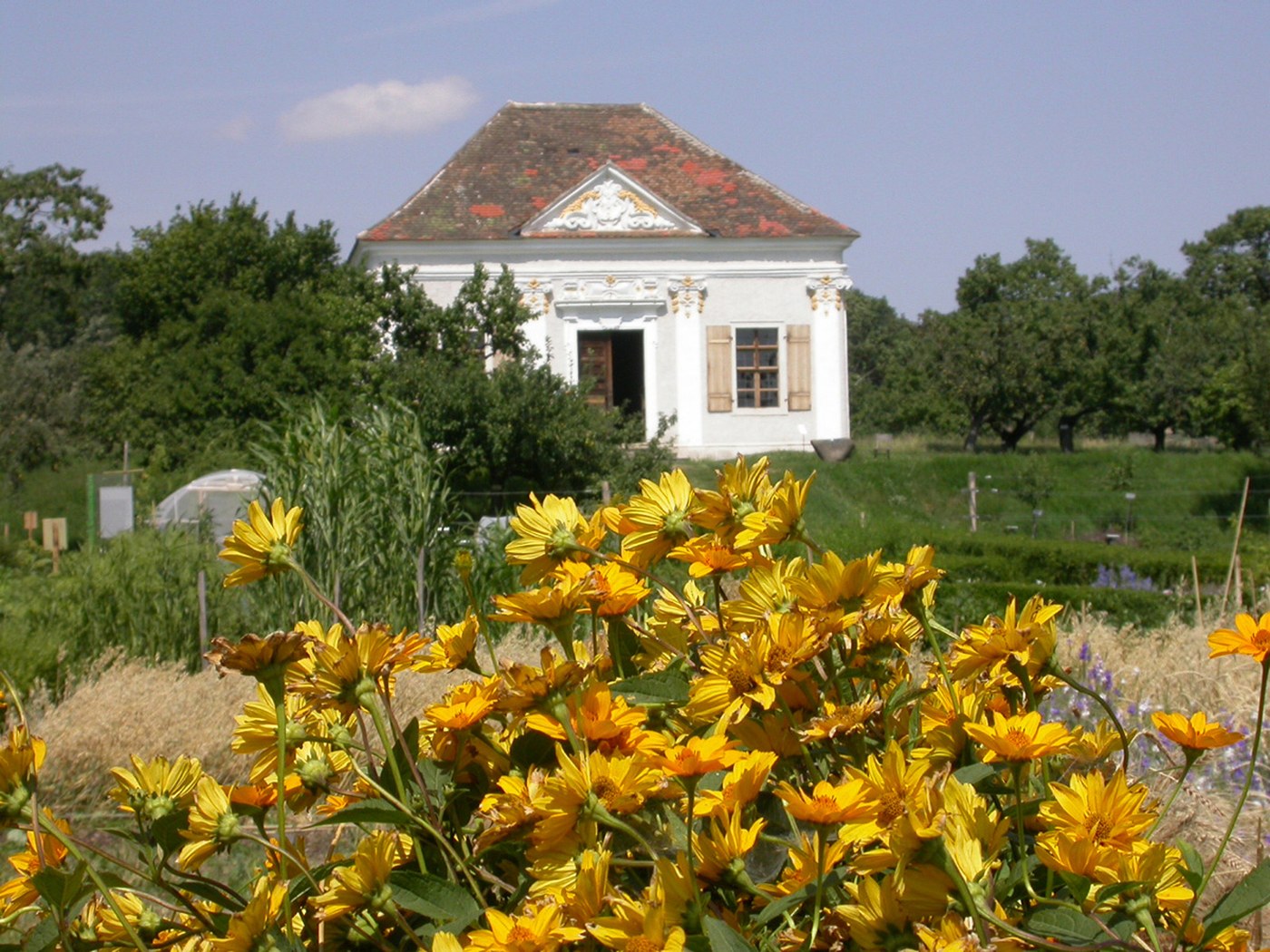
巴洛克花园的凉亭里,主轴两侧墙上保存着原始的湿壁画,画的是历史园林场景。园子分三层,现在全部对公众开放。这个园子得过欧洲园艺奖(European Garden Award)。
走出去收集:克罗地亚与罗马尼亚
保存品种最直接的办法是去把它们带回来。协会1996 年与德国 Gatersleben 的基因库以及克罗地亚萨格勒布的 Bozica Papes-Mokos 合作,组织了一次前往萨格勒布周边、斯拉沃尼亚和萨瓦河湿地的采集旅行,资金来自会员捐款。
背景是南斯拉夫战争之后,克罗地亚的地方品种很可能已经在逃亡和破坏中损失惨重,而国际种子公司正打算把自己的品种打进当地市场。风险在于:仅存的本地品种和南斯拉夫育种品种会被挤掉。
这次旅行的结果是 400 个来源的种子,分成三份,分别在 Gatersleben 和 ARCHE NOAH 的种子库里继续保存、种植、筛选和描述;其中许多品种在奥地利本地种植也很合适。主要目标则是等当地园丁重新对自己的本地品种产生兴趣时,能把种子还回去。1990 年代协会还与 Gatersleben 的基因库合作,在罗马尼亚和下奥地利州做过采集旅行。
这一阶段带出的果实收藏是 1999 年扩大的。与下奥地利州自然保护部门合作开发了本地果树服务,出版《NÖ Obstsortenmappe》(本地果树品种册)——纸本已停,但每张品种说明都能从网上取下打印,而且每年还在增加;此外办本地果树日、提供品种鉴定和按需求嫁接。一个多年期的 Leader 项目建起了老浆果品种收藏,成果之一是《Osterfee und Amazone》一书。所有果树项目的核心是与生物苗木场合作,让老品种的种植材料能重新广泛供应且质量有保证。
把稀有品种送上货架,和种子法
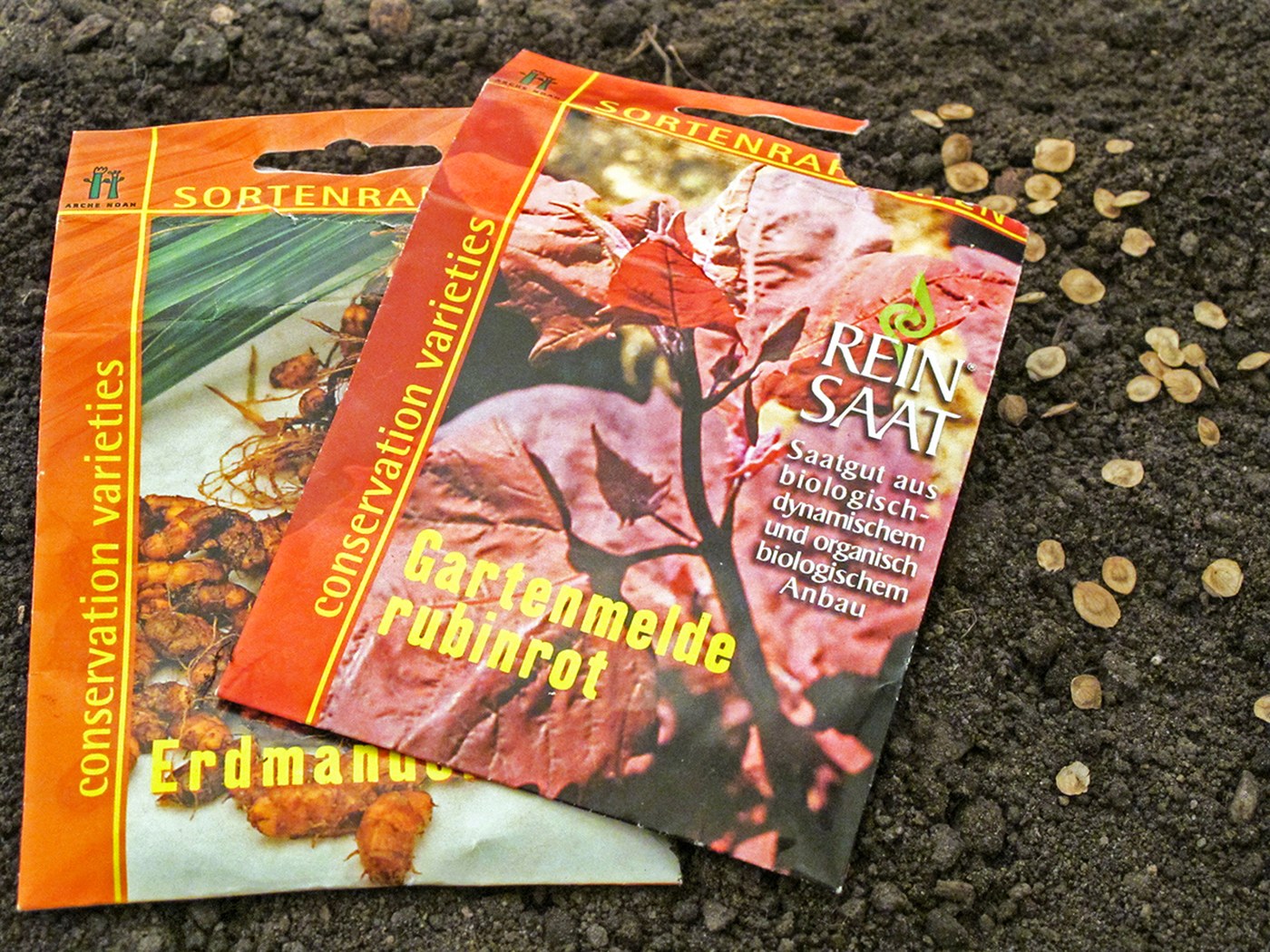
协会的立场很直接:作物多样性只能靠使用来保住,不用就会消失。所以它做了很多看起来像商业的事。1998 年在 Schiltern 办了第一次保存者论坛,主题是「老果树品种」,之后办了许多场,有按主题的,也有按地区联网的。2002 年启动「稀有品种营销网络」项目,做了一份面向直销商的稀有品种采购指南,还组织了大量品鉴会。2003 年与德国种子公司 ReinSaat 合作,把稀有品种的种子推向市场。
这条线上最出名的一次合作是和生物种植者兼加工商Erich Stekovic。2002 年起先用 60 个精选番茄品种做试种并测试腌渍适用性,后来逐步扩大——Stekovic 把种子库里全部 600 个品种都种了出来,期间多次田间走访交流经验,办了好几届番茄节。转向公众的另一条路是每年春天的幼苗展售,2025 年那一次摆出的内容包括 200 棵果树和浆果灌木、35 个番茄品种、25 个辣椒品种、25 个叶菜与沙拉、170 个香草与药用染色植物。
另一头是政策。协会在种子法上做的事比多数保护组织多:反对对种子及其性状申请专利、反对新的基因技术、关注欧盟「专利丛林」对农户和育种者的挤压、关注《名古屋议定书》的惠益分享、参与生物多样性公约的相关讨论。它的立场是一句很简单的话——种子是共同财产。为此还做过很具体的动作:自己动手做种子袋寄给农业部长、征集签名推动欧盟种子法改革、发布关于官僚程序妨碍生物多样性的报告。
教育这一块也有制度化的东西。自 2022 年 5 月起,协会在 ÖPUL 框架下成为认可的培训机构,有机农户可以把这些课程算作继续教育;课程学员里约有二分之一使用会员折扣。协会的出版物目录里,书籍和小册子占了不少,其中那句理由说得最清楚:栽培植物不用就会消失,而关于它们的历史、栽培和用途的知识,跟植物本身一样濒危——所以记录已有知识、补充新知识、再整理得好看些,是一项任务。
Formed from two grassroots seed groups
ARCHE NOAH has a long formal name — Gesellschaft für die Erhaltung der Kulturpflanzenvielfalt und ihre Entwicklung, meaning that it preserves the diversity of cultivated plants and works on its further development. It is generally referred to as the Noah’s Ark association. It is a non-profit association based in Schiltern near Langenlois in Lower Austria, Austria. It is not a seed company.
It was founded in 1990, from the merger of two earlier grassroots groups. The Samenpflegevereinigung (seed cultivation association) in Lower Austria, headed by Reinhild Frech-Emmelmann, worked on organic vegetable breeding and seed propagation; and Fructus in Styria, headed by Max Moser. Both had operated independently, preserving varieties by growing them in members’ own gardens and on farms. Before merging they had already issued a joint seed catalogue in 1988 — at the time Austria was not yet an EU member, vegetables were not subject to the admission rules that came later, and exchanging seed was straightforward.
In the merging year the two organisations had 120 members between them; 39 preservers contributed seed through the catalogue, offering 250 varieties. The association was initially seated in Krems an der Donau.
The best known of the founders is Nancy Arrowsmith. Born in Oxford in 1950 and raised in the United States, she served an apprenticeship in a Munich herb shop in 1977–78, then made a name for herself as a journalist and book author. She founded and edited the gardening magazine “kraut & rüben” between 1984 and 1989. She had privately assembled a collection of endangered old varieties, and that collection is the earliest source of what is now ARCHE NOAH’s seed archive. She served as the first chairwoman from 1990 to 1997, then stepped down following a disagreement at board level over the association’s direction, and now lives in Arizona.
The site publishes the full postal address, telephone, fax, email and register numbers. None of that is reproduced here; the association’s site is the place to reach them.
The seed archive: 5,500 varieties
The seed archive — Samenarchiv today, Sortenarchiv in its earlier years — is the core of the whole association, described on the site as the heart of ARCHE NOAH. It holds more than 5,500 varieties of cultivated plants, covering vegetables, grains, herbs, fruit trees and potatoes.
The living collection is split in two. One part is a working collection used every day, to regrow the seeds, keep them alive and share them with farmers and conservationists. The other is a full backup held at –18°C in a deep-freeze chamber, where the seeds stay viable for decades.
The work is described concretely: safeguard some 5,500 endangered cultivated plants, keep them alive by storing and propagating them, document and describe the varieties, and make seed and knowledge available. Cleaning, preparation and distribution each follow a fixed process, and there is a seed knowledge quiz on the site. The associated collections are a fruit tree and orchard collection, and a potato collection — the latter holding more than 170 varieties and provenances.
Beyond the seed itself, the association runs a varieties portal (Sortenportal), earlier known as the varieties handbook. It is open to private preservers and to gardeners and farmers alike, and exists as a place for those willing to maintain rare and endangered varieties and to share both the plants and their experience. Visitors can browse and search without logging in, though they cannot send a direct request to a preserver; logged-in users can obtain seed. The positioning is worth noting: the site says that anyone who simply wants to grow something unusual in their own garden will find what they are after here too.
There are seven categories: vegetables and field crops, fruit trees and wild fruit, spices and tea and medicinal plants, dye plants, ornamental plants and wild herbs, trees and shrubs, and fungi.
The Schiltern visitor’s garden and the baroque garden behind it
More than 500 varieties can be seen in the Schiltern garden each year: vegetables, herbs, ornamentals and fruit trees. The garden opens from 1 May to the beginning of October, Friday to Sunday and on public holidays, ten to five, with a garden tour at 11:00 and 14:00. Entry is €13, or €10 reduced, and members bring one companion free of charge. The garden is not wheelchair accessible, which the site also states.
The garden’s history is worth telling. It sits in the baroque garden of Schloss Schiltern. The earliest written record of the site goes back to the 1706 Schiltern land register, which already refers to “Hoffgärten” around the castle. What is now the baroque garden was then called the “Kuchlgarten”, the kitchen garden, with a garden pavilion at its centre and a “Krautkeller” — a vegetable cellar — underneath it. Next to it came the “Zwerglgarten”, edged by a plank and planted with fruit trees “grafted on quince”. Around 1740, when the castle was given its baroque remodelling, the wrought-iron garden gate was erected, said to be a donation from Empress Maria Theresa. The garden’s use as an orchard and vegetable plot is documented as late as the 19th century.
Until the early 1980s the garden was worked by an order of “English Nuns”, who ran a boarding school at Schloss Schiltern; the garden then supplied the whole school, and people from the surrounding area were happy to come and collect young plants. After the sisters left, the garden lay uncared-for for fifteen years, and the upper terraces in part grew over into stands of false acacia.
In 1994 the ARCHE NOAH show and propagation garden opened on the site of the former Kuchlgarten. What led to it was an attempt that did not work: in 1993 the association planted the whole collection on a field at Krumau in the Waldviertel, worked on a voluntary basis by Peter Zipser, who had previously run a self-sufficient farm there. The site soon proved unsuitable, the search continued, and the collection eventually landed at Schloss Schiltern.
Original secco murals showing historical garden scenes survive on the walls of the baroque pavilion, which stands on the main axis. The garden is laid out on three levels and all of it is now open to the public. The garden has received a European Garden Award.
Going out to collect: Croatia and Romania
The most direct way to preserve a variety is to go and bring it back. In 1996 the association organised a collecting trip to the area around Zagreb, to Slavonia and to the Sava river floodplain, working with the gene bank at Gatersleben and with Bozica Papes-Mokos from Zagreb, financed by member donations.
The background was that after the Yugoslav wars, fleeing and destruction had probably already caused a great loss of local varieties in Croatia, while international seed firms were moving to get their own varieties into the Croatian market. The danger was that the surviving local and Yugoslav bred varieties would be displaced.
The trip yielded seed from 400 provenances, which at the end was divided into three copies and continues to be preserved, grown, selected and described at Gatersleben and in the ARCHE NOAH archive. Many of them are well suited to growing in Austria too. The main goal, though, is to be able to return the seed to Croatian gardeners when interest in their own local varieties returns. Through the 1990s the association ran further collecting trips with the Gatersleben gene bank in Romania and in Lower Austria.
The fruit side expanded from 1999. Working with the nature conservation department of Lower Austria it developed a local fruit service, publishing a modern pomology called the “NÖ Obstsortenmappe”, holding an annual local fruit tree day, and offering variety identification and grafting to order. The paper edition has stopped, but every variety sheet can be printed from the website, and new ones are added each year. A multi-year Leader project built up a collection of old soft-fruit varieties, and the book “Osterfee und Amazone” came out of it. Central to all the fruit work was cooperation with organic nurseries, so that planting material of old varieties becomes widely available again in reliably identified quality.
Getting rare varieties onto the shelf, and the seed law
The association’s position is straightforward: crop diversity can only be kept alive through use, and what is not used disappears. So it does a great deal that looks commercial. In 1998 it held its first preserver forum in Schiltern on the subject of old fruit varieties, and many more followed, both by topic and by crop, and regionally linked. In 2002 it started a project to build a marketing network for rare varieties, producing a direct-purchase guide for them and organising a large number of tastings. In 2003 it agreed with the German seed company ReinSaat to take rare variety seed to the market.
The best known collaboration on that side is with organic grower and processor Erich Stekovic. From 2002 the varieties were first trial-planted — 60 selected tomato varieties tested for suitability for pickling — and the comparison trials were greatly extended in the years that followed, to the point where Stekovic grew all 600 varieties of the archive. Field walks exchanged experience with other producers, and several well-attended tomato festivals were held. The other route to the public is the spring seedling sale; the 2025 offering included 200 fruit trees and soft-fruit bushes, 35 tomato varieties, 25 pepper and chilli varieties, 25 leafy greens and salads, and 170 herbs, medicinal and dye plants.
The other end is policy. What the association does on seed law is more than most conservation organisations do: opposing patents on seeds and on their traits, opposing new genetic technologies, following the EU “patent thicket” and what it squeezes out of farmers and breeders, following the Nagoya Protocol on access and benefit-sharing, and taking part in the relevant biodiversity discussions. Its position reduces to one sentence — seed is a common good. It has backed that with concrete actions: making its own seed bags to send to the agriculture minister, collecting signatures for reform of the EU seed law, and publishing a report on bureaucracy working against biodiversity.
Education has its institutional side too. Since May 2022 the association has been an approved training provider under ÖPUL, so organic farmers can count its courses as continuing education; roughly half of course participants use the member discount. The publication list is largely books and booklets, and the reason given is the clearest statement of all: cultivated plants disappear if they are not used, and the knowledge of their history, cultivation and use is as endangered as the plants themselves — so documenting existing knowledge, adding new knowledge and preparing it attractively is a task.
相关文章:
 奥地利 苗圃和多年生园丁协会 Baumschulinfo – 78 家会员的行业团体
 奥地利 下奥地利州园丁协会 NÖ Gärtner – 250 余家商业苗圃的行业团体
 加拿大 Gardens North 花园之北 – 本地小型耐寒异域与本土种子供应商
 德国 水花园爱好者协会 – 致力于推动水生和沼泽植物的研究、栽培与应用
 英国 有机花园 Garden Organic – 英国最具代表性的有机园艺慈善机构
 英国 Mickfield玉簪苗圃 – 种苗生产与销售
 美国 Andrews种子公司 – 提供各种花园用品和植物
 英国 HPS 耐寒植物协会 – 英国本土具代表性的耐寒园艺植物科普与保护组织
发表回复