
管理处与园区范围
玉山国家公园管理处隶属台湾内政部国家公园署,园区横跨花莲、高雄、南投、嘉义四县市,地势分成东埔山块、玉山山块与中央山块三大区块,也是浊水溪、高屏溪与秀姑峦溪上游的重要集水区。园区面积约10.3万公顷,约占台湾面积的百分之三,属典型的亚热带高山型国家公园。地质上园区分为五个地质区,板岩、千枚岩与变质砂岩一带占了全园一半以上的面积。
山峰与气候
园区里海拔三千公尺以上、列入台湾百岳的山峰有三十座。玉山主峰、秀姑峦山与达芬尖山是五岳三尖里的两岳一尖;马博拉斯山、玉山东峰、新康山、玉山南峰与关山则是十峻中的五座。玉山主峰海拔3952公尺,为全岛第一高峰,秀姑峦山3825公尺,关山3668公尺。园区海拔从东部拉库拉库溪谷的300公尺一路升到3952公尺,高差3600公尺。3500公尺以上年平均气温约5.9度,2500公尺以上约11.3度;年雨量3000至4700毫米,雨季集中在5到9月,中央山区年平均相对湿度约80%。
植被带与植物种类
植物随海拔分层明显,园区可分五个植群带:3600公尺以上是高山植群带,以玉山圆柏、玉山杜鹃为主;3100到3600公尺为冷杉林带,代表种是台湾冷杉;2500到3100公尺属铁杉云杉林带;1500到2500公尺是栎林带,红桧、扁柏与台湾杉多见于此;500到1500公尺则为楠栧林带。依植物资源页的统计,全园单子叶植物475种、双子叶植物1580种、裸子植物27种、蕨类植物455种、苔藓植物231种、菌类148种;管理处介绍页另把蕨类记作459种。园区占台湾面积约百分之三,却收进台湾半数以上的原生植物。
野生动物的种类与数量
园区的动物以哺乳类、鸟类和蝴蝶最见特色。哺乳类65种,占台湾陆域哺乳类物种数的七成四,其中16种属中大型哺乳类;鸟类约233种,29种为台湾特有种;爬行类46种,分蛇类31种、蜥蜴类12种、龟鳖类3种;两栖类依动物资源页统计为19种,其中有尾类只有阿里山山椒鱼一种,管理处介绍页则记作21种;高山溪流记录到淡水鱼16种。蝴蝶有289种,约占台湾蝴蝶总数的一半,其中灰蝶科74种、蛱蝶科109种、弄蝶科46种、粉蝶科31种、凤蝶科27种,园区昆虫总计1578种。保育类里台湾黑熊、台湾水鹿与台湾野山羊是主角,阿里山山椒鱼与楚南氏山椒鱼则是冰河孓遗的珍稀两栖类。
古道、游憩设施与保育研究
八通关古道是清领时期开发台湾留下的旧迹,日治时期又陆续修筑八通关越道路与关山越警备道路,园区过去也是邹族与布农族生活的区域,古道沿线仍可找到布农旧社遗址。游憩方面,园内有玉山群峰、八通关越岭、南横三山及关山、南二段、新康横断、马博拉斯横断六条步道系统,游客中心与登山服务点分布在水里、塔塔加、梅山、南安与排云一带。保育研究上,管理处自2002年起在楠溪地区设2公顷永久样区做中海拔生态系统长期监测,记录到48种哺乳类、56种鸟与126种植物,2017年起再以塔塔加游憩区与楠溪林道作科研基地试办场域,与邻近学校及研究单位合作进行生态监测与户外探索教育。
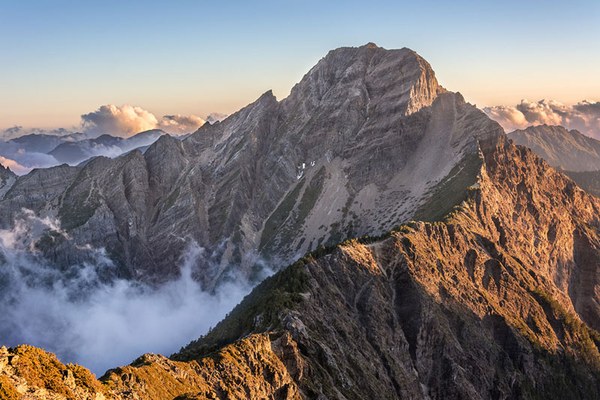
Park Headquarters and Boundaries
The Yushan National Park Headquarters operates under the National Park Agency of Taiwan’s Ministry of the Interior. The park stretches across four counties and cities, Hualien, Kaohsiung, Nantou and Chiayi, and is built on three mountain blocks: the Dongpu, Yushan and Central Range blocks. It also forms the upper catchment of the Choshui, Kaoping and Hsiukuluan rivers. Covering about 1031 square kilometres, the park takes up roughly three percent of Taiwan’s land area and is a typical subtropical high-mountain national park. Geologically it is divided into five units, and the belt of slate, phyllite and metamorphic sandstone covers more than half of the whole park.
Peaks and Climate
Thirty peaks above 3000 metres are listed among Taiwan’s Hundred Peaks. Mount Yushan, the Xueshan Range and Tafengjian count as two of the Five Great Mountains and one of the Three Peaks, while Mabolasi, the Eastern Peak of Yushan, Xinkang, the Southern Peak of Yushan and Guanshan make up five of the Ten Great Summits. Mount Yushan reaches 3952 metres, the highest point in Taiwan; the Xueshan Range stands at 3825 metres and Guanshan at 3668 metres. Elevation runs from 300 metres in the Rakulaku river valley in the east up to the summit, a difference of 3600 metres. Above 3500 metres the annual mean temperature is about 5.9 degrees Celsius, and above 2500 metres about 11.3 degrees. Annual rainfall ranges from 3000 to 4700 millimetres, concentrated between May and September, and the central mountains average about 80 percent relative humidity.
Vegetation Zones and Plant Species
Vegetation changes tier by tier with altitude, and the park falls into five zones: alpine scrub above 3600 metres, dominated by Yushan juniper and Yushan azalea; a fir zone from 3100 to 3600 metres with Taiwan fir; a hemlock and spruce zone from 2500 to 3100 metres; an oak zone from 1500 to 2500 metres, where Formosan cypress, Taiwan cypress and Taiwania grow; and a machilus and castanopsis zone from 500 to 1500 metres. According to the tally on the park’s plant resources page, it holds 475 monocot species, 1580 dicot species, 27 gymnosperms, 455 ferns, 231 bryophytes and 148 fungi, while the headquarters’ own overview page lists 459 ferns. On barely three percent of the island’s land area it carries more than half of Taiwan’s native plants.
Wildlife Species and Numbers
Mammals, birds and butterflies are the park’s strongest draws. There are 65 mammal species, about three quarters of Taiwan’s land mammals, 16 of them medium to large; roughly 233 bird species, 29 of them endemic to the island; and 46 reptiles, split into 31 snakes, 12 lizards and 3 turtles and tortoises. The animal resources page counts 19 amphibians, one tailed species among them, the Formosan salamander, though the overview page puts the number at 21. Mountain streams hold 16 freshwater fish species. Butterflies number 289, around half of Taiwan’s butterflies, with 74 blues, 109 nymphalids, 46 skippers, 31 pierids and 27 papilionids, and the park’s insect total stands at 1578 species. Formosan black bear, Formosan sika deer and Taiwan serow are among the protected animals, while the Formosan and the Soufan salamander are ice-age relics and among the rarest amphibians of the subtropical lowlands.
Old Trails, Visitor Facilities and Research
The Batongguan trail is a remnant of Qing-era development of Taiwan, and the Japanese colonial period added the Batongguan crossing road and the Guanshan military road; the Bunun and Tsou once lived in what is now the park, and abandoned Bunun villages still sit along the old trail. For visitors the park runs six trail systems, the Yushan peaks, the Batongguan crossing, the Southern Cross-island three mountains and Guanshan, South Section Two, the Xinkang crossing and the Mabolasi crossing, and its visitor centres and mountain lodges stand at Shueili, Tataka, Meishan, Nanan and Paiyun. On the research side the headquarters has run a two-hectare permanent plot at Nanxi since 2002 to monitor mid-altitude ecosystems, logging 48 mammal, 56 bird and 126 plant species, and since 2017 the Tataka recreation area and the Nanxi forest road have served as a pilot research base working with nearby schools and institutes on ecological monitoring and outdoor education.
相关文章:
 德国 哈兹国家公园 Harz National Park – 德国最大的森林国家公园之一
 美国 家庭国家公园 Homegrown National Park – 是由美国著名生态学家
 中国 兰花博览园 (China Orchid Exhibition and Trade Park) – 中国成都国兰产业综合体
 德国 萨克森瑞士国家公园 – 德国唯一的砂岩岩峰国家公园
 英国 布斯科特公园Buscot Park – 英国标志性古典庄园花园
 瑞士 塞勒格沼泽公园 Park Seleger Moor – 瑞士最大杜鹃花与落叶杜鹃园
 英国 塔顿公园 Tatton Park – 柴郡慈善保护历史庄园
 美国 波特兰华盛顿公园 Washington Park – 波特兰市内规模最大的城市公园
发表回复