

从一块三千平方米的地开始的园子
Kittenberger Erlebnisgärten 在下奥地利州 Krems 县 Langenlois 附近的 Schiltern 村,夹在葡萄园之间的丘陵地带。它今天的样子和 1977 年那笔 70,000 先令的地皮交易之间,隔着一条几乎连续四十年没有断过的线。
创办人 Reinhard Kittenberger 1961 年出生。他在自家的菜园里就知道自己要什么——「等我长大了要当园丁」。1976 年他到 Langenlois 的园艺专科学校开始学,1977 年买下第一块地,3,000 平方米,花 70,000 先令。1979 年考取园艺熟练工,1980 年办下第一张税号,成立农业苗圃,1981 年给朋友熟人做的第一批花园设计正式开工。1982 年夏天第一批售出的植物过了柜台,当时还是和父亲 Manfred 一起做。1984 年他开自己的园艺场,算是正式自立。
转机出现在 1986 年。那一年他考下风景园林师傅资格,副科是花园设计与花艺,同年拿到花园设计的营业许可;也是那一年,弟弟 Christian 接手苗圃,好让他全心做设计。1987 年公司招了第一个家族之外的员工。1990 年代他开始雇园艺技术员,设计这块业务不再是一个人扛。
1996 年他去了荷兰和英国,回来后在自家花园上做示范园——这就是 Waldviertler Heidegarten,园子旅游从这一年开始。1997 年又添了 5 个示范园,同时弟弟离开公司,接下来几年并不顺。
2002 年 8 月的世纪洪水几乎冲垮了整个园子。泥石流下来,员工、家人和下奥地利州都站在他这边,一起把公司重建起来。2004 年公司第一次完成 200 个花园设计项目;同一年他父亲在一次车祸中去世。2005 年示范园面积从 10,000 平方米翻倍到 20,000 平方米,公司拿到当时最大的一单——Stift Altenburg、Rosenburg 文艺复兴城堡和 Amethyst 世界 Maissau 的园林改造打包成一个 Kamptal 大项目。
需要说明的是,站上把完整街道地址、电话、传真、邮箱、工商登记号和税号都公开列出。本站不转录这些内容,想去请直接查站上的到访信息。
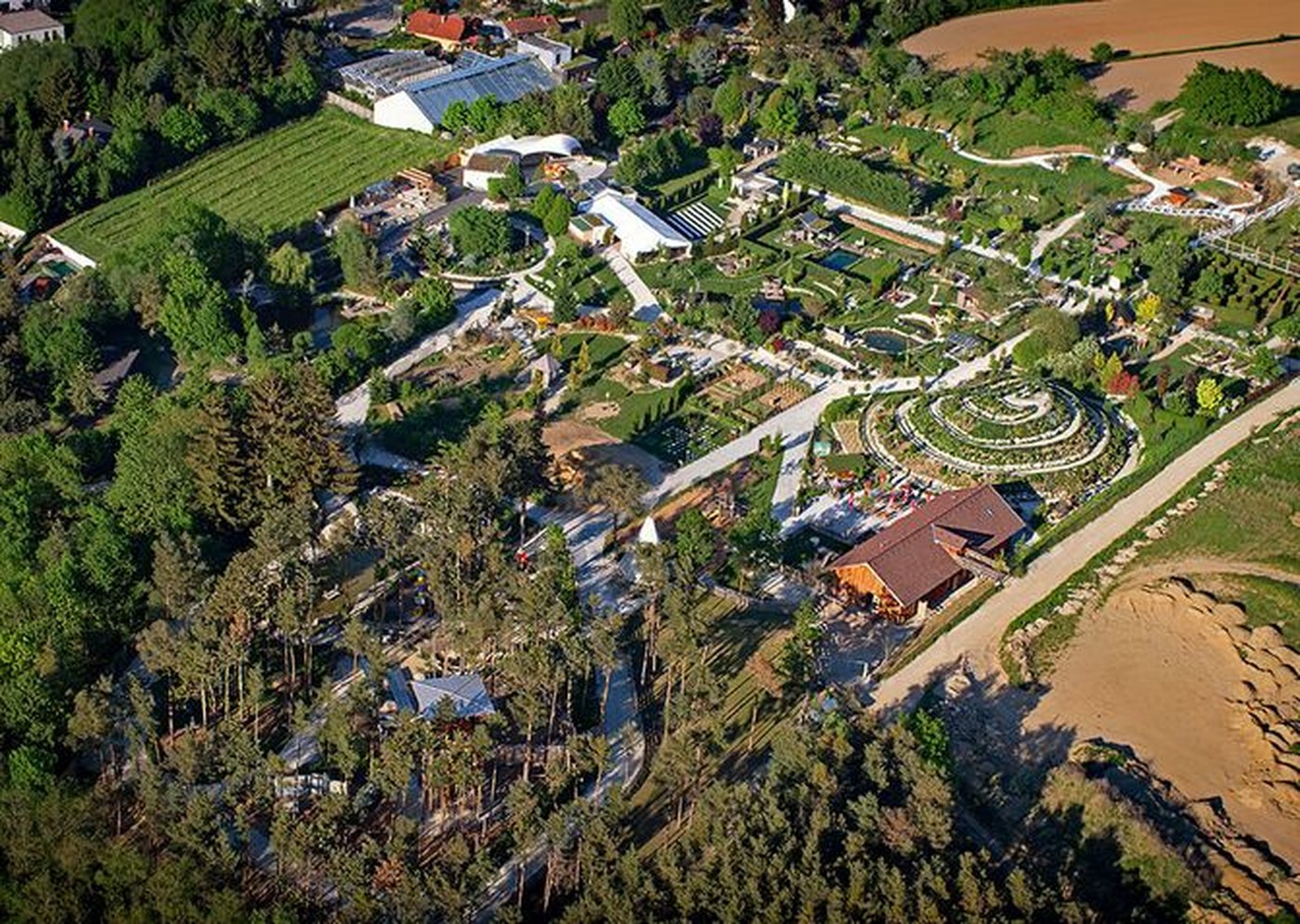
六万平方米、五十个主题园
今天的规模是 6 万多平方米、50 个主题园。逐年扩的过程在站上的年表里有:2011 年加 9,000 平方米并建起玻璃屋餐厅,2012 年再加 4 个园子,2020 年一年就做了 8 个新园子——那年是停摆的一年,空出来的时间全用在这上面了。
6 万平方米这个数字也有过别的说法。Natur im Garten 的介绍页把它写成 6 个公顷,那是把示范园本身当成起点的旧数字;年表记的是 2019 年扩了 10 个主题园之后达到 6 万平方米并稳定至今。按站上现行说法,50 个主题园由 Reinhard Kittenberger 和员工按 Natur im Garten 的标准打理,该组织自 2000 年起就是这个园子的成员。
园子的骨架是按主题划的:玫瑰园、蔬果园、自然园、药草园,以及亚洲园和「心愿之园」这一类。冬天还有一段完全不同的时段——每年 11 月初到 1 月上旬,园子变成圣诞灯光的节庆园,用 60 多万盏灯铺开,是园子一年里最忙的季节之一。这一段 2003 年办起来的时候,只是把淡季硬做成了旺季,后来成了公司最成功的概念之一。
设施上的几条硬规定写得很明确:3 月 14 日到 10 月 31 日每天开放,周一至周六 9 到 18 点,周日和节假日 10 到 17 点;园内所有主路无障碍;狗要牵绳,但整个冒险乐园范围内不许带狗;自行车、轮滑鞋、滑板车和球类在园内禁止使用。园内不提供游泳的地方,虽然那里有真正的天然泳池主题园。成人门票 15.50 欧元,儿童 8 欧元,园艺中心和玻璃屋餐厅免费进。
药草螺旋:站上最硬的一组数字
园子里最有名的是药草螺旋。旧版文章给了一组尺寸:直径 40 米、高 9 米、路径网络 400 米、约 3,000 株植物、400 多种药用植物与香草。这个说法能在外部对上——Langenlois 市的药草节页面给出的是九米高、400 种药用植物、400 米步道网络、约 3,000 株植物,和旧文一致。不过「世界上最大的药草螺旋」和「欧洲最大的药草螺旋」两种说法在外部资料里都能见到,Langenlois 市写的是「世界最大的药草螺旋」,Natur im Garten 写的是「欧洲最大的」,站上年表则记 2012 年那一年是打破世界纪录开园。这三个说法不能互相替换,这里只写能与外部资料核对的尺寸与数量。
这个园子的结构本身要说清楚:药草沿一座丘向上盘绕,两条主要路径一条从下往上、一条从上往下,永远不会相遇。走到坡顶可以按「病症分区」去找哪种香草对哪类不适。螺旋底部两个入口各放着一本香草书。
与它配套的还有每年 5 月中旬的药草节,整整两天,两天里全园只讲香草这一件事,内容包括闻香、尝味,以及怎么用香草入菜、调香膏和做香束。
动物与家庭那一半
冒险乐园是这个园子的另一半招牌,2015 年扩到 13,000 平方米,包含超大滑梯塔、漂流、攀岩墙、技巧路线,以及自己的「动物农园」。动物名单这几年一直在加:羊驼、矮种马、山羊、侏儒山羊、骆马、美洲驼(2024 年新增两只)和卡美隆羊。2024 年还新开了欧洲第一条花车踏板赛道。
动物农园有专门的「狗餐厅」,狗可以在那里吃食。狗在园里牵绳是欢迎的,唯独冒险乐园那片不许带,理由写得很直白:那里孩子的安全优先。
园子的规模换算成人数大致是这样:2006 年首次超过 6.5 万人次;2010 年 7 万;2016 年 16.7 万;2019 年 18.7 万;2022 年 40 周年时接近 19 万,是疫情这几年的最好成绩。
它其实是家造园的公司
容易忽略的一点是:造园子是这家公司的主营业务,开放参观只是副业。Reinhard Kittenberger 1986 年就是奥地利天然泳池建造的先行者之一——他试着在小生境里能不能游泳,由此做起了天然泳池业务。站上年表里 2019 年的数字是:设计团队约 70 人,一年完成约 300 个花园项目,其中约 100 个是天然泳池,自成立以来累计建成约 2,500 个泳池与天然水池。
公司规模也一路跟着长:2020 年约 130 名员工、14 个花园设计团队;Natur im Garten 的介绍页给的数字是 2025 年超过 160 名员工、总面积超过 30 公顷——这里的 30 公顷是包括苗圃和生产基地在内的整个公司面积,不是对外开放的 6 万平方米园子。这两个数字不矛盾,但不要混用。
2014 年他和园艺技术员们一起做出了 Nano.Schwimmteich,自称是最小的泳池——10 平方米水面起就能游泳,最小的园子也能变成私人度假地。2019 年公司拿到 Galabau Award 园艺景观奖,2023 年再得一次,2024 年拿了四项。2022 年 Reinhard Kittenberger 个人获下奥地利州旅游奖。
2022 年底他在园子的南端实现了自己的心愿,开了一家住宿:20 栋木屋,四种样式,40 到 80 平方米,配一个带接待、会议室和地方产品市场的主楼。每栋木屋有单独通道直通园子的核心——一个 3,400 平方米的园中湖,各自还配一块专门营造的主题园。从 2022 年 11 月起他本人在那里接待客人。他自己给这件事起了个双关的说法:于是成了 Kitten(beher)berger。
A garden that began with 3,000 square metres
Kittenberger Erlebnisgärten sits in Schiltern near Langenlois, in the Krems district of Lower Austria, tucked between vineyards in the rolling hills. What it is today and that 1977 land purchase are joined by an almost unbroken forty-year line.
The founder, Reinhard Kittenberger, was born in 1961 and knew in the family’s vegetable garden what he wanted: “When I grow up I will be a gardener.” He started at the Langenlois horticultural trade school in 1976, bought his first plot in 1977 — 3,000 square metres for 70,000 schillings — qualified as a horticultural skilled worker in 1979, registered the first tax number for an agricultural tree nursery in 1980, and took on his first paid garden design commissions for friends and acquaintances in 1981. The first plants sold over the counter went out in the summer of 1982, still working with his father Manfred. In 1984 he opened his own nursery and went properly independent.
1986 was the turning point. He passed the master craftsman examination as a landscape gardener, with garden design and floristry as secondary subjects, and got his licence to design gardens. That same year his brother Christian took over the tree nursery so he could concentrate on design. The company took on its first employee outside the family in 1987, and through the 1990s he began hiring garden technicians so that design was no longer his alone.
1996 brought the idea. After study trips to the Netherlands and England he opened his own show garden, the Waldviertler Heidegarten, and garden tourism began. Five more show gardens followed in 1997, in a year when his brother also left the company and the next few years were difficult.
In August 2002 the century flood almost destroyed the whole site. A mudslide took most of it, and employees, family and the state of Lower Austria stood beside him as the company was rebuilt. In 2004 the company completed 200 design projects for the first time; the same year his father was killed in a car accident. In 2005 the show garden doubled from 10,000 to 20,000 square metres, and the company took on what was then its largest commission: the gardens of Stift Altenburg, Rosenburg castle and the Amethyst World in Maissau, recast together as a single Kampal project.
The site publishes the full postal address, telephone, fax, email, register number and tax number. None of that is reproduced here; the site’s visitor information is the place to look.
Six hectares, fifty theme gardens
Today the site covers more than 60,000 square metres and holds 50 theme gardens. The year-by-year expansion is on the site: 9,000 square metres added in 2011 along with the Glas.Haus glass restaurant, four more gardens in 2012, and eight new gardens in a single year in 2020 — the year of the shutdown, when the empty months went into building.
The 60,000 square metre figure has had rival versions. The Natur im Garten profile gives it as 6 hectares, which is the older number counting the show gardens alone from the starting point; the chronology records the site reaching 60,000 square metres in 2019 after adding ten theme gardens, and staying there. Under the current site wording, the 50 theme gardens are tended by Reinhard Kittenberger and his staff to Natur im Garten standards, and the organisation has been a member here since 2000.
The gardens are laid out by theme: rose gardens, vegetable gardens, nature gardens, herb gardens, an Asian garden, a garden of longing, and so on. Winter brings an entirely different season: from early November to early January the site becomes its Christmas garden, strung with more than 600,000 lights, and it is one of the busiest stretches of the year. That programme started in 2003, when the company turned its slowest months into its busiest; it has since become one of its most successful concepts.
A few rules are stated firmly. Open daily 14 March to 31 October, Monday to Saturday 9 to 18, Sunday and holidays 10 to 17. All main paths are step-free. Dogs are welcome on a lead, except anywhere in the adventure playground. Bicycles, inline skates, scooters and ball games are not allowed anywhere on the site. There is no swimming in the gardens, even though there is a genuine natural-pool garden there. Adult entry is EUR 15.50, children EUR 8, and the garden centre and the Glas.Haus restaurant are free.
The herb spiral
The best-known feature is the herb spiral. The old version of this article gave a set of dimensions: 40 metres across, 9 metres high, a 400 metre path network, around 3,000 plants, more than 400 medicinal plants and herbs. That checks out externally — the Langenlois herb festival page gives nine metres high, 400 medicinal species, a 400 metre path network and some 3,000 plants. The claim about size has three versions in circulation: Langenlois calls it the largest herb spiral in the world, Natur im Garten calls it the largest in Europe, and the site’s chronology records a world record being set when it opened in 2012. Those are not interchangeable, so only the verifiable dimensions and counts are given here.
The structure itself is worth describing. The herbs wind up a hill in a spiral, with two main paths, one running up and one down, that never meet. From the top you can follow the “ailments” sections to see which herb grows where for which complaint. A herb book waits at each of the two entrances at the foot.
The season around it is the herb festival in mid-May, two full days given over entirely to herbs — smelling them, tasting them, and learning to cook with them, make salves and tie herb bundles.
Animals, and the half for families
The adventure playground is the other half of the site’s reputation. It was extended to 13,000 square metres in 2015 and now has a large slide tower, rafting, a climbing wall, an obstacle course and its own animal farm. The animal list has kept growing: alpacas, ponies, goats, dwarf goats, llamas and Cameroon sheep, with two more llamas joining in 2024. That year also brought Europe’s first flower-cart pedal go-kart track.
The animal farm has its own dog bistro where dogs can be fed. Dogs on a lead are welcome across the gardens; the adventure playground is the single exception, and the reason is stated plainly: children’s safety comes first there.
Converting the site’s size into visitor numbers, roughly: first time past 65,000 in 2006; 70,000 in 2010; 167,000 in 2016; 187,000 in 2019; and close to 190,000 at the 40th anniversary in 2022, the best result of the pandemic years.
It is really a garden-building company
One thing is easy to miss: building gardens is this firm’s actual business, and opening to visitors is the sideline. Reinhard Kittenberger was one of the pioneers of swimming pond construction in Austria in 1986 — he experimented with small biotopes to see whether a person could actually swim in one, and that became a swimming pond business. The chronology’s 2019 figures: around 70 people in the design team, some 300 garden projects a year, of which about 100 are swimming ponds, and roughly 2,500 ponds and natural pools built since the company began.
The company has grown with it: about 130 employees and 14 garden design teams in 2020; the Natur im Garten profile gives more than 160 employees and a total area of over 30 hectares by 2025 — that 30 hectares covers the tree nursery and production grounds as well as the visitor gardens, not the 60,000 square metres open to the public. The two figures do not conflict, but they should not be used interchangeably.
In 2014 he and his garden technicians developed the Nano.Schwimmteich, claimed to be the smallest swimming pond — a water surface of 10 square metres is enough to swim in, so even the tiniest garden can become a private holiday resort. The company took the Galabau Award in 2019, again in 2023, and four times over in 2024. Reinhard Kittenberger himself received the Lower Austrian Tourism Prize in 2022.
At the southern end of the gardens he realised a long-held wish in late 2022 and opened accommodation: 20 chalets in four styles, 40 to 80 square metres each, plus a main house with reception, a meeting room and a regional produce market. Every chalet has its own path straight to the heart of the site, a 3,400 square metre garden lake, and a themed garden of its own. Since November 2022 he has greeted the guests there himself, which is where the site’s own pun on his name comes from: he became Kitten(beher)berger.
相关文章:
 奥地利 下奥地利州园丁协会 NÖ Gärtner – 250 余家商业苗圃的行业团体
 奥地利 格罗绍尔 Grossauer 景观规划事务所 – 20 余年景观与开放空间规划
 德国 Park der Gärten – 德国规模最大的主题花园园区之一杜鹃特色收藏
 美国 威斯康星州麦迪逊香草协会 Madison Herb Society 威斯康星州香草爱好者组织 – 行业自律与服务组织
 德国 黑森林国家公园 Nationalpark Schwarzwald – 巴登州首家国家公园
 丹麦 Lille Malunds Have 花园 – 欧洲日德兰中部典型的英式家庭花园
 英国 Great British Gardens – 英国最大花园导览资源门户
 德国 枯山水博客 Zengärten – 德国枯山水门户与图片廊
发表回复