
协会概况
国际无性繁殖园艺植物育种者社区 (CIOPORA, 全称 Community of Breeders of Asexually Reproduced Horticultural Plants) 是无性繁殖观赏及果树植物育种者的全球行业组织,成立于 1961 年,总部依据瑞士法律注册于日内瓦,并在德国汉堡设立行政办公室。协会把分散在不同国家的育种企业、育种者协会、植物知识产权专业人士和顾问集合在一起,共同推动植物品种保护 (Plant Variety Protection, 简称 PVP) 体系的完善与协调。
CIOPORA 在欧洲共同体植物品种办公室 (CPVO) 和国际植物新品种保护联盟 (UPOV) 均持有观察员席位。这种身份让协会能够直接向 UPOV 体系下的成员国、海外品种保护主管机构以及欧盟层面的政策制定者递交意见,反映无性繁殖作物育种者的具体诉求。
主要职责
协会的核心任务是保护与促进植物育种创新,把分散的产业诉求转换成可执行的政策建议。具体工作归纳为五个方向:(一) 政策与立法咨询,向各国政府部门、UPOV 和 CPVO 提供无性繁殖作物相关的立法、执法建议;(二) 行业教育,通过 CIOPORA Academy 项目系统培训园艺价值链上的从业者理解植物 IP;(三) 利益代表,在国际组织、政府部门和行业协会面前代表无性繁殖作物育种者发声;(四) 项目协调,牵头执行会员关心的执法、行业协调与商业拓展项目;(五) 监测与沟通,持续跟踪植物 IP、生物技术与生物多样性领域的全球动态,并通过协会内部刊物向会员通报最新趋势。
协会的官方刊物《CIOPORA Chronicle》以及各类立场文件 (Position Papers),是其面向会员和公众的主要信息通道。
组织结构
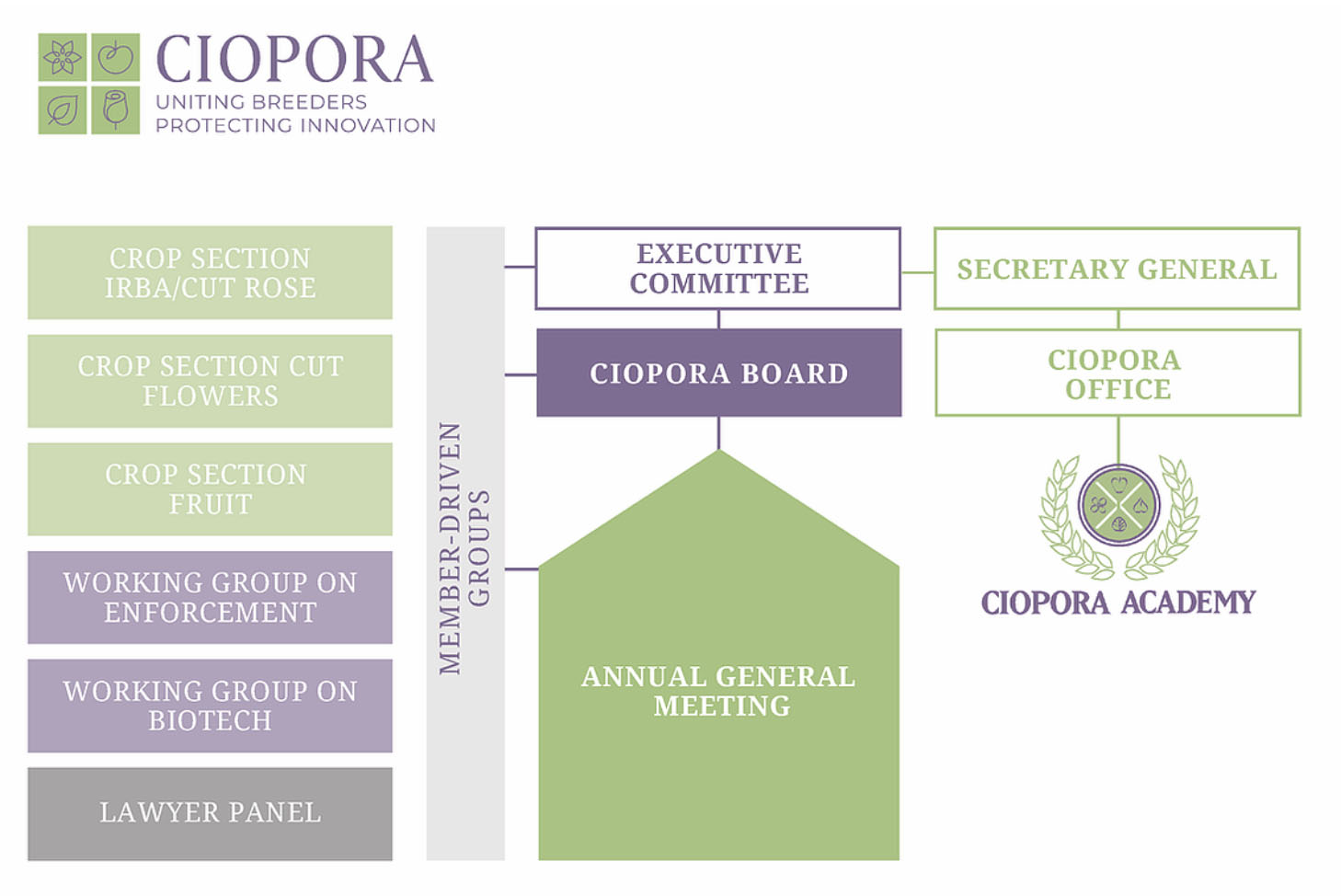
CIOPORA 依据瑞士法律注册成立,日常事务由设在汉堡的 CIOPORA Office 执行,秘书长 (Secretary General) 主持日常运营。最高决策机构为每年召开的全体会员大会 (Annual General Meeting, 简称 AGM),由会员审议重大事项并选举理事会成员。协会理事会是成员大会的执行机构,设会长 (President) 与副会长 (Vice-Secretary General) 各一名。
协会下设作物分会 (Crop Sections) 和工作组 (Working Groups),针对不同作物种类和行业议题开展专项工作。作物分会覆盖:切花玫瑰 / IRBA 切花月季与玫瑰分会、切花 (Cut Flowers) 综合分会、果树 (Fruit) 分会。工作组包括执法 (Enforcement) 与生物技术 (Biotech) 两大主题方向。法律相关事务则由律师小组 (Lawyer Panel) 集中处理,会员中的 IP 法律专家以志愿身份参与。所有上述机构均由会员 (Member-driven) 直接驱动,普通会员可通过加入相关工作组参与特定议题讨论。
协会的章程 (Bylaws) 是治理的根本文件,2019 年 4 月发布了最新修订版,可从协会网站下载查阅。
教育与会员项目
CIOPORA Academy 是协会专门为园艺从业者打造的植物知识产权教育平台,采用线上与线下相结合的形式,围绕植物品种保护法、执法实务、商业化授权等主题开设系统课程与短期工作坊。会员参加协会所有教育活动均可享受五折优惠。
协会还定期举办年度全体大会 (AGM)、国际研讨会和中期会议 (Midterm Meeting),为育种者、IP 从业者、学者与政策制定者提供对话平台,讨论植物 IP 的现状与未来方向。AGM 在不同大洲轮流主办,既是会员社交网络的核心节点,也是行业趋势发布的窗口。
为何关注 CIOPORA
植物育种是一项长期且高成本的工作,培育一个新品种常常需要十年以上的时间与持续投入。育种者只有获得清晰、稳定的植物品种权,才能回收前期投入并继续投入下一步研发。无性繁殖作物 (主要是观赏植物、果树与部分蔬菜) 由于品种繁殖特性不同于种子作物,品种权保护在国际植物 IP 体系中具有自身的复杂性。CIOPORA 正是围绕这些复杂性而成立的行业自律平台——它在育种者与政策制定者之间搭桥,并通过 CIOPORA Academy 把 IP 知识系统传递给整个园艺价值链。
对于育苗企业、园艺品种代理商、家庭园艺从业者,理解 CIOPORA 的工作与立场有助于把握观赏植物 IP 政策走向、跟踪行业重点议题的演变。
Association Overview
The International Community of Breeders of Asexually Reproduced Horticultural Plants (CIOPORA) is the global industry association for breeders of asexually reproduced ornamental and fruit crops. Founded in 1961, it is registered in Geneva, Switzerland under Swiss law, with its administrative office based in Hamburg, Germany. CIOPORA brings together breeders, breeder associations, plant intellectual property experts, and consultants to advance and harmonise Plant Variety Protection (PVP) systems worldwide.
CIOPORA holds observer status at the Community Plant Variety Office (CPVO) and at the International Union for the Protection of New Varieties of Plants (UPOV). Through these seats, the association channels the views of breeders of asexually reproduced crops into legislative processes at both the European Union and the UPOV member-state levels.
Core Activities
CIOPORA’s mission is to protect and promote innovation in plant breeding by strengthening PVP systems. Its work spans five pillars: Policy and legislative advice, where CIOPORA advises governments, UPOV, and CPVO on laws and enforcement that affect asexually reproduced crops; Education, delivered through the CIOPORA Academy, which trains the horticultural value chain on plant IP; Representation, voicing breeder interests before international organisations, governments, and industry groups; Project coordination, running member-driven projects on enforcement, coordination, and business development; and Monitoring and communication, tracking global developments in plant IP, biotechnology, and biodiversity and reporting them via The CIOPORA Chronicle and Position Papers.
Organisation and Structure
CIOPORA is registered in Geneva and run from its administrative office in Hamburg under the leadership of the Secretary General. The supreme authority is the Annual General Meeting (AGM) of members, which elects the Board that governs the association’s affairs between meetings and is chaired by the President.
Member-driven working units form the operational backbone. The Crop Sections cover: IRBA / Cut Rose, Cut Flowers, and Fruit. The Working Groups focus on Enforcement and Biotech. Plant IP legal matters are handled by the Lawyer Panel, where member lawyers and IP attorneys contribute on a voluntary basis. Any member may join the relevant Working Group or Crop Section to engage with a specific topic or crop.
The association is governed by its Bylaws, last updated in April 2019 and available for download from the official site.
Education and Member Programmes
The CIOPORA Academy is the association’s dedicated education programme on plant intellectual property, combining online webinars and in-person workshops around PVP law, enforcement practice, and commercialisation. Members receive a 50% discount on all CIOPORA education offerings.
Beyond the Academy, CIOPORA hosts the Annual General Meeting (AGM), international congresses, and midterm meetings. These convenings rotate among different regions and serve as the principal venues for breeders, IP practitioners, academics, and policymakers to exchange views on the status and future of plant IP.
Why CIOPORA Matters
Plant breeding is a long, capital-intensive process — bringing a new variety to market often requires more than ten years of focused effort. Breeders can only recoup such investment and fund the next cycle of innovation when plant variety rights are clear, enforceable, and harmonised across markets. Asexually reproduced crops (mainly ornamentals, fruit crops, and some vegetables) face protection challenges distinct from seed-propagated crops, and CIOPORA exists precisely to address this gap. Through its policy work and its Academy, CIOPORA both narrows the gap between breeders and regulators and channels plant-IP literacy down through the horticultural value chain.
For nurseries, plant variety agents, and home-garden professionals, tracking CIOPORA’s positions and events provides an early read on where ornamental plant IP policy and industry priorities are heading.







发表回复