
历史沿革
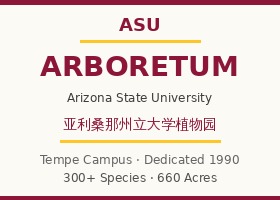
亚利桑那州立大学植物园(Arboretum at Arizona State University)的历史可上溯至 1920 年代,首任校长 Arthur John Matthews 聘用了校园第一位景观设计师,开启了长达 90 年的”孕育期”;1990 年 11 月 20 日,在时任校长 Lattie F. Coor 与多位生命科学教授共同出席的植树仪式上,整个坦佩(Tempe)校园被正式命名为一座植物园;2008 年,亚利桑那州立大学获 Arbor Day Foundation 授予 “TREE CAMPUS USA” 称号,并成立由师生员工与社区成员组成的 Tree Advisory Committee,统筹全校园木调查、补植与科普工作。
园区布局与位置
植物园分布于亚利桑那州立大学坦佩校区约 660 英亩的开阔地上,植物沿步道、广场与教学楼之间自然铺开,游客可从周边城市街道直接进入,免费参观;核心园区是位于 Tempe Butte 北坡、靠近 Desert Financial Arena 的”沙漠植物园公园”(Desert Arboretum Park),占地约 2.5 英亩,汇集索诺兰(Sonoran)、莫哈韦(Mojave)、奇瓦瓦(Chihuahuan)三大北美沙漠的原生植物,设有四口实验水塘与”Urban Forestry”雕塑(由雕塑家 Joe Tyler 与 Scott Cisson 捐赠);学生服务中心北侧的香草园(Arboretum Herb Garden)由志愿者维护,所产罗勒、薄荷、番茄通过 ASU 本地食物计划供应校内食堂。
植物收藏与特色
园区现有植物 300 余种,以适应干旱环境的乔灌木为主,既包括索诺兰沙漠的本土仙人掌、龙舌兰与牧豆树,也收集了来自地中海、中东等世界干旱区的耐旱物种;馆藏亮点是位于 Polytechnic 校区 Upton Avenue 一带的枣椰种质库(Date Palm Germplasm),共 137 株、涵盖 Medjool、Kadrawy、Braim、Hayany、Zahidi 等 40 多个椰枣品种,是全美四大椰枣种质库之一,也是美国本土最大的公开收藏;植物园还登记加入北美植物收藏联盟(North American Plant Collections Consortium)与美国公共花园协会(American Public Gardens Association),与全美同行共享种子库、栽培记录与种质资源。
教育与社区
植物园是亚利桑那州立大学的户外课堂,直接服务于生命科学学院的园艺、植物学、景观建筑等课程;每年秋季的椰枣采摘活动可收获近 3000 斤新鲜椰枣,果实部分在校内销售、部分供学校餐厅与节庆市集使用,学生同时可参与校园香草园(Local Foods Initiative)的种植与收获;校方与亚利桑那州原生植物学会(Arizona Native Plant Society)长期合作开展生物多样性监测,校方生命科学学院的标本馆也参与其中,使物种清单与本土保育工作持续更新。
认定与公共服务
植物园由学校设施管理处下的 Ground Services 部门运营,资金来源包括设施管理处拨款与 Friends of the Arboretum(ASU 基金会附属基金)的社会捐赠及专项研究经费;校方提供 “Arboretum Tree Tour” 移动端自助导览,整个园区对公众免费开放,配有无障碍停车位与无障碍步道;植物园还承接校园环保日、地球日、园艺工作坊与对外学术研讨会,志愿者项目因制度更新已暂缓,但捐款页面与信息订阅保持活跃。
History
The Arboretum at Arizona State University traces its roots to the 1920s, when then-President Arthur John Matthews hired the campus’s first landscape architect, beginning a roughly 90-year gestation period; on November 20, 1990, then-ASU President Lattie F. Coor, together with life sciences faculty, formally dedicated the entire Tempe campus as an arboretum during a commemorative tree-planting ceremony; in 2008, ASU received the “TREE CAMPUS USA” designation from the Arbor Day Foundation and established a Tree Advisory Committee comprising students, faculty, staff, and community members to oversee tree inventories, plantings, and outreach.
Landscape and Layout
The arboretum is integrated across roughly 660 acres of ASU’s Tempe campus, with plantings distributed along walkways, plazas, and between buildings rather than enclosed within a single boundary, and visitors can enter directly from surrounding city streets at no charge; the central landscape is the 2.5-acre Desert Arboretum Park, set against Tempe Butte north of the Desert Financial Arena, featuring native flora from the Sonoran, Mojave, and Chihuahuan deserts, four experimental ponds that simulate arid-zone riparian conditions, and a recycled-steel sculpture titled “Urban Forestry” donated by sculptors Joe Tyler and Scott Cisson; the Arboretum Herb Garden on the north end of the Student Services Building is maintained by volunteers and integrated with ASU’s Local Foods Initiative to supply basil, mint, and tomatoes to campus dining.
Plant Collections
The collection includes more than 300 species, with an emphasis on drought-tolerant trees and shrubs suited to the arid Southwest, pairing native Sonoran Desert plants—cacti, agaves, and mesquites—with dryland species from Mediterranean and Middle Eastern regions; the signature feature is the Date Palm Germplasm repository on the Polytechnic campus, comprising 137 specimens of more than 40 cultivars including Medjool, Kadrawy, Braim, Hayany, and Zahidi, one of only four date palm germplasm collections in the United States and the largest open to the public; the arboretum is registered with the North American Plant Collections Consortium and the American Public Gardens Association, sharing germplasm, cultivation records, and conservation practices with peer institutions.
Education and Community
The arboretum functions as a living outdoor classroom for the School of Life Sciences, supporting courses in horticulture, botany, and landscape architecture; each fall, ASU holds a date palm harvest that yields close to 3,000 pounds of fresh dates—one of the largest harvests in any public garden in the United States—with fruit sold on campus and supplied to university dining and seasonal markets, while students engage with the Local Foods Initiative through the Herb Garden, working the beds from planting to harvest; the arboretum has collaborated with the Arizona Native Plant Society on biodiversity monitoring since the early 2000s, with the university’s herbarium contributing to species surveys and conservation planning.
Recognition and Public Access
The arboretum is managed by the university’s Facilities Management Ground Services department and funded by Facilities Management, Grounds Services, and the Friends of the Arboretum, an ASU Foundation affiliate fund that accepts public donations; visitors can explore the arboretum through a mobile-friendly self-guided Arboretum Tree Tour that highlights labeled specimens across the campus, with all sites open to the public daily without charge and supported by accessible parking and step-free pathways; the arboretum regularly hosts Earth Day events, sustainability workshops, and academic symposia, and although volunteer intake is currently paused for policy updates, donations and mailing-list sign-ups via the Friends of the Arboretum remain active.




发表回复