

采石场上的百年老地
这座园子的地,原先是采石场。砂岩一直采到 1870 年前后,石头砌进了城里不少房子。采石场停工后,从 1880 年起这里变成庄园公园;约 1890 年起,庄园主之一、银行家 Karcher 请法兰克福的园林设计师 Siesmayer 按英式手法重整,园中建有温室、观景塔和一间新艺术风格的大厅。
纳粹当政期间,庄园主一家被没收产业,整块地交给当地一家棉纺厂。1939 至 1945 年的空袭把两栋别墅连同公园夷为平地。1980 年纺织厂破产后,市政府接手此地,改成劳特河谷公园开放,但少人管理,慢慢荒了下来。
1996 年,市里为日式庭园选定了这块地。看中的就是它剩下的一百多年老树和起伏地形。原有的砂岩露头与部分原生植被直接留进了新园,不必重新堆山。如今这块地约一万三千六百平方米,维基百科记作一万三千五百平方米;园方和市政资料都把它称作德国最大的日式庭园,在欧洲也算得上最大的几座之一。
一纸承诺换来一座园子
更早的起点是城市间的伙伴关系。1988 年,凯撒斯劳滕与东京的文京区开始结对。1993 年代表团访问文京区时,市长 Gerhard Piontek 当场表示,作为回礼,凯撒斯劳滕要建一座日本庭园。当时列入考虑的还有城市公园和市民公园。
1995 年,市政绿化部门负责人 Volker Menzel 提议用采石场旧址作园址。1996 年,这座日式庭园被写进「劳特河谷绿色走廊」规划,成为 2000 年州级园艺展的规划基础。1997 年,协会「凯撒斯劳滕日本庭园之友」成立,Menzel 当选首任会长,第一批设计构想同时出炉;1998 年开工,日本建筑师 Kunihiko Akamatsu 参与方案细化。
1999 年,协会会员已超过五百人,网站也在这年上线。2000 年,建了两年半之后第一期工程完工,园子开放。全园规划分五个阶段推进,总建设投入约三百万欧元;规划、施工管理与建筑设计都由协会成员无偿完成。
三种基本形式与水景
园子里集齐了日本庭园的三种基本形式:池庭、以枯山水为代表的观赏庭园和茶庭。水是贯穿全园的主线。地势落差二十米,所以园中套园;谷底一段照应日本的海与湖,山坡那侧则越来越野,接近山中的样子。
路网不设直线轴线,也不用对称,主路是一圈环线,走几步景色就换一次。踏石、天然石阶、盘曲的小径和一座刷成日本红的木桥串起园中路径;上池水面上的踏石,2019 年换成了十二米长的木制之字桥。连接两个池庭的谷路做到了无障碍。
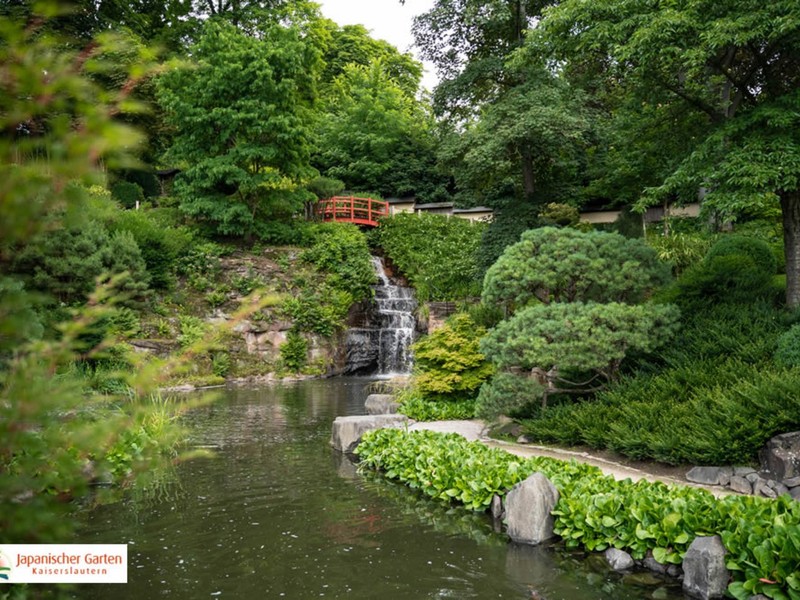
入口是一道五米高的朱红鸟居,2020 至 2021 年整修过一遍。按神道说法,鸟居标示从日常世界跨进神圣之地的一步。上池约有二百五十尾锦鲤,另有一座用三株松树盆景表示的鹤岛,象征的是不朽;岸边靠石组、芦苇和低垂的树枝接进园景,视线则被引向茶室。下池边立着一道约十二米高的瀑布,红桥上是俯看这片水面最好的位置——这座桥用花旗松木做成,2011 年翻新过一次,2022 年又整修了一轮。
山庭、枯山水与老树
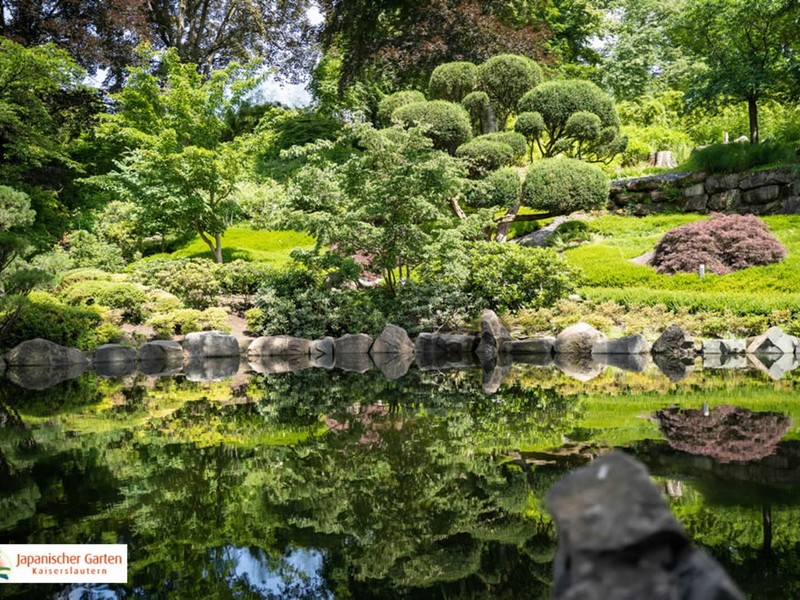
山庭「筑山」用精心布置的石组、杜鹃矮林、低矮竹子和成片修剪的黄杨做出山势,2007 年建成。一条石板拼成的干流从山谷流下,越过一道想象中的瀑布汇入上池,水在这里只留了抽象的痕迹。枯山水取自京都龙安寺的石庭样相:那座石庭建于 1577 年,耙平的砂砾代表水,苔庭则象征日本这座海中的绿色山岛。这座枯山水 2004 年落成,缩小成微缩景观,由一道矮墙围住,只能从外面看。
园里的老树基本保住了:一百多年的山毛榉、雪松和红豆杉,另有悬铃木、枫香和榛树,还有一株很大的银杏。新栽的部分以远东树种和竹子为主。修剪走的是日本做法,从地景造型松、云形修剪到成片块面修剪都有。
造园的想法也写在这些做法里:把风景当画来布局,细节只留必要的部分;神道、禅与道家的想法都留在园子的秩序里。走在园中,感觉像是穿过一幅风景画——这不是巧合,日本庭园本来就是被刻意安排的自然。
协会、门票与到访
园子由「凯撒斯劳滕日本庭园协会」(Japanischer Garten Kaiserslautern e.V.)运营,董事会全部志愿任职。会员从最初的十八人增长起来,园方的编年史记着 2005 年时已经超过八百人。日常开销靠会员费、门票、捐款和赞助自己周转;园地由市政府出借,租期先定三十年,与市里是公私合办的关系。日本驻法兰克福总领事馆、莱茵-内卡德日德协会、莱茵 TÜV 等机构也出力支持。
会员年费按身份分档,二十五到一百欧元不等:青少年、在训学员、学生、失业者二十五欧元,六十五岁以上三十欧元,个人和六十五岁以上的夫妇五十欧元,家庭、夫妻或同居伴侣六十欧元,公司、社团、政党等团体一百欧元。会员免门票,在商店和 Bunkyo-an 小吃摊还有折扣。普通门票六点五欧元,优惠票五点五欧元,十一岁及以下儿童免费;冬天票价降到五点五欧元,优惠票四点五欧元。
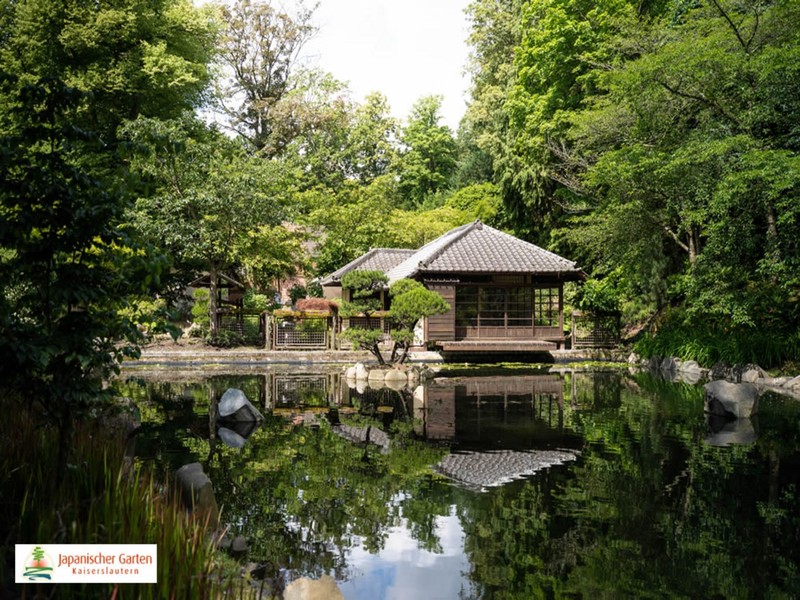
开放时间分三段:三、四月和十月十点到十八点,五月到九月延到十九点,十一月至次年二月是十点到十六点,最后入场十五点半,周一闭园(节假日与调休补班日除外)。导览从三月初到十月底,接待不超过二十五人的团体,需提前三到四周预约,也可以安排英语讲解。园子常年办各种活动:花见、七夕、赏月夜、茶道、太鼓、角色扮演日、森林散步、读书漫步、瑜伽和摄影。茶室原是 1900 年前后东京某座公园里给外宾和外交官用的客舍,1983 年被一位德国私人买家买下,拆运回德国重建,2003 年市政买下并在上池边重新搭建,2005 年开放。2017 年新开的 Bunkyo-an 小吃摊供应日式餐食;2019 年园子还与文京区的 Higo-Hosokawa 庭园签下园际伙伴关系。
A quarry that became a garden
The land under this garden was once a quarry. Sandstone was cut here until about 1870, and the stone went into a good share of the town’s buildings. After the quarry closed, the site became a villa park from 1880; from around 1890 the banker Karcher, one of the villa owners, had the Frankfurt landscape architect Siesmayer lay it out as an English-style park, with a greenhouse, a lookout tower and a hall finished in the Art Nouveau manner.
Under the Nazi regime the family that owned the estate was expropriated, and the property passed to a local spinning mill. Allied bombing between 1939 and 1945 destroyed both villas and the park. When the mill went bankrupt in 1980, the city took the site over and opened it as the Lautertalpark, but with little attention it was allowed to fall into neglect.
In 1996 the city picked this site for its Japanese garden, precisely because of the trees more than a century old and the varied topography. Sandstone outcrops and part of the original vegetation were built into the new garden instead of being recreated. The site covers roughly 13,600 square metres – Wikipedia records 13,500 – and the garden’s own site and the city both describe it as the largest Japanese garden in Germany, while Wikipedia counts it among the largest in Europe.
From a promise in Tokyo to an opening day
The story starts earlier, with a partnership between two cities. In 1988 Kaiserslautern began twinning with Bunkyo-ku, a district of Tokyo. When a delegation visited Bunkyo-ku in 1993, mayor Gerhard Piontek promised on the spot that Kaiserslautern would build a Japanese garden in return. The city park and the people’s park were both discussed as possible sites at the time.
In 1995 Volker Menzel, head of the city’s green spaces department, proposed the old quarry site. In 1996 the Japanese garden became part of the Green Ribbon development concept for the Lauter valley and formed the planning basis for the 2000 state garden show. In 1997 the association Friends of the Japanese Garden Kaiserslautern was founded, Menzel was elected its first chairman, and the first design concepts were drawn up. Construction began in 1998, with the Japanese architect Kunihiko Akamatsu helping to refine the plans.
By 1999 the association already had more than five hundred members, and the website went online that year. In 2000, after two and a half years of building, the first of five planned sections was finished and the garden opened. The whole project cost roughly three million euros, and planning, site management and architectural design were all done on an unpaid basis by association members.
Three classic garden types and the water
The garden brings together all three classic forms of the Japanese garden: the pond garden, the viewing or dry landscape garden, and the tea garden. Water is the running theme throughout. The terrain drops by twenty metres, so there are gardens within gardens; the valley section mirrors the seas and lakes of Japan, while the slopes grow wilder and more like mountain country.
There are no straight axes and no symmetry in the paths. The main route is a loop, and the view keeps changing as you walk it. Stepping stones over the water, natural stone steps, winding paths and a red wooden bridge make up the route system; the stepping stones on the upper pond were replaced in 2019 by a twelve-metre wooden zigzag bridge. The valley path linking the two pond gardens is barrier-free.
Entrance is through a five-metre torii gate in flame-red lacquer, renovated in the winter of 2020 and 2021. In Shinto tradition the gate marks the step from the everyday world into the sacred. The upper pond holds some two hundred and fifty koi, and an island marked out by three pine bonsai stands for the crane and for immortality; the shoreline is tied into the garden with rockwork, reeds and overhanging branches, and the view is directed towards the tea house. A waterfall about twelve metres high dominates the lower pond, and the red bridge is the best place to look down over the whole water scene – it is built from Douglas fir, was renewed in 2011 and overhauled again in 2022.
Mountain garden, dry landscape and old trees
The mountain garden in the Tsukiyama style builds up a stylised Japanese mountain landscape from carefully arranged rockwork, rhododendron thickets, low bamboo and box clipped flat in the Karikomi manner; it was completed in 2007. A dry river of slate slabs runs down into the valley and empties over an imaginary waterfall into the upper pond, so that water is left in abstract form. The dry garden follows the model of the stone garden at Kyoto’s Ryoanji temple, created in 1577, where the raked gravel stands for water and the moss garden for Japan, the mountainous green island. This version opened in 2004, reduced to a miniature, framed by a low wall and meant to be viewed from outside.
Most of the old trees were kept: copper beeches, cedars and yews over a century old, along with plane trees, amber trees and hazels and one very large ginkgo. Newly planted are Far Eastern tree species and bamboo. Pruning follows Japanese practice, ranging from landscape-style Niwaki pines and cloud pruning to flat clipped Karikomi masses.
The philosophy sits inside these techniques. A landscape is composed like a painting, with detail reduced to what is essential, and ideas from Shinto, Zen Buddhism and Taoism are worked into the order of the garden. Walking through it feels like moving across a landscape painting – not by accident, since a Japanese garden is deliberately shaped nature.
The association, tickets and visiting
The garden is run by the Japanischer Garten Kaiserslautern e.V., whose board serves on a voluntary basis. Membership grew from the original eighteen, and the association’s own chronicle records more than eight hundred members by 2005. The park pays its way from membership fees, admission, donations and sponsorship. The city leases the land, initially for thirty years, and the two are partners in a public-private arrangement. The Japanese Consulate General in Frankfurt, the German-Japanese Society Rhein-Neckar and TÜV Rheinland have also supported the project.
Membership fees are tiered by status, from twenty-five to one hundred euros: twenty-five for young people, trainees, students and the unemployed, thirty for people over sixty-five, fifty for individuals and for couples over sixty-five, sixty for families, married couples and unmarried partners, and one hundred for companies, clubs and parties. Members enter free and get discounts in the shop and at the Bunkyo-an snack kiosk. A standard day ticket costs six euros fifty, the reduced rate five euros fifty, and children up to and including eleven enter free; in winter the ticket drops to five euros fifty, or four euros fifty at the reduced rate.
Opening hours run in three blocks: ten to eighteen in March, April and October, ten to nineteen from May to September, and ten to sixteen from November to February, with last entry at half past three; Mondays are closed apart from holidays and substitute working days. Guided tours are offered from the beginning of March to the end of October for groups of up to twenty-five, and need to be booked three to four weeks ahead; English tours can be arranged on request. Events run all year: cherry blossom viewing, Tanabata, moon-viewing evenings, tea ceremonies, taiko drumming, cosplay days, forest bathing, reading walks, yoga and photography. The tea house was originally a guest house for foreign visitors and diplomats in a Tokyo park around 1900; a German private buyer bought it in 1983, had it dismantled and rebuilt in Germany, and in 2003 the city bought it and re-erected it beside the upper pond, where it opened in 2005. The Bunkyo-an kiosk serving Japanese food followed in 2017, and in 2019 the garden signed a partnership with the Higo-Hosokawa garden in Bunkyo-ku.
相关文章:
 德国 露地日本庭园 ROJI Japanische Gärten – 日本庭院设计建造遍及三洲
 德国 Park der Gärten – 德国规模最大的主题花园园区之一杜鹃特色收藏
 德国 柏林植物园 Botanischer Garten Berlin – 近两万种植物与分类研究
 奥地利 格拉茨大学植物园 Botanischer Garten Graz – 施蒂利亚州植物学教育与研究
 德国 埃尔兰根植物园 Botanischer Garten Erlangen – 百余年教学收藏与濒危种保护
 瑞士 圣加仑植物园 Der Botanische Garten St.Gallen – 瑞士植物多样性展示的代表性机构之一
 美国 圣地亚哥日本友谊花园 Japanese Friendship Garden – 加利福尼亚
 德国 北极高山植物园 Arktisch‑Alpiner‑Garten – 四千余种高山植物保育园
发表回复