

从祖母的野草篮子和一个跳蚤市场摊子开始
苗圃的主人叫 Daniel Rühlemann,德国下萨克森州霍尔施泰特(Horstedt)人,地方在汉堡和不来梅之间。他小时候跟着来自图林根的祖母采野草,蓍草、车前草都往篮子里放,祖母说开粉花的那种最好。后来他去奥地利格拉茨学音乐,学生宿舍没有花园,就在窗边弄了三平方米的香草角,越种越杂,慢慢开始收集别处见不到的品种。
真正把他推到这一步的是一株不知名的茶树。朋友搬家,送他两截带泥的根,说是”那株白的”,从一位农妇那里得来。他以为是柠檬香蜂草,可翻遍手里的香草书都对不上,很多年后才在一家苗圃里认出来——柠檬猫薄荷。一件事想不明白就成了瘾:既然书里漏了这么好的茶草,那还有多少被忘掉的?他开始专门搜罗外来香草。
1991 年,他把自家院子里多出来的苗装进酸奶杯,用一张裱糊桌支起摊子,在不来梅的跳蚤市场上卖。橙子薄荷、菠萝鼠尾草这类东西问的人最多。他说,如果当年顾客只问欧芹和细香葱,这家苗圃根本不会开起来。同年他在霍尔施泰特租地,一个人干起了苗圃。
今天的规模:两公顷、六座温室
三十多年过去,一个人变成了一支队伍。常年固定员工二十人左右,春夏旺季加上季节工,据他本地的报纸《Kreiszeitung》报道,最忙时接近一百人。场地扩到两公顷、六座温室,最大的那座 2016 年才建好,造价两百万欧元,里面除了办公区,还塞下了发货大厅和一个小摄影棚。
发货大厅里有八百个货位,一年从这里寄出大约六万株植物,收货地址一直远到西西里。旺季有一半人手整天只做发货这一件事:先把长势不达标的苗挑出来,修剪、除草,能出库的才推进配货通道,再裹上包装纸和木丝装箱,当天由 DHL 或 DPD 取走。
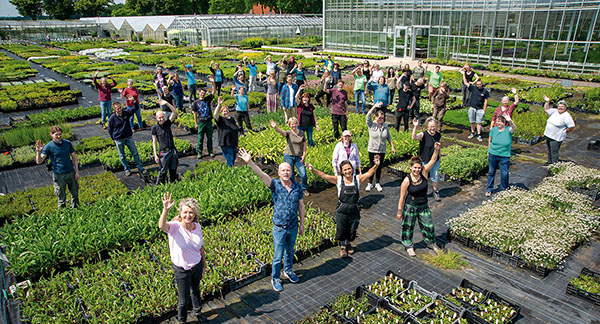
上图是 2020 年苗圃员工在自家育苗区前的合影,身后的长条台上摆满了待发的盆苗,白色玻璃温室就是 2016 年落成的那座。
约九百种植物,八百多种种子
把店里的商品清单数一遍,能数出九百七十多种植物和一千多种种子,合起来两千多个条目可下单。德国媒体前几年的报道写的是约九百种植物、约八百种种子,目录每年都在加,数字一直在往上走。同一物种常常既卖苗也卖种子:迷迭香这类从种子起苗要慢一年,直接买苗更划算;法国龙蒿根本不能靠种子繁殖;茴香有直根,反而要就地播种才长得好。
繁殖基本自己做。用他的话说,绝大部分从播种、扦插、分株一步步养起来,外购只占很小一部分。不少今天在建材市场和超市能见到的外来香草,最早是他们引进德国的,比如被叫作”不死草”的绞股蓝,二十年前他们就开始卖;柠檬马鞭草和灌木罗勒也一样。他还从 1996 年起自己选育罗勒,’Wildes Purpur’ 就是自家挑出来的品种。
分类方式不止按植物学。店里有一套按用途分的目录:采来做茶的、做香料的、染色用的、驱虫的、给蜜蜂和熊蜂的、给猫的、做绿沙冰的、做香草花束的,还有按地区分的意大利香草、普罗旺斯香草。另一套按气味分,他本人把香调归成二十类:八角、果香、咖喱、臭味、青草、树脂、蜂蜜、茉莉、芫荽、水芹与芥末、葛缕子、韭葱、薄荷、丁香、玫瑰、巧克力、百里香与牛至、香草、紫罗兰、辛香。
目录、书和论坛
每年出一本纸质目录,2026 年版已经是第 34 期,A4 开本三百七十页,德国境内五欧元,寄到国外十欧元,网站上也能直接下载 PDF。目录里每株植物都标了代码、耐寒等级和用途字母:H 是全耐寒,HH 只能扛零下五度,R 是熏香植物,B 是蜂媒植物,T 是茶用,X 表示有毒。
他还写书。和厨师 Wolfgang Pade 合著的《Weltkräuterküche》一百六十页,讲的是怎么把世界各地的外来香草搬到自家厨房里。苗圃自己还有一个论坛和一个博客,园艺问题在上面问,比打电话快。德国园艺咨询电话每周三下午四点到六点开放,从一月到十月。
怎么买,怎么收到
植物发货每年三月底才开始,因为要等苗长到能扛住运输。订单从十二月新目录出来就开始堆,所以头几周不一定发得完;怕冷的品种(比如多数罗勒)还会往后压。单株植物都标了可发货月份,比如”四月中到十月”。一单里如果混了晚熟的品种,整单会等最后一株能发了才一起走。网站上的参考时效是一周左右,包裹发出后通常一到两天到。
种子和植物走两条线,运费分开算。除了网店,还能按目录上的订单页填好寄过去、传真或电话下单,最低订单额十五欧元。想上门看实物也可以,苗圃本身有零售区;2012 年起每周六中午十二点到下午三点有免费的自由参加时段,员工带着讲繁殖、栽种、采收、干燥和用法,不用预约,具体日期每年四月公布在博客上。
From a grandmother’s herb basket to a flea-market table
The nursery belongs to Daniel Rühlemann, who comes from Horstedt in Lower Saxony, between Hamburg and Bremen. As a boy he foraged with his grandmother, who had come from Thuringia: yarrow and plantain went into the basket, and she always said the ones with pink flowers were the best. He later studied music in Graz, Austria, where a student flat left him no garden, so he kept a three-square-metre herb corner by the window. It grew, and he began collecting varieties he could not find elsewhere.
What really started it was an unnamed tea plant. A friend who was moving out handed him two muddy rootstocks, saying it was “the white one”, passed on from a farmer’s wife. He assumed lemon balm, but nothing in his herb books matched, and only years later did he identify it in a nursery as lemon catnip. Not knowing the answer became an obsession: if the books had missed a tea plant this good, what else had been forgotten? He began hunting exotic herbs on purpose.
In 1991 he filled yoghurt pots with surplus plants from his own garden, put up a pasting table and sold them at a flea market in Bremen. Orange mint and pineapple sage drew the most questions. Had customers only asked for parsley and chives, he says, the nursery would never have existed. That same year he rented ground in Horstedt and started on his own.
Today: two hectares and six greenhouses
More than three decades on, one man has become a team. Around twenty people work there year-round, with seasonal staff added in spring and summer; the local Kreiszeitung reported close to a hundred at the busiest point. The site has grown to two hectares and six greenhouses. The largest was finished only in 2016, cost two million euros, and houses the offices, the dispatch hall and a small photo studio alongside the plants.
The dispatch hall holds eight hundred picking positions, and roughly sixty thousand plants leave from it each year, with addresses as far away as Sicily. In peak season half the staff do nothing but shipping: plants that are not up to standard are cut back and weeded out, the rest move into the packing lane, get wrapped in paper and packed with wood wool, and go out with DHL or DPD the same day.
The photo above was taken in 2020 in front of the nursery’s own propagation beds; the white glasshouse behind the team is the one completed in 2016.
About nine hundred plants, over eight hundred seeds
Count the shop’s own product list and you get more than nine hundred and seventy plants and over a thousand kinds of seed, more than two thousand orderable items altogether. German press coverage from a few years ago quoted about nine hundred plants and eight hundred seed varieties; the catalogue grows every year and the numbers keep climbing. Many species are sold both ways. Rosemary raised from seed is about a year behind a plant, so buying the plant makes sense; French tarragon cannot be grown from seed at all; fennel has a taproot and does better sown in place.
Propagation is mostly done in-house. In his words, the great majority are raised from seed, cuttings or division, and only a small share is bought in. Quite a few of the exotic herbs now sold in garden centres and supermarkets were first brought into Germany here: jiaogulan, the so-called herb of immortality, has been on their list for about twenty years, and lemon verbena and shrub basil went the same way. He has also bred his own basil since 1996; ‘Wildes Purpur’ is one of his own selections.
The range is not sorted only botanically. One set of categories follows use: tea herbs, kitchen herbs, dye plants, pest-repelling plants, plants for bees and bumblebees, cat herbs, greens for smoothies, herbs for cutting. Another follows scent, and he has sorted the vocabulary of fragrance into twenty directions, from anise, fruit, curry and green grass through resin, honey and jasmine to rose, chocolate, vanilla and violet.
Catalogue, books and a forum
A printed catalogue comes out every year. The 2026 edition is the thirty-fourth issue, 370 pages at A4, five euros inside Germany and ten euros abroad, and the PDF can be downloaded from the site. Each entry carries a code, a hardiness grade and letters for use: H for fully hardy, HH for hardy to about minus five, R for incense, B for bee plants, T for tea, X for poisonous.
He writes books as well. Weltkräuterküche, written with the chef Wolfgang Pade, runs to 160 pages on bringing herbs from around the world into an ordinary kitchen. The nursery also runs its own forum and blog, where gardening questions usually get a faster answer than on the phone. Telephone advice is open on Wednesdays from four to six, January through October.
How to order and how it arrives
Plant dispatch only starts at the end of March, once plants are sturdy enough to travel. Orders pile up from December, when the new catalogue appears, so the first weeks cannot clear everything; tender sorts such as most basils are held back longer. Every plant is marked with the months it can ship, for example mid-April to October. If an order mixes in a late variety, the whole parcel waits until the last plant is ready. The shop quotes about a week, and parcels usually arrive one to two days after dispatch.
Seed and plants run on separate lines with separate postage. Besides the online shop, orders can go in by post using the order forms in the catalogue, by fax or by phone, with a minimum order of fifteen euros. Visitors can look at the plants on site, since the nursery has its own retail area; since 2012 there have also been free open sessions on Saturdays from noon to three, where staff cover propagation, planting, harvesting, drying and use. No booking is needed, and dates appear on the blog each April. Questions also collect on the nursery’s forum.
Official Site: https://www.kraeuter-und-duftpflanzen.de/








发表回复