

废弃黏土坑里的世界第八大奇迹
伊甸园项目在英国康沃尔郡。英文维基百科记的年份是:1996 年有人提出这个想法,1998 年动工,2000 年 5 月游客中心先开门,同年 9 月第一批植物进场,2001 年 3 月 17 日整个园区才对外开放。
脚下的黏土坑采了 160 多年,站方说坑深 60 米,位置比地下水位还低 15 米,原来既没有土也没有植物。1981 年英国广播公司在这里拍《银河系漫游指南》,拿这个坑当星球马格瑞瑟的表面。设计出自格雷姆肖事务所,几百个五边形和六边形的充气罩撑在钢管网格穹顶上,整个工程做了两年半。
站方自己的沿革页写着,开门那天《泰晤士报》称这里是「世界第八大奇迹」,头一年就来了 180 万人。2026 年 3 月 17 日是这个园子的 25 岁生日,站方统计这 25 年里一共接待了 2500 多万游客。
两座大温室,一千多种植物
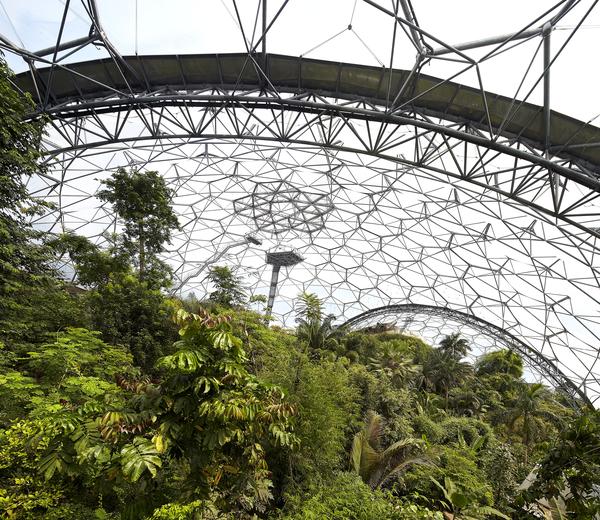
雨林温室是其中更大的一个。英文维基百科记它的长宽高分别是 200 米、100 米和 55 米,占地 1.56 公顷。站方说里面有一千多种植物,常年保持 18 到 35 摄氏度,绕一圈大概要一个半小时。
园子最高处有一座悬在树冠之上的观景台,2010 年由探险家贝尔·格里尔斯揭幕;还有一条空中步道,2013 年先开了第一段,2017 年又添上模拟暴雨的造雨展区。巨魔芋大约一年开一次花,开放时间只有 48 小时,得靠园丁拿着沾了花粉的画笔替它授粉。园里还养着两株翡翠藤,这种花在野外已经濒危;猴面包树能活三千年以上。
地中海温室小一些,站方说同样有一千多种植物,来自地中海、加州、南非和西澳大利亚,那里的橄榄树有的已经活了两千年。雨林温室的说明牌上还写了一句:按这个温室的面积算,全世界每 11 秒就有同样面积的热带雨林被毁掉。
户外花园和三千多种植物
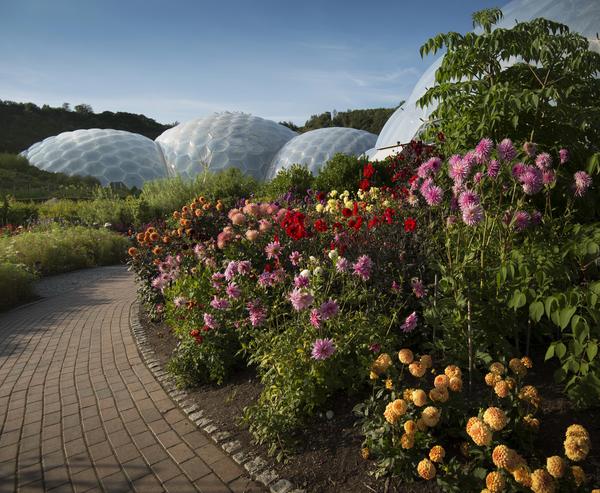
户外花园有多大,站方给了两个说法:园内总览页写的是三十英亩,户外花园页和课程介绍页写的是二十多英亩。园方说有 20 多个以植物为主题的展区,另有随季节变化的花境、艺术装置和游乐区,光植物就三千多种。
布局分成几块:荒野边缘区摆的是温带地区的植物,作物区介绍粮食、燃料、药材和工业原料分别来自哪些植物,还有一座气候花园沿着 4 亿年的时间线往回走。
园里有些树活得比大多数建筑都久。银杏是世界上最古老的活树种之一,早在 3.5 亿年前就已经存在;红豆杉估计超过 3000 年。茶有大约 3000 种,喝起来什么味道取决于种在哪儿、用什么灌木。2023 年 7 月,这里新开了一处自然游乐场,中间立着一座九米高的生命之树塔架,加上升降梯、滑梯、攀爬网和玩水区,占地将近 500 平方米。
核心建筑和它头顶上的铜屋顶
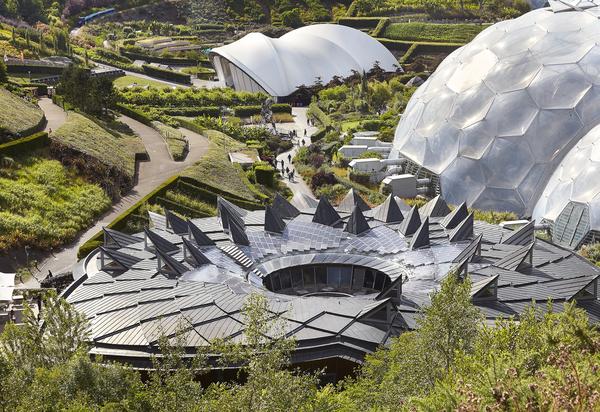
核心建筑也是格雷姆肖事务所设计的。站方的沿革页记它 2005 年 9 月落成并由女王正式揭幕,核心馆自己的介绍页则写 2006 年开放。三个楼层嵌在坡地里,每一层都能从地面直接走进去,整个造型照着向日葵的结构做。
用的材料都写在明处:地板是亚麻压成的板,混凝土掺了当地的瓷砂,绿色地砖由回收的喜力啤酒瓶烧制,铜屋顶则来自力拓的一座矿,站方说这家矿的环境和社会标准在全球属于最高的一档。
2007 年 6 月,雕塑家彼得·兰德-佩奇的作品「种子」落进核心馆,重 167 吨,用博德明荒野一处采石场整块切下来的康沃尔花岗岩雕成。2018 年 5 月,核心馆开出常设展「无形世界」,正中是陶瓷装置「无限蓝」。到 2027 年 9 月 19 日之前,地面层还挂着「灭绝:更新」特展,36 位世界知名艺术家的作品摆在一起。
教育、慈善,还有康沃尔之外的伊甸园
伊甸园项目是一家教育慈善机构,站方说门票、会员和捐款都用来支持它的工作,在康沃尔筹到的钱再用到英国各地和海外的项目上。25 年里,它为康沃尔和西南地区带来的经济影响超过 68 亿英镑,平均每年维持约 700 个岗位。
教育是它最看重的一块。站方说 25 年里有 75 万多名中小学生和大学生来参访,一年超过 3 万人次,通过教育项目接触到的年轻人超过 100 万。它还和大学合作,支持约 200 名本硕学生。2015 年 9 月开办的伊甸园学位课程由康沃尔学院承办、普利茅斯大学认证,园艺、植物科学、园林设计都有;站方另外提供英国皇家园艺学会的植物生长与发育原理二级证书课程,在线就能修。
2023 年 6 月,园里的深地热电站并网发电,是英国自 1986 年以来第一座新投运的深地热电站。5 公里的地热井给两个温室、苗圃和办公区供热,每年少排 500 吨二氧化碳,天然气用量几乎降到零。雨水和地下水承担了园里三分之二的水,垃圾不再填埋,站方说要在 2030 年前成为一家碳中和的机构。
康沃尔之外也有伊甸园。2025 年 6 月开门的东方伊甸园在青岛胶州湾畔,由金茂控股投资运营,占地 200 英亩,站方在沿革页里写它有全世界最大的圈养雨林,讲的是水的故事;课程介绍页上则把康沃尔这边的雨林温室称作「世界上最大的圈养雨林」,两处说法不一样。英国这边还有莫克姆的新伊甸园,计划 2028 年底开放;迪拜的世博城和哥斯达黎加的尼科亚半岛也有它的项目。此外它办的社区聚餐从 2009 年延续至今,带动了 150 多万场聚会,1.2 亿人参与其中。
A World Wonder Built in a Worked-Out Clay Pit
The Eden Project sits in Cornwall, in the south-west of England. English Wikipedia gives the dates: the idea was put forward in 1996, construction began in 1998, the visitor centre opened in May 2000, the first plants arrived that September, and the whole site opened to the public on 17 March 2001.
The clay pit underneath had been worked for more than 160 years. The Project says it was 60 metres deep, sat 15 metres below the water table and had neither soil nor plants to begin with. In 1981 the BBC filmed The Hitchhiker’s Guide to the Galaxy there, using the pit as the surface of the planet Magrathea. Grimshaw Architects drew up the design: hundreds of hexagonal and pentagonal inflated cells resting on a steel grid dome, with the whole build taking two and a half years.
The Project’s own history page records that on opening day The Times called the place the ‘eighth wonder of the world’, and that 1.8 million people came in the first year. On 17 March 2026 the garden turned 25, and the Project counts more than 25 million visitors over those 25 years.
Two Great Glasshouses, a Thousand Plant Varieties Each
The Rainforest Biome is the larger of the two. English Wikipedia gives its dimensions as 200 metres long, 100 metres wide and 55 metres high, covering 1.56 hectares. The Project says it holds over a thousand varieties of plant, is held between 18 and 35 degrees Celsius, and takes about an hour and a half to walk around.
At the highest point there is a Lookout suspended above the canopy, opened in 2010 by the adventurer Bear Grylls, and a treetop walkway whose first section opened in 2013, later extended in 2017 with a Weather Maker exhibit that brings tropical storms indoors. The titan arum flowers about once a year and only for 48 hours, so the gardeners pollinate it by hand with a paintbrush on a long pole. Two jade vines are kept here; the species is already endangered in the wild. Baobabs live for more than three thousand years.
The Mediterranean Biome is smaller but the Project says it also holds over a thousand varieties, drawn from the Mediterranean, California, South Africa and Western Australia, where some of the olive trees are two thousand years old. A sign in the Rainforest Biome notes that an area of rainforest the size of the Biome is destroyed somewhere in the world every eleven seconds.
The Outdoor Gardens and Three Thousand Plant Varieties
How big the Outdoor Gardens are depends on which page you read: the overview of what is here says thirty acres, while the Outdoor Gardens page and the learning pages say over twenty acres. The Project says there are more than twenty plant-based exhibits, along with seasonal borders, art installations and play areas, and over three thousand varieties of plant.
They are laid out in sections: the Wild Edge shows temperate lands from around the world, the Crops area introduces the plants behind food, fuels, medicines and materials, and a Climate Garden works its way back through 400 million years.
Some of the trees here outlive most buildings. The ginkgo is one of the world’s oldest living tree species and was already around 350 million years ago; yews are estimated to be over three thousand years old. There are roughly three thousand different types of tea, and the flavour depends on where they are grown and on the species of bush. In July 2023 a natural adventure play area opened, built around a nine-metre Tree of Life tower with slides, swings, a wood wide web and water play, covering nearly 500 square metres.
The Core and the Copper Roof Above It
The Core was also designed by Grimshaws. The Project’s history page records that it opened in September 2005 and was formally opened by the Queen, while the Core’s own page gives 2006. Its three floors are built into the hillside so that each can be reached from ground level, and the whole shape is based on the structure of a sunflower.
The materials are on show: floors made of pressed flax, concrete mixed with local china-clay sand, green tiles fired from recycled Heineken bottles, and a copper roof from a single Rio Tinto mine, which the Project says operates to some of the highest environmental and social standards in the world.
In June 2007 a 167-tonne sculpture called the Seed, by Peter Randall-Page, was lowered into the Core, carved from a solid block of Cornish granite blasted out of a quarry on Bodmin Moor. In May 2018 the Core opened its permanent exhibition Invisible Worlds, with the ceramic work Infinity Blue at its centre. Until 19 September 2027 the ground floor also carries the Extinction: Renewal exhibition, bringing together work by 36 artists from around the world.
Education, Charity and Edens Beyond Cornwall
The Eden Project is an educational charity. The Project says every ticket, Membership and donation supports its work, with money raised in Cornwall spent on projects right across the UK and around the world. Over 25 years it says it has generated more than £6.8 billion of economic impact for Cornwall and the South West Region, sustaining an average of 700 jobs.
Education is the part it puts first. The Project says more than 750,000 children and young people have visited on school and college trips, over 30,000 a year, and that more than a million young people have been reached through its education programmes. It works with universities to support around 200 undergraduate and postgraduate students. The Eden degree courses, launched in September 2015, are run by Cornwall College and accredited by Plymouth University, covering horticulture, plant science, garden and landscape design; there is also an online RHS Level 2 certificate in the Principles of Plant Growth and Development.
In June 2023 the site’s deep geothermal power plant came online, the first new operational deep geothermal power plant in the UK since 1986. Its 5km well heats the Biomes, the nursery and the buildings, saving up to 500 tonnes of carbon dioxide a year and cutting gas use to almost nothing. Rainwater and groundwater meet two thirds of the site’s water needs and nothing goes to landfill, and the Project aims to be climate positive by 2030.
There are Edens beyond Cornwall too. Oriental Eden opened in Qingdao in June 2025, on the coast of Jiaozhou Bay, owned and run by Jinmao Holdings on a 200-acre site; the Project’s history page says it holds the largest captive rainforest in the world and tells the story of water, while its learning pages call the Rainforest Biome in Cornwall the largest rainforest in captivity, so the two claims do not quite agree. A new Eden in Morecambe in the UK is due to open in late 2028, and there are projects in Expo City Dubai and on the Nicoya Peninsula in Costa Rica. The Big Lunch, started by the Eden Project in 2009, has also inspired more than 1.5 million events connecting 120 million people, the Project says.
相关文章:
 美国 Eden Brothers 伊甸兄弟 – 美国最大种子和种球在线零售商
 比利时 Eden Magazine 伊甸园杂志 – 比利时荷法双语园艺季刊
 美国 Almost Eden – 路易斯安那邮购罕见植物苗圃
 美国 Open Directory Project 园艺资源目录 – 方便不同国家和地
 德国 柏林植物园 Botanischer Garten Berlin – 近两万种植物与分类研究
 中国 重庆南山植物园 – 中国亚热带低山植物专类园
 德国 埃尔兰根植物园 Botanischer Garten Erlangen – 百余年教学收藏与濒危种保护
 英国 特雷巴赫花园 Trebah Garden – 英国最南端的亚热带山谷花园
发表回复