
从鹿苑到林地花园
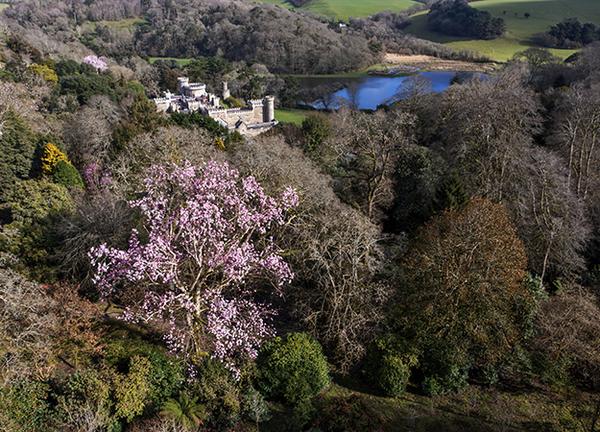
凯尔海斯庄园在康沃尔郡南岸的 Porthluney 山谷里。城堡由摄政时期的建筑师约翰·纳什在 1807 年动工、1810 年建成,是英国一级保护建筑。园子有 140 余英亩,从城堡林一路延伸到 Kennel Close 林、Forty Acres 林和 Old Park 一带,被英国遗产署登录为二级星级的保护园林,邱园也把它列为重要程度突出的园林。
庄园最早属于 Trevanion 家族,从 1370 年到 1840 年。那一带当时以鹿苑为主,现在还能在林子里看到当年圈鹿用的石墙残迹。十九世纪中叶庄园易主时,房子已经破败得厉害,修补的花费不小。此后一个多世纪里,家族一边修房子一边收集植物,园子才慢慢成了今天的模样。家族持有庄园的年份,站上各页说法不一:家族史页写 1853 年,庄园简介页写 1855 年,页脚标语则写 1860 年。
真正的转折在二十世纪初。家族把兴趣投向植物收藏,正好撞上采集中国植物的那股热潮,园子由此长成英国最像样的花园之一。罗克、虎克、德拉维等人在 19 世纪带回中国的植物,以及洛布兄弟从南美带回的品种,在这里大多没能留下来;能稳稳扎下根的,是二十世纪初从中国西南运来的那一批。
国家木兰收藏
2000 年,凯尔海斯申报国家木兰收藏获得批准。英国国家植物保护与花园委员会 1978 年成立,全国植物收藏计划如今有约 630 个收藏点分布在 450 个园址,守护着约七万个种和品种,全国共有四处国家木兰收藏,凯尔海斯是其中之一,另外三处分别在约克郡的温特沃斯城堡、伯克郡的温莎大公园和北威尔士的博德南特。
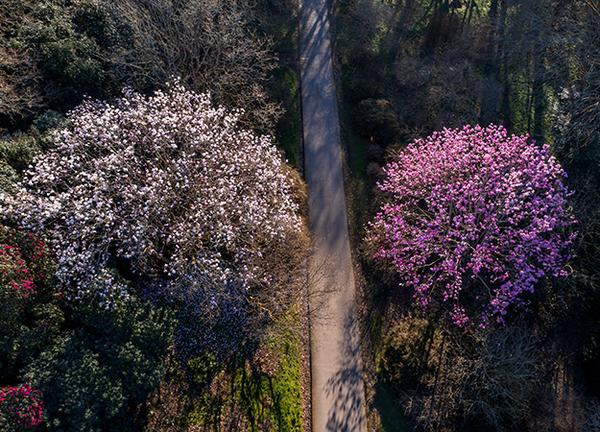
园里的木兰属、木莲属和含笑属合计四十余种,另有 170 个已经命名的栽培品种,以及约 250 株还没有名字的实生苗。新品种的来源不止中国,还有新西兰、法国、荷兰、比利时和瑞士。收藏的意义并不只是好看:野外有一半以上的木兰属植物已经濒危,被列进联合国的红色名录,中国西南采集来的种子就算在原产地被当作柴烧、被山羊啃食或被开垦掉,这里仍留着从野外来的纯正种质。
英国的这套国家收藏计划还要求收藏点尽量分布在不同地方,好让同一批植物在各地长得不一样。凯尔海斯至今还留着若干木兰种在西方最早、活到今天的植株。
猎花人的遗产与山茶杂交
园里木兰的来历要从 1897 年算起。欧内斯特·威尔逊和乔治·福雷斯特是两位决定性的采集者:前者生卒于 1876 至 1930 年,后者生卒于 1873 至 1932 年,他们在云南和四川的山里收集种子,把西方此前没见过的一批木兰带回了欧洲。凯尔海斯是这些种子的主要落脚点之一。
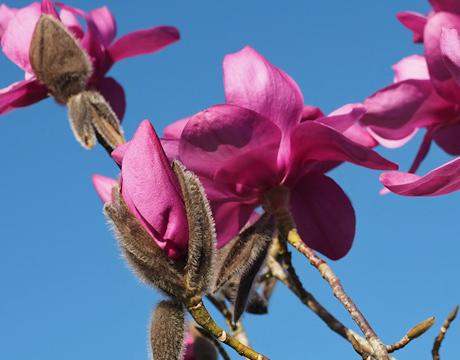
这些树在园里已经长到相当可观。老木兰能长到上百岁,早春先花后叶,一根枝条上能开出成百上千朵六英寸左右的粉白色花,是整个园子里最先热闹起来的地方。当年在西方还无人见过的一些新种,如今在园里仍能见到原始植株,一百多年过去还在原地。
山茶是园里的另一条线。1920 年代,J.C. 威廉姆斯培育出最早的 x williamsii 山茶杂交系,这一杂交种后来改变了全世界山茶栽培的面貌,凯尔海斯因此成了世界山茶育种史上绕不开的一个名字。
十八个植物区和园丁队伍
花园按植物分成十八个区块,枫树和槭树、山茶、杜鹃、鹅耳枥、绣球、冬青、木兰、栎树、罗汉松、吊灯花、省沽油、野茉莉、树蕨等各占一处,另有专门展示冠军树的一区。按英国树木登记册的统计,园里的冠军树超过 75 棵。
管这片园子的是总园艺师杰米·帕森斯。他是 1896 年以来凯尔海斯的第四位总园艺师,1994 年进园做工,1996 年接替干了四十多年的菲利普·特雷古纳上岗。2003 年以来他带人在园里新辟了 30 英亩,是本世纪初园子最大的一次扩种。他自己也育出并命名了若干杜鹃和木兰杂交种,2009 年凭杜鹃栽培方面的成绩拿到英国皇家园艺学会的 A.J. 瓦利奖章,2024 年又获该学会的副荣誉奖章。
副总园艺师迈克尔·莱维特 2000 年从罗瑟沃恩园艺学院毕业后进园,负责园里的植物标签和每年新栽植物的记录,也管播种、扦插、压条这些繁殖活。他到任之后,庄园在 2011 年拿到了第二项国家收藏,这次是罗汉松属。庄园日志从 1897 年起由家族一天天记下来,现在仍在写;庄园主查尔斯·威廉姆斯同时也是英国专业植物苗圃 Burncoose 的高级合伙人。
2027 年的开放安排与门票
城堡和花园现在处于关闭状态,2027 年 2 月重新开放。花园每年从 2 月中旬开到 6 月初,前后约 100 天,一年接待约一万五千名访客。2027 年的日程是:2 月 15 日花园开放,3 月 1 日城堡开始导览,6 月 13 日花园与城堡一起收园。3 月 3 日有一整天的「A Celebration of Spring」活动,上午导览、下午在 The Vean 办写作工作坊;3 月 5 日庄园主讲国家木兰收藏并带人走园;4 月 5 日是「Magnolias at Caerhays Castle」的步行讲解。
票价按现在的票务页列着:单逛花园成人 13.50 英镑,5 至 16 岁儿童 5 英镑;进城堡成人 15 英镑、儿童 7 英镑;花园加城堡的联票成人 25 英镑、儿童 10 英镑;花园季票单人 40 英镑、两人 60 英镑、一家 70 英镑。历史建筑协会会员整个季节免门票入园,康沃尔园艺协会会员减 1 英镑,BBC《园艺世界》持卡人从 4 月 1 日起两人入一。城堡导览每场只带 12 到 15 人。
团体来访可以约花园导览和城堡导览,由庄园主或者两位总园艺师带队。乔治亚厅和餐厅能接 25 人的正餐,人更多就办厨师自助餐;讲堂安排在乔治亚厅,最多 45 人、最少 25 人,配讲解、导览和一餐的收费每位在 40 英镑加税以上,庄园与英国皇家园艺学会合办的春季讲座系列就办在这里。茶室改由 Manor Made Cornwall 经营,2026 年 3 月 2 日到 6 月 14 日开门;礼品店和植物销售暂时停着,2027 年 2 月随花园一起重开,网上买植物走 Burncoose。婚礼每次只办一场,场地有四处:能看海的 Coastguard’s Lookout(最多 40 人)、可容 18 位宾客的 The Vean、靠沙滩的 Beach Meadow 和以城堡作背景的 Castle Field。
From a deer park to a woodland garden
Caerhays Castle stands in the Porthluney valley on the south coast of Cornwall. The castle was begun in 1807 and finished in 1810 by the Regency architect John Nash, and it is now a Grade I listed building. The garden covers more than 140 acres, running on through Castle Wood, Kennel Close Wood, Forty Acres Wood and the Old Park. English Heritage registers it as a Grade II* park and garden, and Kew has singled it out as being of outstanding importance.
The estate belonged to the Trevanion family from 1370 until 1840, and the deer park was the main feature of the place at that time; traces of the walls that once fenced the deer are still visible in the woods. When the estate changed hands in the mid-nineteenth century the house was badly dilapidated and the repairs were extensive. Over the following century and more the family built up the house and collected plants at the same time, and the garden grew into what it is now. The site’s own pages give different years for the family’s ownership: 1853 on the family history page, 1855 on the About page and 1860 in the footer.
The real turning point came around 1900, when the family’s interest in plants coincided with the collecting of Chinese plants. The introductions of Joseph Rock, Hooker and Delavay earlier in the nineteenth century, and the Lobb brothers’ work from South America, are largely absent here; what took root was the material sent back from south-west China in the early twentieth century.
A National Collection of Magnolias
Caerhays was accepted as a holder of a National Collection of Magnolias in 2000. The National Council for the Conservation of Plants and Gardens was founded in 1978, and its National Plant Collection Scheme now runs around 630 collections on 450 sites, safeguarding roughly seventy thousand species and cultivars. Caerhays is one of four National Magnolia Collections, the others being at Wentworth Castle in Yorkshire, Windsor Great Park in Berkshire and Bodnant in North Wales.
The magnolia, maglietia and michelia plants here number just over forty species, alongside a further 170 named cultivars and some 250 seedlings that have yet to be named. New material has come from China and also from New Zealand, France, Holland, Belgium and Switzerland. The point of a national collection goes beyond appearance: more than half of the magnolias that exist in the wild are classified as endangered and appear on the United Nations Red List, so even where seed collected in China has been burnt as firewood, ring-barked by goats or cleared for cultivation, the pure genetic material of those species survives here.
The scheme also asks collection holders to spread a collection over more than one place, so the same plants can grow differently in different soils. In several cases Caerhays still has the original and oldest living plants of a given species in the Western world.
Plant hunters’ legacy and the williamsii camellias
The story of the magnolias here begins to take shape after 1897. Ernest Wilson and George Forrest were the two great collectors involved with Caerhays: Wilson lived from 1876 to 1930 and Forrest from 1873 to 1932, and both gathered seed in the mountains of Yunnan and Sichuan, bringing to Europe magnolias that had never been seen there before. Caerhays became one of the principal homes for that material.
These trees have had a century and more to grow. Some of the old magnolias are over a hundred years old and come into flower before the leaves, opening hundreds or even thousands of six-inch pink and white blooms along every twig, which makes them the earliest and most dramatic event of the garden year. The collection list now on show underlines the point: several species that were unknown in Western Europe survive here only because successive generations of gardeners kept the seed going.
Camellias run the other line of the story. In the 1920s J.C. Williams bred the original x williamsii strain of camellias, plants that went on to transform camellia cultivation around the world. That cross changed the way camellias are grown, and it is a large part of why Caerhays holds the place it does in the history of camellia breeding.
Eighteen plant groups and the garden team
The garden is laid out in eighteen plant groups. Maples, camellias, rhododendrons, Carpinus, hydrangeas, hollies, magnolias, oaks, podocarpus, enkianthus, Staphylea, Styrax and tree ferns have their own ground among others, along with a section given over to champion trees. By the count of The Tree Register, the gardens hold more than seventy-five champion trees.
The head gardener is Jaimie Parsons, the fourth head gardener at Caerhays since 1896. He started work on the estate in 1994 and became head gardener in 1996, when Philip Tregunna retired after more than forty years in the gardens. Since 2003 Parsons has had thirty acres of new planting established, the largest extension to the gardens this century. He has also raised and named a number of his own rhododendron and magnolia hybrids, work the Royal Horticultural Society recognised with the A.J. Waley medal in 2009 for work on the cultivation of rhododendrons, and with an Associate of Honour medal in 2024 for outstanding contributions to horticulture and gardening.
The deputy head gardener, Michael Levett, joined in 2000 after training at Rosewarne Horticultural College. He is responsible for the plant labelling seen throughout the gardens, for recording the details of every new planting each spring, and for the seed, cuttings and layering that go into propagation. Since he took the job, Caerhays has taken on a second national collection, this time of Podocarpus, awarded in 2011. The Garden Diary, kept by the family day by day since 1897, is still being written. Charles Williams, who owns the estate, is also senior partner of Burncoose Nurseries, one of the UK’s leading specialist plant nurseries.
Opening dates and admission for 2027
The castle and gardens are closed at present and will reopen in February 2027. The gardens run from mid-February to early June, a little over a hundred days, and attract around fifteen thousand visitors in a year. The 2027 diary has the gardens opening on 15 February, castle tours starting on 1 March, and the gardens and castle closing together on 13 June. On 3 March there is a full day of ‘A Celebration of Spring’, with a garden tour in the morning and a mindful writing workshop at The Vean in the afternoon; on 5 March the owner gives a talk on the National Collection of Magnolias and leads a tour; on 5 April there is a walk and talk on ‘Magnolias at Caerhays Castle’.
Admission is listed on the current ticketing page: gardens unguided, £13.50 for adults and £5.00 for children aged 5 to 16; the castle, £15.00 and £7.00; and a combined ticket at £25.00 and £10.00. Season tickets for the gardens alone are £40.00 individual, £60.00 joint and £70.00 for a family. Historic Houses members are admitted free of charge for the whole season, Cornwall Garden Society members get £1.00 off, and BBC Gardeners’ World subscribers get two for one from 1 April. Castle tours are limited to parties of 12 to 15 people.
Groups can book garden and castle tours led by the owner or by one of the head gardeners. Set lunches in the Georgian Hall or Dining Room take up to 25 guests, with a Chef’s Buffet for larger parties, and lectures in the Georgian Hall are arranged for a maximum of 45 and a minimum of 25 people; a lecture with a conducted tour and a meal is likely to cost more than £40 plus VAT per head, which is how the estate runs its spring lecture programme with the Royal Horticultural Society. The Magnolia Tea Rooms is now under the management of Manor Made Cornwall and opens from 2 March to 14 June 2026. The shop and plant sales are closed until the gardens reopen in February 2027, with online plant sales run through Burncoose. Only one wedding is hosted at a time, across four venues: the Coastguard’s Lookout for up to 40 guests with sea views, The Vean for up to 18 guests, Beach Meadow by the sand, and Castle Field with the castle behind it.
相关文章:
 英国凯尔海斯庄园 Caerhays Estate – 一级遗产林地花园玉兰国家收藏
 苏格兰 德拉姆兰里格城堡花园 Drumlanrig Castle Gardens – 苏格兰国家级造景园林遗产
 英国 Burncoose 苗圃 – 英国康沃尔邮购家族苗圃
 苏格兰荣誉花园 Glorious Gardens – 英国西部花园旅游联合体
 英国 莱昂纳德利湖园 Leonardslee Lakes & Gardens – 英国一级登录历史园林
 英国 特雷巴花园 Trebah Garden – 康沃尔亚热带花园全英八十佳园林
 苏格兰 卡罗赛德花园 Carolside Gardens – 玫瑰名园苏格兰最浪漫的花园之一
 荷兰 库肯霍夫城堡 Kasteel Keukenhof – 荷兰二百六十公顷历史遗产庄园
发表回复