
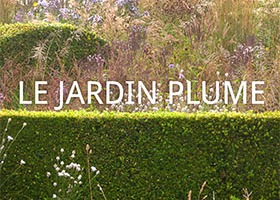
花园概貌
羽毛花园(Le Jardin Plume)位于法国诺曼底地区滨海塞纳省(Seine-Maritime)的奥佐维尔-叙里村(Auzouville-sur-Ry),距鲁昂以东约二十五公里,是一座以宿根花草与观赏草为主角的私家花园,由西尔维与帕特里克·基贝尔夫妇(Patrick et Sylvie Quibel)共同设计、营造与维护,于二〇〇六年获得法国文化部颁发的「杰出花园」(Jardin Remarquable)官方认证。整座花园占地约二点八公顷,被划分为羽毛园、果园、花圃、夏园、秋园五块主题园区,外加一处专营宿根植物与观赏草的小型苗圃。花园把古典法式花园的结构骨架与近三十年新兴的自然主义种植风格融合在一起,既保留了修整成波浪形与方阵的黄杨与山毛榉绿篱,又在结构之内大面积放手种植随风摇曳的细瘦花穗、轻盈草叶和零星散布的多年生花卉。
历史由来
西尔维和帕特里克·基贝尔都是自学成才的园艺爱好者,从业已超过四十年。一九九〇年代初,两人先在法国本土开起专营宿根植物与观赏草的苗圃,为日后的花园实践积累了第一批植物素材。一九九六年,夫妇二人在走访英国、比利时、荷兰与意大利的众多经典花园之后,来到奥佐维尔-叙里村,购置下一处带有大片苹果园与绵羊牧地的旧式诺曼底农庄。一九九七年冬季,他们在这片原本只是果园与草地的土地上同时启动了花园与苗圃的营造,第一批定植的植物中就包括了至今仍然旺盛生长在南向花架下的黄木香(Lutea Banksiae)。二十多年来,花园逐年从最初的果树林地演化为如今这座结构稳定、四季可游的综合性花园,并被业内视作法国当代自然主义花园领域的代表作之一。
园区格局
羽毛花园的整体骨架以东西向与南北向两条主轴展开:东西轴把果园与水面连成一体,南北轴贯穿果园通向远方草场。花园的中央是一方贴近草坪的大方形水池,四周的修剪草坪迅速成为访客最钟爱的休憩空间;高处的夏园被削平成一个略高于地面的台地,南向俯瞰水池;秋园是一个由山毛榉与鹅耳枥绿篱围合的封闭方形空间,以高大的晚季花卉取代整齐的边界。在所有主题园区里,基贝尔夫妇都用黄杨修剪出方块、波浪、头巾状等不同形态的造型骨架,并在冬季充当花园的「骨骼」,让整座园子在花卉凋零之后依然保有清晰的层次。
植物收藏与苗圃
羽毛花园被誉为法国境内收藏观赏草最丰富的花园之一,植物材料主要来自三大洲:北美洲贡献了高大的婆婆纳类、紫松果菊与野生圆锥福禄考,亚洲贡献了高大的唐松草、白紫粉三色地榆与各类虎耳草,欧洲则有法国蓝盆花、丘山梅利大麦草、耧斗菜等乡土物种。秋园里高大的升麻、美国紫菀、本园选育的「Saturnia」芒草与俗称「钻石草」的针茅属草种反复出现,构成贯穿整个秋季的银色穗海;夏园则集中栽种唐菖蒲、大丽花、火把莲、萱草、向日葵、旱金莲与红色罂粟,将红、金、橙、黄四种暖色调花卉从六月一直延续到十月。基贝尔夫妇常年经营的苗圃仅销售园中可见的宿根植物与观赏草,不接受邮购、不接受银行卡结算,所有苗木都以盆栽方式出售。
开放与服务
羽毛花园在常规季节对公众开放,访客按场次购票入场,花园在售票日之外的日子则留给基贝尔夫妇剪枝、修剪草坪、补植、浇水、采集果实等维护工作。花园也接待摄影记者、电视节目组与同行业者参观,并常年更新媒体名录与年度回顾,记录历年来访过的报刊与电视栏目。访客参观时可以从羽毛园走进果园,从回望的视角更清楚地理解那条波浪形黄杨绿篱在整个花园构图里的分量:它既呼应了羽毛园里随风摇曳的花草之「轻」,又在冬季为整座花园保留下沉稳的轮廓。门票与开放日期以花园官方网站的年度公布为准。
Garden Overview
Le Jardin Plume is a private garden in the village of Auzouville-sur-Ry, in the department of Seine-Maritime in Normandy, about twenty-five kilometres east of Rouen, in northern France. Created and maintained by Patrick and Sylvie Quibel, the garden focuses on perennials and ornamental grasses and was awarded the official « Jardin Remarquable » label by the French Ministry of Culture in 2006. The site covers roughly 2.8 hectares and is organised into five themed gardens — the Feather Garden, the Orchard, the Flower Garden, the Summer Garden and the Autumn Garden — together with a small nursery specialised in hardy perennials and grasses. The design blends the strong bones of a classical French layout with the looser, more naturalistic planting style of recent decades, combining carefully clipped box and beech hedges with wide drifts of airy flower spikes and swaying grasses.
History
Patrick and Sylvie Quibel are self-taught gardeners who have been working with plants for more than forty years. In the early 1990s they opened a nursery in France specialising in perennials and grasses, an experience that gave them the plant material later used in the garden. After trips to gardens in Britain, Belgium, the Netherlands and Italy, they bought an old Norman farm at Auzouville-sur-Ry in 1996 — a property made up mostly of an apple orchard and sheep pasture. In the winter of 1997 they began laying out the garden and the nursery at the same time; one of the very first plants installed was the banksiae lutea rose that still covers the south-facing wall of the house. Over the following decades the working orchard gradually became a structured, four-season garden, and it is now regarded as one of the leading contemporary naturalistic gardens in France.
Garden Layout
The garden is structured along two crossing axes. An east–west axis links the orchard to a square mirror pond at its centre, and a north–south axis continues through the orchard towards the open prairie beyond. The Summer Garden sits as a raised terrace south of the house, looking down over the pond, while the Autumn Garden is an enclosed square wrapped by beech and hornbeam hedges, where narrow paths let visitors wander among tall late-season plants. Boxwood cut into open squares, waves and turbans — inspired by baroque gardens — provides the permanent skeleton that remains visible in winter once the herbaceous plants have died back.
Plant Collection and Nursery
The garden is known as one of the largest collections of ornamental grasses in France, with plants drawn from three continents: North America contributes tall veronicastrum, ratibida and wild phlox paniculata; Asia contributes tall thalictrum, white, pink and purple sanguisorba and aconitums; Europe contributes œillets de Chartreux, briza media and aquilegias. In the Autumn Garden, tall cimicifuga, American vernonia, small-flowered asters, the garden’s own Miscanthus ‘Saturnia’ and the diamond grass (achnatherum) carry the season into October, while the Summer Garden gathers crocosmias, scarlet dahlias, heleniums, hemerocallis, rudbeckias, kniphofias, tall sunflowers, nasturtiums and red poppies into a warm red-and-gold palette from June to October. The on-site nursery sells, in containers, most of the perennials and grasses visible in the garden; no mail-order service and no credit cards are accepted.
Visiting
The garden opens to the public on scheduled days during the season, with entry tickets sold per session; on the days it is closed the Quibels return to pruning, weeding, mowing, replanting, watering and picking up apples, so that the garden is at its best by the next opening. Photographers, journalists and TV crews are also received on these working days, and the garden keeps a running press list of the newspapers and television programmes that have visited over the years. Visitors are encouraged to step back into the orchard to see the long wavy box hedge from a distance, where its role in the overall composition — echoing the airy foam of the grasses in the Feather Garden and giving the garden its visible skeleton in winter — becomes clear. Ticket prices and the current opening calendar are published on the garden’s official website.
相关文章:
 法国鸢尾之路 – 法国中部鸢尾盛花观赏路线
 摩纳哥 异国情调花园 Jardin Exotique de Monaco – 依山势而建百年悬壁多肉专类园
 加拿大 安娜多年生植物苗圃 Anna’s Perennials – 3英亩耐寒植物花园中心
 智利 地中海花园苗圃 Jardín Mediterráneo – 宿根草本与本土植物的自然主义倡导者
 瑞士 Jardin des Senteurs 香草苗圃 – 种苗生产与销售
 爱尔兰湖山花园 Lakemount – 科克私人花园
 法国 康沃尔植物园 – 英式自然林地风格的活体植物博物馆
 英国 斯蒂林弗利特庄园花园 Stillingfleet Lodge – 家庭花园兼独立植物苗圃
发表回复