
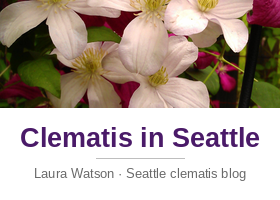
博客与作者
这是 Laura Watson 一个人写的铁线莲博客,2012 年 10 月在西雅图的花园里开篇。她自称 clemaniac,种铁线莲从 90 年代中期开始,先在波士顿的花园里种,留下 50 株;2005 年搬到西雅图后花园里养到 145 株,还在陆续添。她的铁线莲种在树上、灌木上,爬过多年生草本,也上了篱笆、格栅和花架。博客最早在 WordPress.com 上写,最近一次内容更新是 2019 年 1 月,全站 83 篇文章,栏目分「每月一株」「聚光灯铁线莲」「修枝」「买苗」「播种」「种植」「国际铁线莲大会」几类。
一年四季记下来的事
她写的基本是手上正在做的事:修剪、买苗、定植、收种子、翻纸质园艺目录、去别的花园看铁线莲、查病害。修剪写得很细。2013 年那篇讲早花大花组的修剪,写到这一组铁线莲整个冬天挂着老叶老柄不落,剪不动,要等春天看见绿色营养芽鼓起来才知道从哪儿下剪;作者说这一组修剪费工,一只 ‘Fair Rosamond’ 她理了三个钟头,还提到这组最容易得铁线莲枯萎病。定植一篇写的是 2012 年 10 月自己买苗下地的过程:先在园子里找位置,苗连盆泡水,挖坑,坑里灌满水等它渗下去,坑要比苗盆深一倍宽一倍,她自己挖的坑约 18 英寸深、15 英寸宽。
认得的品种
她按花期记品种,一年一个月一株。2016 年 5 月那篇记 ‘The First Lady’,说两年前她买的时候标的是 ‘Rhapsody’,开花后才认出买错了名字;今年这株终于从一丛雪松下面爬出来见光,才看到她在意的那朵花,薰衣草色,最大的一朵量到直径 9 英寸,配酒红色雄蕊。2015 年 2 月记 ‘C. armandii’,说常绿铁线莲在西雅图一般到 3 月中才开,那年冬天特别暖,提前一个多月就开了,她在本地苗圃的盆苗和西北花卉展上看到一大片同样的花,都是为了赶展览催出来的幼苗。
冬天开花的那几种
冬花类她写得最有看头。2018 年 12 月和 2019 年 1 月连着两篇写 ‘C. napaulensis’,喜马拉雅山的种,冬天落叶不休眠,10 月抽苹果绿新叶,1 月到 2 月开成对的小花,米白色萼片卷着很长的紫色雄蕊,夏天看着就是一把枯枝。她这株在北侧花架上种了七年,只在 2015 年 1 月和 2017 年各开过两三朵,2018 年底突然攒满花苞,2019 年 1 月开出四十朵以上。同类的 ‘C. cirrhosa’ ‘Freckles’ 稳定得多,几乎整个冬天零星开花,她自己也说这两种算是亲戚。
资料来源与引用的机构
博客里常引几个机构。国际铁线莲学会(International Clematis Society)和英国铁线莲学会(British Clematis Society)她是会员,参加过 2010 年波特兰和 2011 年比利时的国际铁线莲大会,计划 2013 年 6 月去德国那次。俄勒冈州波特兰南边的 Rogerson 铁线莲收藏(Rogerson Clematis Collection)由 Brewster Rogerson 的收藏发展而来,约 500 个分类群、近 900 株苗,是西半球最大的收藏之一,在 Luscher Farm 老农舍周边种出示范花园,门票免费。另外两个常查的网站是英国 Hull 大学的 Clematis on the Web(有字母序检索,苗圃现场用手机查很方便)和铁线莲国际学会的年刊 Clematis International。她自己也在这个圈子里写东西——她为铁线莲国际的 Gallery 栏目写过 ‘C. Will Baron’ 的介绍和照片。
The Blog and Its Author
This is a one-person clematis blog written by Laura Watson, started in October 2012 out of her Seattle garden. She calls herself a clemaniac and has been growing clematis since the mid-1990s, first in a Boston garden where she left behind 50 plants, and since 2005 in Seattle, where the count in her garden has reached 145 and counting. She trains them into trees and shrubs, lets them scramble over perennials, and runs them along fences, trellises and arbors. The blog ran on WordPress.com, was last updated in January 2019, and holds 83 posts filed under headings such as Clematis of the Month, Spotlight on Clematis, Pruning Clematis, Buying Clematis, Growing Clematis from Seed and Planting Clematis.
What She Writes About
The posts are mostly about whatever she is doing at the time: pruning, buying, planting, collecting seed, going through paper catalogues, visiting clematis in other gardens, and dealing with disease. The pruning posts are detailed. A 2013 piece on early-blooming large-flowered clematis notes that this group holds its leaves and petioles all winter, so there is nothing to cut until spring when the new green buds swell and show you where to cut; she calls the work fiddly, records spending about three hours on one ‘Fair Rosamond’, and flags wilt as the disease this group is most prone to. A planting post from October 2012 walks through her own method: pick the spot, soak the pot in a bucket of water while you dig, make the hole at least twice as deep and twice as wide as the pot, fill it with water and let it drain. Hers came out about 18 inches deep and 15 inches wide.
Named Varieties
She follows cultivars by flowering season, one a month. A May 2016 post covers ‘The First Lady’: bought two or three years earlier under the name ‘Rhapsody’, the first thin flower already showed the plant was mislabelled, and it took until 2016 for it to drag itself out from under a large Fatshedera into the sun and show what the mislabelled clematis actually produces, lavender blooms up to 9 inches across with burgundy stamens. A February 2015 post on ‘C. armandii’ explains that this evergreen normally waits until mid-March to flower in Seattle, but a very mild winter that year brought it forward more than a month; she then saw it in pots at her local nursery and in quantity at the Northwest Flower and Garden Show, all young plants forced into bloom for the show.
The Winter Bloomers
Her writing on winter-flowering species is the most detailed part of the blog. Two posts in December 2018 and January 2019 cover ‘C. napaulensis’, a species from the Himalayas that is wintergreen rather than evergreen, pushes out fresh apple-green leaves in October, and flowers in pairs in January and February with creamy white tepals curling around long purple stamens; in summer it looks like a bundle of dead sticks. Her plant had been on the arbor on the north side of the house for about seven years and had flowered only twice, with two or three blooms each, in January 2015 and again in 2017. In late 2018 it set a heavy crop of buds and by 27 January 2019 had at least 40 open. She treats ‘C. cirrhosa’ ‘Freckles’ as the reliable one, flowering sporadically all year but really showing up in midwinter, and points out how close the two are related.
Sources and the Groups She Cites
Several institutions turn up repeatedly. She is a member of the International Clematis Society and the British Clematis Society, and attended the 2010 Portland and 2011 Belgium conferences, with the 2013 German meeting planned for June. The Rogerson Clematis Collection, just south of Portland, grew out of Brewster Rogerson’s own collection and holds roughly 500 taxa and nearly 900 plants, one of the largest collections in the Western Hemisphere; it is planted around the historic Luscher Farm farmhouse, has a greenhouse, and charges nothing to visit. Two websites she consults often are Clematis on the Web, run from the University of Hull in the UK, which has an A-Z index useful for checking a plant on a phone while standing in a nursery, and the International Clematis Society’s journal Clematis International. She also writes for this circle: she supplied the notes and photographs for a ‘C. Will Baron’ profile in the International Clematis Society’s online gallery.
相关文章:
 美国 Rogerso铁线莲花园 – 俄勒冈州铁线莲专类收藏园
 荷兰 范·佐斯特铁线莲苗圃 J. van Zoest BV – 家族式铁线莲育种苗圃
 美国 常春藤协会 The American Ivy Society和常春藤杂志Ivy Journal
 网络上的铁线莲 Clematis on the Web – 欧洲铁线莲品种数据库
 美国 西雅图月季(玫瑰)协会 Seattle Rose Society – 西雅图地区现存历史最悠久的园艺学会
 英国铁线莲协会 The British Clematis Society – 英国铁线莲栽培与推广组织
 美国 西西雅图 West Seattle Nursery & Garden Center – 独立花园中心和苗圃
 网络上的铁线莲 Clematis on the Web – 专业园艺服务机构
发表回复