
苗圃概况
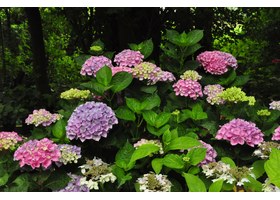
Ajisai 是一家位于比利时西弗兰德地区 Sijsele(Damme 镇,距布鲁日约 9 公里)的家族式绣球花专类苗圃,注册为企业实体 BV,企业号 BE-0479753387,日常由 Dirk Staels 与女儿 Maja Staels 共同打理。苗圃以日文「紫阳花」作为品牌名,意指绣球花在酸性土壤中常见的蓝紫色调。园区兼作绣球展示园,目前共保育 350 余个品种,其中 345 个以上在园内露地栽培,便于访客直接对比花型、叶色与株型。
绣球品类与展示园
苗圃按绣球经典分类法,将藏品划入九个主要类群:粗毛绣球(aspera)、乔木绣球(arborescens,包括 Annabelle、Strong Annabelle、Pink Annabelle)、蜡莲绣球(heteromalla)、苞片绣球(involucrata)、大叶绣球(macrophylla,涵盖球状与平顶 lacecap 两个亚型)、山绣球(serrata,圆叶山地品种)、圆锥绣球(paniculata,包括 Limelight、Pinky Winky、Bobo、Little Lime Punch 等热门品种)、栎叶绣球(quercifolia)以及 Sargentiana(属 aspera 亚系)。另保留少量爬藤类型,如 Schizophragma hydrangeoides、绣球荚蒾及 Seemannii 等。园方根据多年露地表现自育或筛选出若干特色栽培种,包括以家族成员命名的 macrophylla ‘Maja’、macrophylla ‘Oma’、lacecap ‘Pink Anais’以及 serrata 杂交系 ‘Blue Hawaian’。
栽培要点与种植建议
苗圃认为购买绣球前应先评估三件事:土壤酸碱与质地、种植位置的日照时长、植株成年后的高幅与周边树木竞争。砂质偏酸或中性土壤适合大部分品种;黏重土壤则需要加入酸性植物专用土壤改良剂(bodemverbeteraar)。在沙土中可拌入 Terracotem 保水剂或膨润土改善水分管理。日照以每日 5–6 小时晨光或傍晚光为佳;正午暴晒下可选 paniculata、arborescens 与 heteromalla 等耐晒类群。蓝色花朵需在酸性土壤中并辅以铝盐(aluminiumsulfaat)方能稳定,pH 中性时花色会向紫红偏移。白色品种在花期末会出现独特的粉红色「outbloei」秋季色变,部分阔叶绣球还能展示漂亮的叶秋色,对蜜蜂和蝴蝶同样友好。
开放时间与开放日
苗圃常规开放期为 2 月 1 日至 11 月 30 日,每周三、周五、周六 10:00–18:00;其他时段与日期可电话预约,闭圃期仍可通过邮件下单并以邮政、快递或自有运输送达。每年 6 月最后一个周末与 7 月第一、二个周末设为公开开放日(Opendeurdagen),8 月起圆锥绣球进入盛花期,aspera 同步盛开,部分 macrophylla 与 serrata 已可见秋色。园内接受主流银行卡支付,亦支持 Payconiq 电子支付。苗圃每月以荷兰语发行新闻通讯,介绍新品、促销、园内花境组合与当月栽培要点。
历史源流与比利时绣球脉络
绣球属植物的化石记录可追溯至 4000–6500 万年前的北美西部,亚洲的发现则证实其分布远比人类更古老。1736 年英国 Peter Collison 将原产宾夕法尼亚的 H. arborescens 自北美引入欧洲;1753 年林奈正式定名 Hydrangea 属并沿用至今。1775 年 Carl Peter Thunberg 经长崎出岛将 5 株绣球从日本本土运回欧洲;1823 年德国医生兼植物学者 Philipp Franz von Siebold 借日本出岛眼科行医之便,将 involucrata、anomala ssp. petiolaris、hirta、paniculata 等多份种质带回欧洲。比利时本土的绣球脉络与 Jelena 与 Robert de Belder 夫妇密切相关——两人自多次亚洲考察引种,并在 Hemelrijk 园艺与 Kalmthout 树木园体系中留下持续影响。Ajisai 苗圃自身作为家族经营单位,延续了这种以私人长期栽培与选育为核心的欧洲绣球文化。
Nursery Profile
Ajisai is a family-run hydrangea nursery located in Sijsele, a district of the municipality of Damme in West Flanders, Belgium, about nine kilometres from Bruges. The nursery operates as a BV (Besloten Vennootschap) under enterprise number BE-0479753387 and is run day-to-day by Dirk Staels and his daughter Maja Staels. The Dutch name Ajisai (Japanese for hydrangea) reflects the blue-purple flower tones typical of acid-soil cultivation. The site functions simultaneously as a production nursery and a display garden: more than 350 cultivars are held in the collection, of which over 345 are grown in open ground so visitors can compare flower form, foliage and habit directly.
Hydrangea Assortment and Display Garden
The collection is organised along the classical hydrangea taxonomy, covering nine principal groups: H. aspera, H. arborescens (including the Annabelle, Strong Annabelle and Pink Annabelle cultivars), H. heteromalla, H. involucrata, H. macrophylla (both mophead and lacecap forms), H. serrata (the mountain hydrangea), H. paniculata (Limelight, Pinky Winky, Bobo, Little Lime Punch and others), H. quercifolia, and H. sargentiana (within the aspera complex). A small selection of climbing hydrangeas is also kept, including Schizophragma hydrangeoides cultivars and H. seemannii. Through years of open-ground trials the nursery has selected or stabilised several named cultivars of its own, including macrophylla ‘Maja’ and ‘Oma’ (named after family members), the lacecap ‘Pink Anais’, and the serrata hybrid ‘Blue Hawaian’.
Planting and Care Guidance
The nursery recommends three checks before purchase: soil texture and pH, daily sunlight at the planting site, and the eventual size and root competition from nearby trees. Sandy or neutral soils suit most cultivars; heavier loam or clay calls for an acid-soil amendment. In very sandy ground, water-retaining agents such as Terracotem or bentonite help moisture management. Five to six hours of morning or evening sun is ideal; for full midday exposure, the palette narrows to sun-tolerant groups — paniculata, arborescens and heteromalla. Blue flowers need acid soil plus aluminium sulphate to remain stable; under neutral pH the blooms shift towards purple and pink. White varieties often develop a decorative pink-red autumn flush, and several macrophylla and serrata clones show attractive leaf colour in autumn. The lacecap and panicle types are also popular with bees and butterflies.
Opening Hours and Open Days
Standard opening runs from 1 February to 30 November, Wednesday, Friday and Saturday from 10:00 to 18:00. Other days are available by appointment, and during the closed season orders can still be placed by email for dispatch by post, courier or the nursery’s own transport. The annual open days (Opendeurdagen) are held on the last weekend of June and the first two weekends of July; from August the paniculatas reach peak display, asperas come into bloom, and several macrophylla and serrata clones already show early autumn tones. Card payments and Payconiq are both accepted on site. The nursery publishes a monthly newsletter in Dutch covering new acquisitions, promotions, planting combinations and seasonal care notes.
Hydrangea History and the Belgian Lineage
Fossil records of the genus Hydrangea date back 40 to 65 million years in western North America (Alaska, Oregon, California); later finds in East Asia confirm that the lineage long predates humans. In 1736 Peter Collison introduced the first H. arborescens from Pennsylvania into England; Linnaeus formalised the genus name in 1753, and the name has remained unchanged. In 1775 Carl Peter Thunberg, a pupil of Linnaeus, succeeded in shipping five hydrangeas out of mainland Japan through the Dutch trading post of Dejima in Nagasaki Bay. Around 1823 the German physician-botanist Philipp Franz von Siebold, working as an ophthalmologist on Dejima, brought back involucrata, anomala ssp. petiolaris, hirta and paniculata. Within Belgium the modern hydrangea tradition is closely linked to Jelena and Robert de Belder, whose repeated Asian seed-collecting expeditions fed the Hemelrijk garden and the Kalmthout arboretum network. Ajisai, as a multi-generation family nursery, continues this private-cultivation approach to European hydrangea growing.




发表回复