
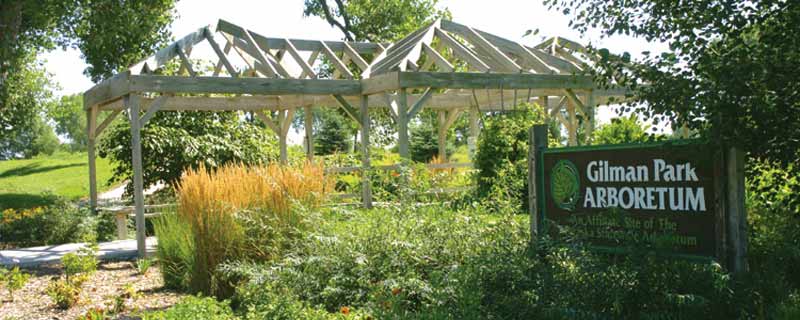
园区概况
Gilman公园树木园(Gilman Park Arboretum)位于美国内布拉斯加州 Pierce 市,建于1993年,占地14英亩,环绕风景秀丽的Bill Cox纪念湖。园内拥有超过300种标注明确的乔木和灌木品种,共813株木本植物,并设有6个景观花园,种植超过100种多年生植物和观赏草。1.2英里的无障碍步道为游客提供舒适的游园体验。
历史沿革
Gilman公园树木园于1993年由美国小型商业管理局(U.S. Small Business Administration)、社区林业援助计划(Community Forestry Assistance Program)以及Lower Elkhorn自然资源区联合拨款建立 Pierce市政府配套资金共同建成。1996年,树木园正式加入内布拉斯加全州树木园网络(Nebraska Statewide Arboretum),该网络覆盖全州48个社区的80余座树木园、公园和历史景观,由内布拉斯加大学林肯分校树木园办公室统筹协调。此外,园区通过纪念捐款已累计获得超过25,000美元的捐赠支持。
六大主题花园
入口花园于1998年落成,由当时内布拉斯加全州树木园的Kate Paul设计,内设环形座椅可作为导览集合点。1999年完成绿化,种植28种宿根花卉和11种灌木,并保留了一组60余株颤杨,由1993年栽植的5株母株繁衍而成。耐旱花园(Xeriscape Garden)于1998年夏季建立,种植25种耐旱宿根植物和观赏草,以及15种木本植物,展示干旱地区可持续景观设计。野花与观赏草花园同期建成,收集26种野花和8种本土及观赏草。蝴蝶花园位于园区西南角,1999年建成,种植20种蜜源宿根植物和6种灌木,吸引多种蝴蝶栖居。历史桥梁花园于1997年秋季在桥梁两端种植415株宿根植物和92株灌木。
历史桥梁
园区内的历史桥梁原建于1913年,由俄亥俄州Canton Bridge Company建造,曾位于Pierce县Willow Creek上方约八英里处。1994年桥梁迁至现址,为内布拉斯加州仅存的两座”刚接格构小跨桁架桥”之一,已列入国家历史遗迹名录和内布拉斯加历史桥梁名录。桥梁迁移及安装费用的80%来自联邦跨模态表面运输效率法案(ISTEA)拨款。1998年,桥梁旁竖立了内布拉斯加历史标志。
千年树林
2000年,美国农业部森林局与American Forests Historic Trees计划合作开展”千年树林”项目,为各州提供100株从各地著名和历史树木上采集种子培育的树苗。内布拉斯加州的9株树苗于2001年在园区定植,2006年正式对公众开放。园中包括:亚伯拉罕·林肯肯塔基州出生地的白橡树、Amelia Earhart堪萨斯州故居的糖枫、Harriet Beecher Stowe俄亥俄州辛辛那提故居的两株白蜡、George Washington Carver密苏里州出生地的两株绿白蜡、马克·吐温回忆录中描述的洞穴入口处的bur橡、路易斯与克拉克蒙大拿州 Trail的东部棉白杨、J. Sterling Morton在内布拉斯加的住宅Arbor Lodge的鹅掌楸,以及约翰·查普曼(Johnny Appleseed)约1840年栽植的最后一株存活Rambo苹果树。
如需了解更多信息,请访问Gilman Park Arboretum 官方网站。
Park Overview
Gilman Park Arboretum is located in Pierce, Nebraska, USA. Established in 1993, the 14-acre arboretum surrounds Bill Cox Memorial Lake and features over 300 labeled varieties of trees and shrubs among 813 woody plants, along with six landscape gardens showcasing over 100 perennial and grass species. A 1.2-mile paved, handicapped-accessible trail serves visitors year-round.
History
Gilman Park Arboretum was established in 1993 through grants from the U.S. Small Business Administration, the Community Forestry Assistance Program, and the Lower Elkhorn Natural Resources District, with matching funds from the City of Pierce. In 1996, it became affiliated with the Nebraska Statewide Arboretum, a network of over 80 arboreta and public landscapes across 48 communities in the state, coordinated by the University of Nebraska-Lincoln. The arboretum has received over $25,000 in memorial donations to support ongoing development.
Six Landscape Gardens
The Entrance Garden, completed in 1998, was designed by Kate Paul of the Nebraska Statewide Arboretum, featuring built-in benches for guided tours. Landscaping in 1999 incorporated 28 perennial varieties and 11 tree and shrub species, including a thriving colony of over 60 Quaking Aspens grown from five parent trees planted in 1993. The Xeriscape Garden, planted in mid-summer 1998, showcases 25 drought-tolerant perennial and grass varieties alongside 15 woody plants, demonstrating sustainable landscaping without supplemental irrigation. The Wildflower and Ornamental Grass Garden features 26 wildflower species and 8 native and ornamental grasses, while the Butterfly Garden, established in 1999 in the southwest corner, provides food, shelter, and wind protection for butterflies with 20 perennial varieties and 6 shrubs. The Historic Bridge Garden was planted in autumn 1997 with 415 perennials and 92 shrubs on both approaches to the bridge.
Historic Bridge
The historic Pierce County bridge was moved to the arboretum in 1994. Originally built in 1913 by the Canton Bridge Co. of Canton, Ohio, it spanned Willow Creek approximately eight miles southwest of Pierce. One of only two remaining rigid-connected lattice pony truss bridges in Nebraska, it is listed on the National Register of Historic Places and the Nebraska Historic Bridge Inventory. Eighty percent of the relocation cost was funded by a federal ISTEA grant. A Nebraska historic marker was placed near the bridge in 1998.
Millennium Grove
In 2000, the USDA Forest Service co-sponsored the Millennium Grove program in partnership with American Forests Famous and Historic Trees program, providing tree seedlings grown from seeds of famous and historic trees nationwide. Nine of these trees, received through a grant administered by the Nebraska Community Forestry Council, were planted in 2001. The grove officially opened to the public in 2006, featuring trees including a White Oak from Abraham Lincoln’s Kentucky birthplace, a Sugar Maple from Amelia Earhart’s Kansas home, two White Ash from Harriet Beecher Stowe’s Cincinnati home, two Green Ash from George Washington Carver’s Missouri birthplace, a Bur Oak from the cave entrance described by Mark Twain, an Eastern Cottonwood from the Lewis & Clark trail in Montana, a Tulip Poplar from J. Sterling Morton’s Nebraska home (Arbor Lodge), and a Rambo Apple tree from one of the last living trees planted by Johnny Appleseed around 1840.




发表回复